
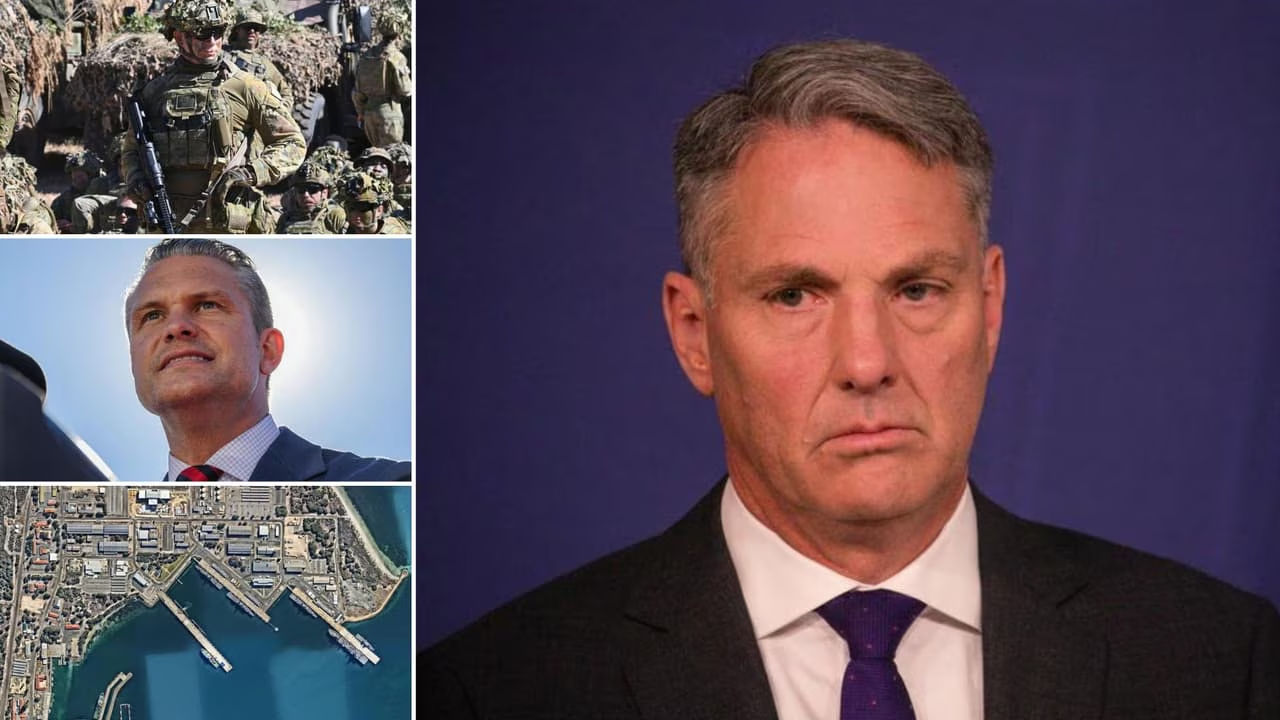
A retired senior Australian Defence Force (ADF) Brigadier has slammed the US over covert security checks on Aussie bases.
The Pentagon and the US Department of War ordered undercover agents to breach ADF bases in a series of covert missions to test security, according to The Daily Telegraph.

It’s alleged those security measures failed on multiple accounts.
Retired ADF Brigadier Ian Langford said Australian bases had “good standards” and regulations in line with Five Eyes expectations.
Mr Langford said there was no question security vulnerabilitiess should be addressed as a matter of urgency but questioned the need for testing and the way they were conducted.
“It kind of, to some degree, infringes on our own idea of sovereignty and security obligations as it relates to security and base infrastructure. I think it’s more a case of just a lack of communication and understanding between those responsible for security on the base and the implementation of policy. So, I think it’s a bit unnecessary. Some good co-ordination and liaison could have prevented the need [for testing]. Australia, and the Department [of Defence], subscribes to a very high level standard of protection. So, I’m not sure why they’re doing it.”
Mr Langford, a former special forces commando, said the US could have dealt with the vulnerabilities on our bases “more appropriately” and expressed those concerns to Canberra directly.
“I would offer this proposition: How would the Americans feel if we did this to them? That’s where I think the conversation needs to start.”
News.com.au understands the Department of Defence is aware of covert testing taking place on Australian assets. The practice is said to be part of landstanding security arrangements with allies.
‘Pretty unhelpful’
Mr Langford said the episode was embarrassing for Defence and seriously risked the support of everyday Australians to station US troops on our soil. It also imperilledd public support for the AUKUS submarine deal, which Mr Langford said was “in serious competition with an alternative narrative.”
“This is not how allies treat allies,” he said.
“How does this help solve and make the case for AUKUS amongst the Australian public? All it does is just create a false division and all it does is embarrass and compromise the efforts that are here to help reinforce US interests inside Australia. So I’m not sure why they did it.”
Mr Langford said alliances are built on trust and mutual respect and doesn’t believe the clandestine tests were an effective way to advance the relationship or lead a public discussion around the future of US force posture in Australia.
“I think it’s pretty unhelpful,” he said.
US Department of War agents, including real-life officers of the Naval Criminal Investigative Service (NCIS), accessed Australian Royal Navy bases using covert tactics while testing security provisions as part of the AUKUS submarine deal.
They were sent undercover to key sites, including HMAS Stirling in Western Australia and HMAS Kuttabul in Sydney, to “test existing physical security measures,” according to an ADF insider who spoke to the paper.
“Once inside, (agents) were reportedly able to move through restricted areas without being challenged and photograph areas subject to security controls,” the ADF whistleblower said.
Department of War officials shared its findings with the ADF.
‘Regularly reviewed’
A Department of Defence spokesperson said the department worked with US Department of War representatives “to manage and apply reciprocal security and protection measures.”
“Security and force protection procedures are regularly reviewed. Defence reviews security settings at each of its bases to respond to the evolving security threat environment,” they said, adding Defence does not provide information on specific security settings and process for operational security reasons.
Earlier, the department told The Daily Telegraph since the announcement of the AUKUS Optimal Pathway in March 2023, Defence, the Australian Submarine Agency and US and UK agencies, including NCIS, have been working collaboratively to assess and enhance security arrangements for the rotational presence of US and UK nuclear-powered submarines, as well as Australia’s future nuclear-powered submarines.
Defence minister Richard Marles said Australia was operating its bases in a more challenging environment.
“Base security is really an issue which is front and centre in terms of what we are managing,” Mr Marles said on the sidelines of a defence conference in Perth.
“I can assure you that we have been increasing our base security across the entirety of the footprint of Defence. And we work very closely with our friends and partners who operate from our bases. And that very much includes the United States, but not just the United States.”
A Department of War official told news.com.au as part of the ongoing establishment of Submarine Rotational Force – West in Western Australia, US and Australian security officials regularly cooperate on physical security and force protection at HMAS Stirling “to ensure robust implementation of trilaterally agreed-to security requirements.”
It comes as a former senior defence official warned Australia’s military bases were undermanned and easy to infiltrate.
The national security insider, who did not want to be identified, as they still work with the Department of Defence, said bases are so insecure anyone could jump a fence to get in – and they would go unnoticed.
They also described the defence of Australia’s critical infrastructure like electricity and telecoms grids as “lackadaisical”.“A terrorist only needs to be lucky once. We need to be lucky every single day,” they told news.com.au.
The warning comes as five men were arrested and later released on bail over an alleged bomb plot on a British Royal Air Force base in southwest England last week.
In July, several unmanned aircraft systems (UAS) were spotted flying in restricted airspace above the Australian Defence Force’s Williamtown RAAF. The ADF said it doesn’t know who was operating the drones, or why they were in a no-fly zone.
They were not shot down or jammed, but the incident was reported to NSW Police’s counter-drone unit.
At the time, the ADF told commanders to close window blinds to protect against the unwitting release of information.
The base is home to the country’s most advanced stealth combat aircraft, including the F-35A Joint Strike Fighters and the E-7A Wedgetail.