
Microsoft and Nvidia took the stage together at a Windows event in San Francisco on October 8 to unveil the next phase of the personal computer. In a rare joint appearance, the two companies’ CEOs announced a sweeping collaboration spanning operating system security architecture to hardware design, with the goal of making AI agents the core computing entities within the Windows ecosystem.
Nvidia CEO Jensen Huang made clear during the conversation that the personal computer, once a tool for humans, will in the future serve both people and AI agents. He pointed out that agents have the potential to utilize software capabilities far more fully than humans, since users typically only know 10% to 15% of an application’s features, whereas an agent can master every function.
Microsoft CEO Satya Nadella framed the collaboration as a paradigm shift in computing. He noted that when agents begin directly manipulating files, applications, and cloud services, the operating system must be redesigned to allow agents to execute tasks safely and efficiently.
From Graphics Computing to the Agent Era
The two executives reflected on their decades-long partnership. Huang said Nvidia was essentially founded because of Windows. In late 1992, during the Windows 3.1 era, he and the other co-founders began imagining a personal computer with 3D graphics capabilities that could handle both gaming and design work.
Windows 95 truly connected the GPU to the personal computer, and DirectX and Direct3D allowed developers to integrate GPU capabilities into applications. By the DirectX 8 era, the two companies jointly developed the first generation of programmable GPUs, a technical trajectory that later extended to CUDA and became a critical foundation for the development of deep learning.
Nadella added that the collaboration did not stop at the PC. Microsoft early on brought high-performance computing technology to Azure and worked with Nvidia to leverage InfiniBand high-speed interconnect technology, laying the groundwork for large-scale AI training. Huang revealed that Nadella was the first person to use InfiniBand in the cloud, which enabled Nvidia to bring supercomputers to OpenAI for training GPT models.
MXC: An OS-Level Security Boundary
One of the most closely watched technology announcements at the event was Microsoft Execution Containers (MXC). Nadella positioned it as the security boundary for agents executing tasks, designed to give agents the necessary operational capabilities while preventing uncontrolled access to system resources.
The architecture encompasses isolation at multiple levels, including micro-virtual machines, virtual machines, and Windows sessions. Nadella stressed that isolation alone is not enough; the system must have observability, giving agents a traceable, independent identity and separating their activity logs from the user’s own actions.
Enterprises also need to integrate policy management, IT operations, security monitoring, and tracking of token usage and spending. Nadella pointed out that an agent execution environment cannot only solve the technical isolation problem; it must also be incorporated into an overall governance framework.
Huang spoke highly of MXC. He compared its significance to the impact Windows and DirectX had on application development, arguing that for agents to be deployed at scale, they must have corresponding security and execution foundations. He said bluntly that the architecture Nadella described will become the foundation of the next generation of IT.
Hybrid Intelligence: Intelligent Routing Between Local and Cloud
Microsoft also introduced the concept of “Hybrid Intelligence,” allowing models to operate without being fixed to either local or cloud environments. The system can schedule different models and compute resources based on task requirements. Nadella used a creative workflow as an example: a user could generate assets through ComfyUI, process them in Blender, enhance images using Photoshop’s local models, and complete follow-up work with cloud tools.
Nadella believes that in the future there will no longer be a deliberate moment of deciding “this runs locally, that runs in the cloud” — Hybrid Intelligence will become a ubiquitous capability. He also noted that agents may become one of the primary users of the file system, which must simultaneously balance access efficiency and security.
RTX Spark and Hardware Strategy
On the hardware side, RTX Spark laptops are now available for pre-order and will launch on October 16; compact desktop PCs will go on sale in November. Acer, ASUSTeK Computer, Dell, HP, Lenovo, Microsoft, Micro-Star International, and Giga-Byte Technology will all offer related systems.
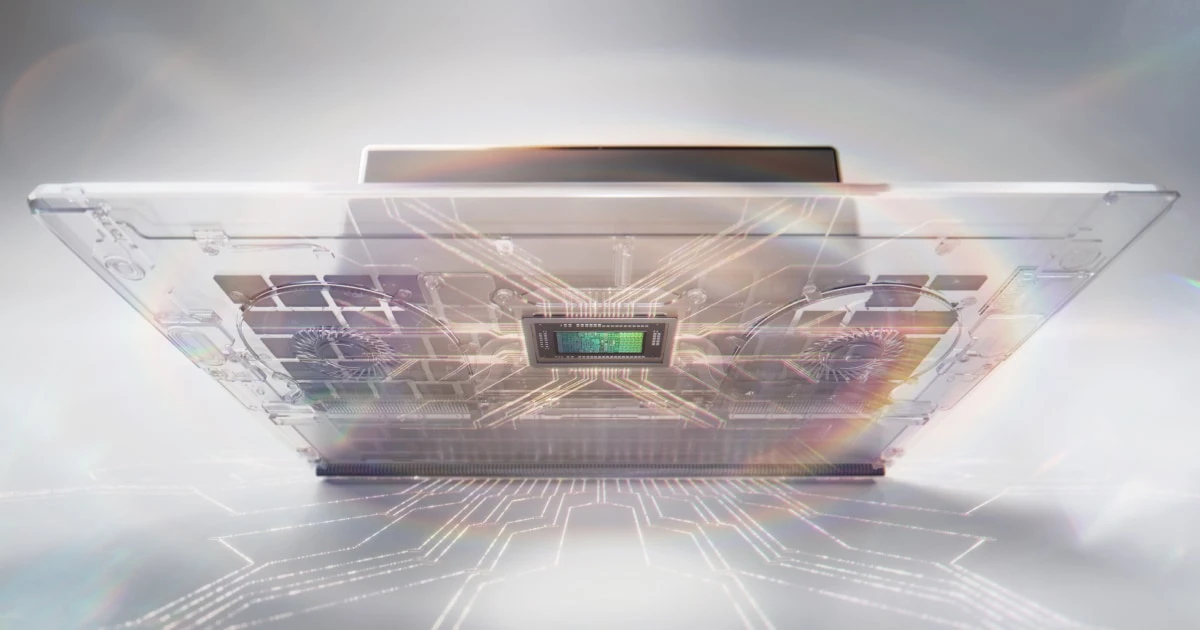
RTX Spark combines an NVIDIA Blackwell RTX GPU with up to 6,144 cores and an NVIDIA Grace CPU with up to 20 cores, interconnected at 600 GB/s. With 1 PetaFLOP of FP4 AI performance and up to 128GB of unified memory, RTX Spark can run models with up to 125 billion parameters, such as Qwen 3.8 Flash Next, without consuming cloud credits or sending data to the cloud.
Huang described this product lineup as a redesign of the personal computer, with the project involving more than 4,000 engineering person-years. He noted that the new architecture uses a rectangular superchip formed by connecting two large chips, delivering 1 PFLOPS of compute power. Nvidia has tested more than 1,200 applications across different technology ecosystems including DirectX, OpenGL, and CUDA.
Microsoft’s Surface Laptop Ultra is the flagship RTX Spark device, starting at $2,599 (approximately NT$83,000), with some RTX Spark PC configurations reaching up to $6,999 (approximately NT$220,000). Pavan Davuluri, Executive Vice President of Windows and Devices, said the device is built around RTX Spark and can run models on a laptop that traditional computers cannot accommodate.
The event also offered an early look at the NVIDIA DGX Station for Windows, the first desktop AI supercomputer to bring GB300 Grace Blackwell-class AI infrastructure to the Windows ecosystem. It features 748GB of coherent memory and up to 20 PetaFLOPS of FP4 AI compute performance, sufficient to run models with up to 1 trillion parameters locally.
Trust, Permissions, and Insurance Pricing
When agents begin executing tasks on behalf of users, establishing trust and defining permissions become critical challenges. Nadella believes agents must first have an independent identity and ensure traceable behavior through isolation mechanisms, activity logs, and monitoring measures. Only then can users gradually grant agents the authority to act on their behalf.
He further suggested that in the future, consumers may use insurance mechanisms to price the risks associated with agents acting on their behalf. While authorization protocols like OAuth can provide a technical foundation, the market still needs to establish corresponding risk assessment and management mechanisms as agents begin performing more complex tasks on behalf of individuals.
Huang reiterated that the widespread adoption of agents still depends on the security isolation, identity, observability, and monitoring mechanisms involved in technologies like MXC and OpenShell, ensuring agents can execute tasks within clearly defined permission boundaries.
At the close of the conversation, Nadella said Microsoft wants to keep the Windows ecosystem supporting a wide range of applications, graphics technologies, CUDA, OpenGL, and next-generation AI workloads, without letting existing software and development frameworks be made obsolete by new technologies. Huang concluded by referencing his 34-year history with Windows, saying this partnership appears set to continue for another 34 years.
From this conversation, the next phase of the Microsoft-Nvidia collaboration is not just about bringing more powerful AI compute into personal computers, but about building a computing environment that both humans and agents can use together. Security isolation, identity management, permission granting, and risk governance will be just as important as hardware performance in determining whether AI personal computing can achieve widespread adoption.