
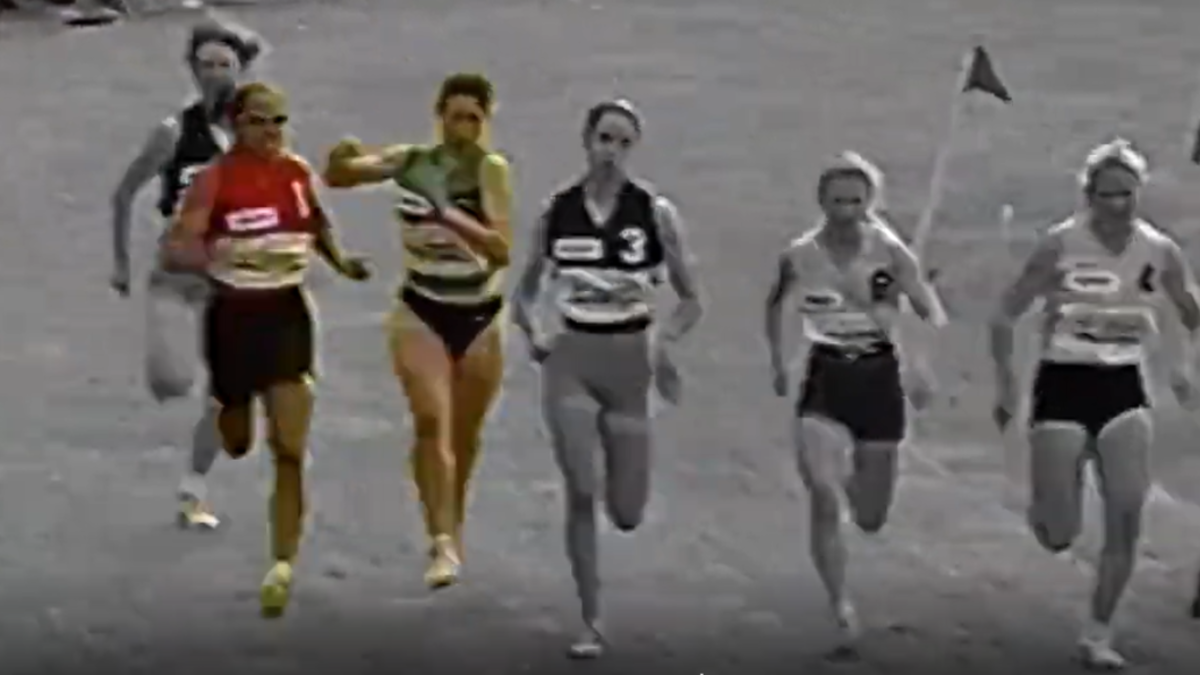
Not since Jackie Lewis rammed an elbow into Cathy Freeman as the track icon steamed past en route to her legendary Stawell Gift win had the two of them crossed paths.
A moment 30 years in the making arrived in February this year, at Lakeside Stadium in Melbourne, when the seven women who competed in the 400-metre final at the 1996 Stawell Gift gathered for interviews to be featured in a documentary about the famous race.
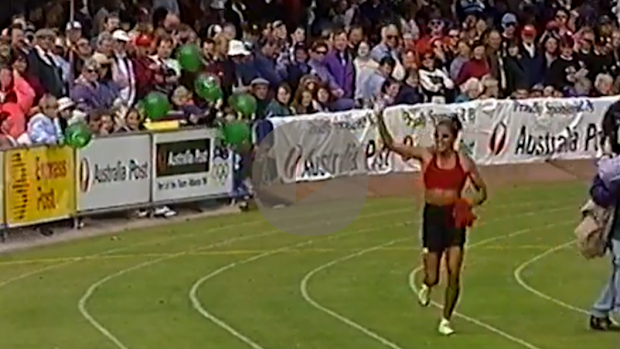
Cathy Freeman on a victory lap after her iconic 1996 Stawell Gift win. Supplied
The documentary, That Race, will premiere at Astor Theatre in Melbourne on Sunday evening, marking the 30th anniversary of a run Freeman ranks higher, purely in terms of performance, than her heroics at the Sydney 2000 Olympics.
Freeman and Lewis, who now goes by the surname Chehade, will see each other again when hundreds flock to the theatre for the premiere.
No prizes for guessing who the antagonist is.
“They had to have some sort of villain in the whole thing,” Chehade, laughing, tells nine.com.au.
Interviews with every one of the seven women who competed in the storied 1996 race – Freeman, Chehade, Shanie Singleton, Tara Gleeson, Emma Yeomans, Kim McDonough and Debra Tomsett – feature in the documentary.
They reminisce on a race on the grass of Central Park in which Freeman, 23 at the time, started off scratch with a handicap of up to 54 metres, but with her long, flowing, beautiful stride mowed down all six of her rivals for a remarkable triumph.
She caught and overtook second place in the race, Singleton, in her final stride, stopping the clock at 50.54 seconds.
There are two runs from Freeman’s career the track legend ranks above all others, solely in terms of performance: her victory at the 1996 Stawell Gift, and her run at the Atlanta Olympics a few months later where she claimed silver behind French rival Marie-José Pérec.
Freeman had already won a 400m Stawell Gift title in 1995, but not in the fashion of ’96.
A book, also titled That Race, was released about the iconic run in April, a couple of weeks after the 144th edition of the event.
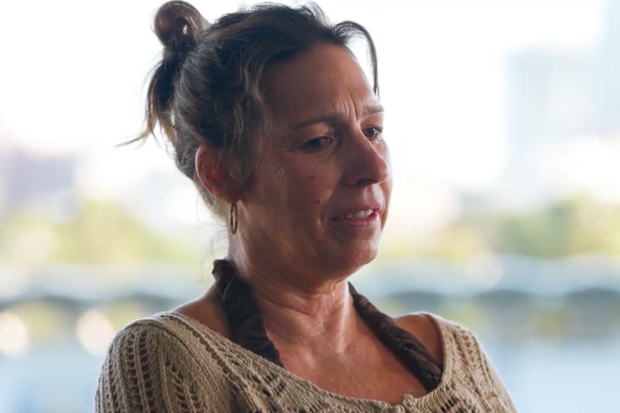
Jackie Chehade speaking in the documentary. Supplied
How does Freeman reflect on the push from Chehade?
“If I’m to really break it down to that moment – and seeing her today helps a lot – it was a surprise,” the Olympic champion recalls in the documentary.
“A bit of a shock.
“Because that behaviour only occurs in 800m running, and this was a 400m race,” Freeman adds, laughing.
“And you can’t help but take it personally, and you can’t help but think, ‘Well, this woman is actually trying to stop me here’.”
Chehade remembers it differently.
She even claims Freeman apologised to her immediately after the race, having veered into her.
“She leaned into me, I pushed her off, and that’s all it was pretty much,” Chehade tells nine.com.au.
“It wasn’t really argy-bargy. It looks worse than what it was, I think.
“She did apologise to me after the race, which she can’t remember, which I did say to her earlier this year. I said, ‘Do you remember coming and saying sorry for bumping into me during the race?’ She forgot that, but she did apologise.”
In Chehade’s view, Freeman would not have won the race if she hadn’t shoved her.
“That made her actually win the race,” she says.
“That pushed her out in front, and she won the race after that. I gave her a bit of momentum to get her there to the line.”
Chehade assures there are no lingering ill feelings.
“No animosity, none whatsoever, absolutely none,” she says.
But 30 years on, Chehade is still copping blowback.
She has lost count of the number of nasty comments people have made under videos of the famous race posted on social media, even though in her mind she was simply defending her line as Freeman swerved into her.
“My kids say to me, ‘Stop reading the comments, don’t read them’,” Chehade says.
“I’ve been called racist and all sorts of horrible stuff.
“Everybody around me has been extremely encouraging and supportive. Everybody. Most people that I know are involved with pro running anyway, so no, there are never problems with people I know.
“They [the online critics] are just going to be unkind to anyone, have no knowledge of the actual sport, and are just going to have a go at anyone.”
It will never be lost on Chehade just how fortunate she was to be in the same race as Freeman.
“At the time you just go, ‘Oh yeah, I ran against Cathy Freeman’. But 30 years later, when you turn 60 and you look back on that, you go, ‘Oh my God, was I really there? Was I actually doing that?’,” she says.
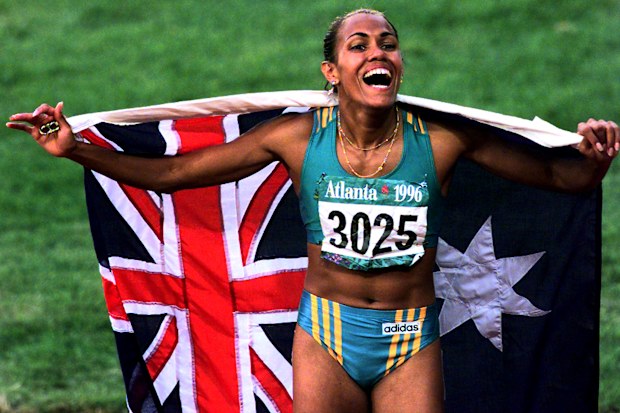
Cathy Freeman after claiming silver in the 400m at the 1996 Atlanta Olympics, a few months after her iconic Stawell Gift win. Vince Caliguiri
“I was just in the right place at the right time, I suppose, and lucky enough to be in that race against an absolute champion who then became an Olympic champion.”
In the documentary, Freeman and the six others are filmed rewatching the race in the Lakeside Stadium stands.
Freeman and Chehade share a sweet, jovial moment when the bump occurs, and again when the commentator remarks post-race that Freeman “got a shove and all”.
“Without these ladies, there’s no way I would have got out what I got out of myself. There’s no doubt about it,” Freeman says.
“And I will always be grateful, and I will acknowledge you.
“Because it’s not just about one person in a race – it’s about all of us.”