
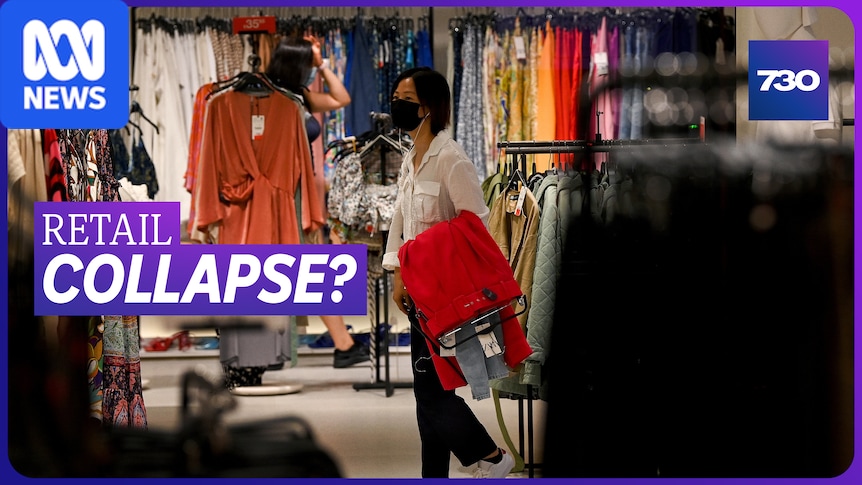
ANGELIQUE DONNELLAN, REPORTER: Once upon a time if you wanted a new outfit you’d head to a store like this. The internet has fundamentally changed the way people shop.
But it’s not the only challenge traditional bricks and mortar stores are facing.
CAROL TAN, SCHOOL OF FASHION, RMIT: Labour costs is one of them, heavy rents.
IVAN COLHOUN, ECONOMIST, CREDITORWATCH: Transport costs, weak consumer confidence.
ANGELIQUE DONNELLAN: And the latest interest rate rise will squeeze the sector further.
IVAN COLHOUN: With budgets under pressure, you’ll see people deciding to be a little bit more cost conscious and a little bit more cautious.
ANGELIQUE DONNELLAN: Australia’s clothing and footwear sectors have faced significant structural change – some of the most recognisable brands have folded.
After more than seven decades of operation Roger David called it quits in 2018.
Katie’s dressed Australian women for around 70 years. The brand shut up shop at the start of last year after its parent company collapsed into administration.
Other casualties include Betts and Jeanswest – both have been restructured into online only retailers.
CAROL TAN: What they all have in common is that they had a huge retail footprint.
They’ve been in an industry for a very long time. They haven’t really adapted to the current market condition. They are just paying a lot of different types of costs.
ANGELIQUE DONNELLAN: Women’s retailers Cue and sister label Veronika Maine are among the latest big brands to fall into financial hardship because of high overhead costs.
IVAN COLHOUN: We saw roughly a thousand first time retail insolvencies last financial year. The expectation has to be that we will see more retail insolvencies going forward.
ANGELIQUE DONNELLAN: When Cue went into receivership last month it had more than 130 outlets across Australia and New Zealand, five stores have been closed.
CAROL TAN: Cue is very interesting because they were the brand that people went to when they wanted to get their first job interview or their first job, very structured clothing.
Since the casualization of the workforce, we might not want to wear such structured suits.
So because a company like Cue has fallen into financial hardship, it tells you that just having heritage is not enough.
ANGELIQUE DONNELLAN: University fashion professor and industry watcher Carol Tan says the department store model is also under significant strain.
CAROL TAN: I don’t want to go into a warehouse and if I ask for service, the person is going to tell me, “Sorry, I don’t work for that brand. I work for the brand next door and I cannot help you.” And that seems to be increasingly the experience that customers are facing when they go into a department store.
ANGELIQUE DONNELLAN: Last month Myer cited volatile trading amid ongoing cost of living pressures in posting a significant financial year loss.
David Jones has also been in the red but its parent company has rejected print media reports that a key lender has engaged an insolvency advisor to start preparations for receivership.
CAROL TAN: Brands such as Gucci, Dior has removed their shoes and their small leather groups.
You’ve got a Gucci store that’s right outside David Jones and so brands like that, they’re thinking, “Why do I want to be a concession when I have my own store that the customers that can come into my space and I’m going to create the customer experience because I’m going to provide them gold-class service.”
ANGELIQUE DONNELLAN: COVID transformed the retail industry helping online businesses thrive.
So called ultra-fast fashion is cheap and convenient, and the market is rapidly growing.
CAROL TAN: 7.9 million customers shopped on Shein and Temu just in 2025.
If I can buy something online that is cheaper and in my pyjamas, why would I want to go in store?
ANGELIQUE DONNELLAN: But Carol Tan believes bricks and mortar retailers can survive and thrive if they offer a compelling reason for customers to head in store.
CAROL TAN: It’s really thinking about who your customer is, who is shopping in your store, because for example, someone from Gen Z might be completely different from the way Gen X shop, and it’s not just the generations, but giving your customer an understanding what makes them tick.
ANGELIQUE DONNELLAN: Adelaide retailer Miss Gladys Sym Choon has been around for more than 40 years. Manager Chloe Mozuras says in her store staff know regulars by name.
CHLOE MOZURAS, MISS GLADYS SYM CHOON: It’s real old school customer service, even our online store, it’s very personalised. We’re the ones replying to customer emails, we’re packing the orders. If people don’t know how something is going to fit, we’ll try it on for them, send them photos. Yeah, very much that personal experience.
ANGELIQUE DONNELLAN: Chloe’s staying upbeat about the future despite interest rates being at their highest level in 15 years.
CHLOE MOZURAS: They say I think retail, fashion, and eating out maybe are the first things to go in this kind of economy but, you know, we’re still here, it’s not our first rodeo.
ANGELIQUE DONNELLAN: She says it has been upsetting to see a number of retailers shut down on the same street.
CHLOE MOZURAS: It’s important to have the Australian independent clothing stores because otherwise everyone’s going to end up looking exactly the same. Yeah, people want a bit of variety. They want to find something that is unique to them.
ANGELIQUE DONNELLAN: Cue and Veronika Maine are just down the street. Receivers are hoping a buyer can be found for the brands, but the uncertainty has highlighted the importance of evolving to stay relevant.
CAROL TAN: So this is evident not only in Australia, but globally. And if the brands do not adapt to what and how the current customer shop, they are not going to survive.