
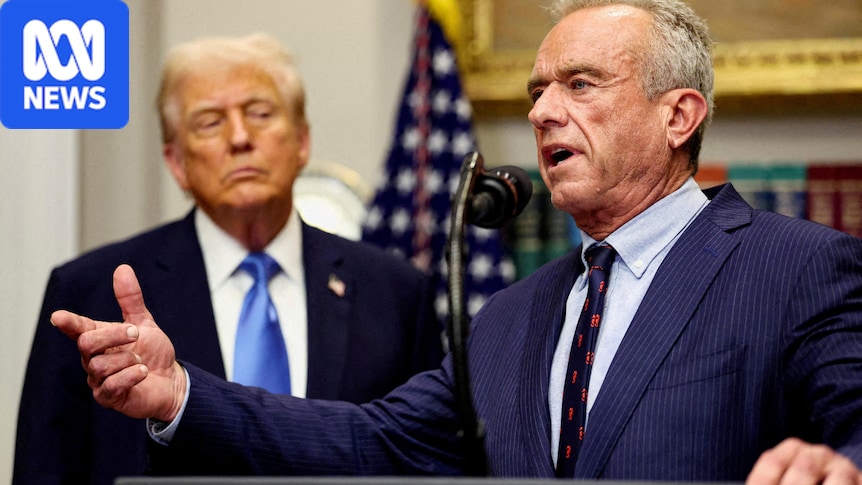
You may know Robert F Kennedy Jr as the scion of America’s most storied Democratic dynasty, or perhaps you think of him as the US Secretary of Health and Human Services who once claimed to have a parasitic brain worm.
An environmental lawyer and one-time presidential candidate, he became the leader of the Make America Healthy Again (MAHA) movement, which promised to tackle an epidemic of illness by taking on Big Food, Big Agriculture and Big Pharma.
But since becoming the country’s most powerful health official, he has disappointed some followers on this charge.
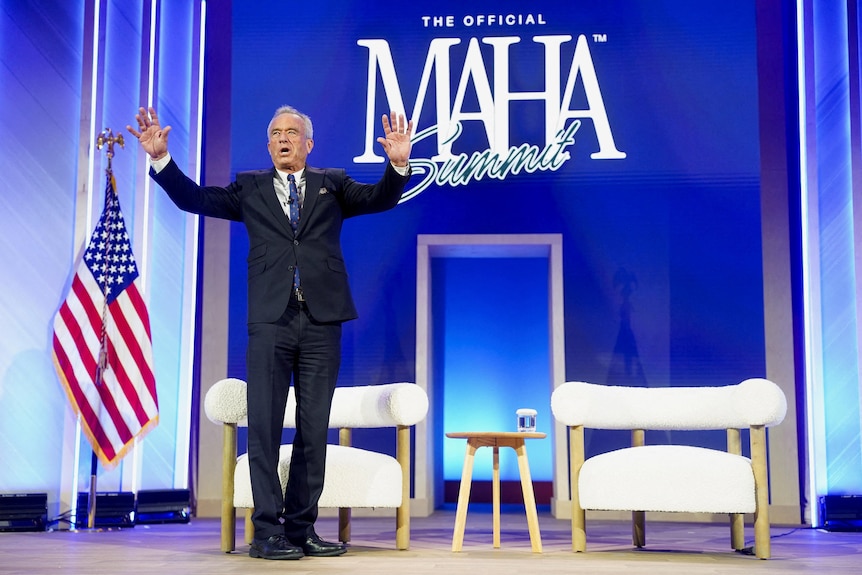
Robert F Kennedy and the MAHA movement promised to tackle an epidemic of illness. (Reuters: Nathan Howard)
Elizabeth Frost is one of those. She grew up in conservative rural Ohio, but when she first heard Mr Kennedy speak, her world turned on its head.
“This man was laying out corporate capture and corporate influence more eloquently than I’d ever heard someone do it before,” she told 7.30.
“I prayed for guidance and what I felt was a conviction that what I needed to do was to do everything I could to get that man elected.”
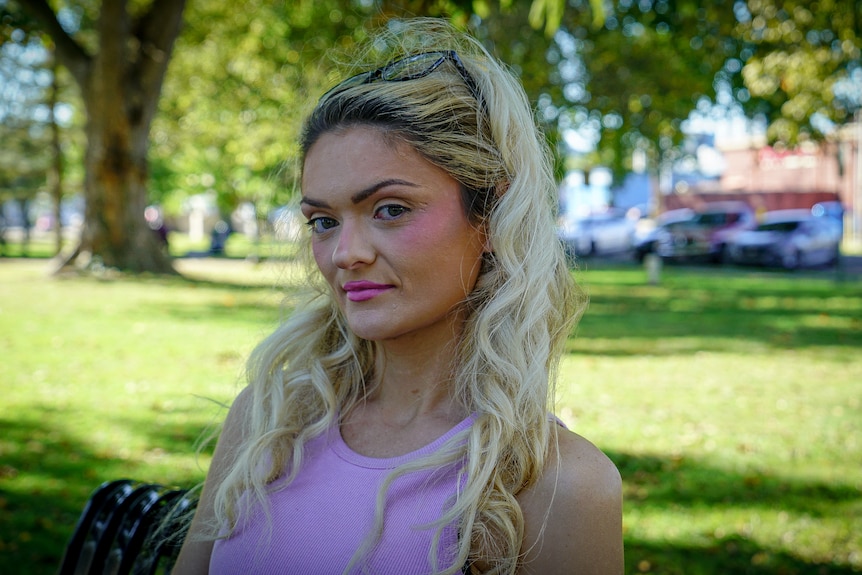
Elizabeth Frost says she finally felt seen when she heard Robert F Kennedy Jr speak. (ABC News: Lauren Day)
From the foothills of the Appalachian Mountains, Ms Frost watched the opioid epidemic devastate her community and family.
Her father battled addiction to painkiller OxyContin, and her cousin died from complications related to a drug overdose.
“Anyone in Appalachia will tell you that they know someone who has been significantly affected, if not killed, by the opioid epidemic,” she said.
“So growing up in that environment it’s impossible to believe that our public health systems are impervious to corporate capture.”
Mr Kennedy echoed her sharp criticisms of Big Pharma, accusing major drug companies and federal health agencies of corruption and collusion.
Ms Frost said she finally felt seen by a major player in US politics and joined the then-independent’s presidential campaign.
From believer to disillusioned supporter
It would ultimately be derailed when RFK Jr dropped out of the race to endorse US President Donald Trump. Ms Frost says it felt like “a blind side and a gut punch”, but like many loyal supporters, she followed him to the Republicans.
Like many MAHA supporters, she was about to learn a hard lesson: change can be promised, but it’s hard to deliver from inside the machine.
Ms Frost has been disappointed by the Trump administration’s health policies and Mr Kennedy’s performance.
She watched as funding dried up for a program that delivered vouchers to low-income seniors to buy fresh local fruit and vegetables, and baulked at what she saw as an increasingly cosy relationship between the White House and big business.
“I think it’s most concerning when we see members of Big Tech or Big Food and Big Ag spending more time around the president and his cabinet,” she said.
“I don’t think that that reads to anyone in MAHA as what they wanted.”
She believes Mr Kennedy has been unable to enact the agenda he ran on because the administration is constraining him.
“I think he is playing a game that has to be played if he wants a seat at the table,” she said.
Since bringing MAHA voters with him to Mr Trump’s camp, Mr Kennedy has fired the entire vaccine advisory board and presided over a crisis at the Centers for Disease Control that saw four senior officials quit in protest.
Under his watch, measles — eliminated in the US in 2000 — has come roaring back, with more than 4,000 confirmed cases this year.
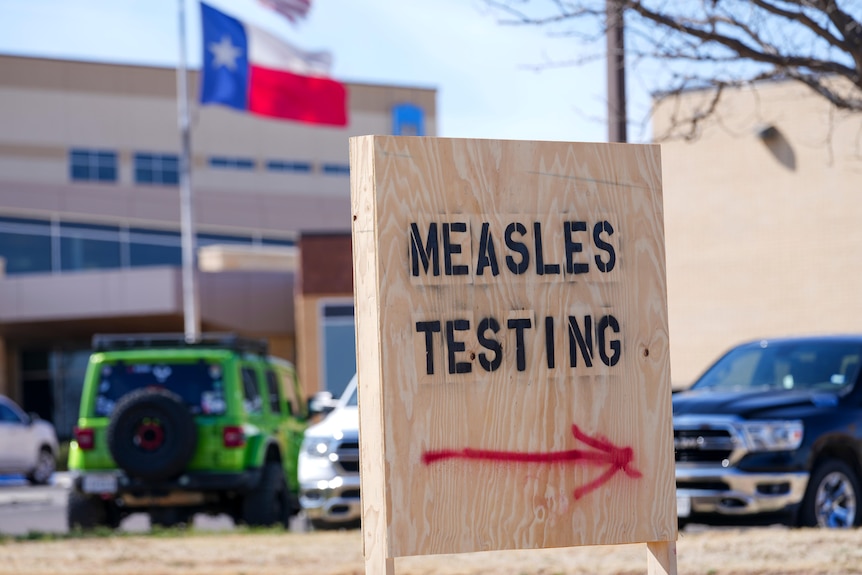
Measles cases have continued to rise in the US. (AP: Julio Cortez)
While some MAHA supporters backed his moves on vaccines, others believe Mr Kennedy’s focus on vaccine scepticism has distracted from more pressing issues.
The weedkiller issue
One is what many in the MAHA movement see as broken promises about the herbicide glyphosate, used in the weed-killing product Roundup, whose manufacturer faces tens of thousands of lawsuits in the US.
Glyphosate was declared a probable carcinogen by the World Health Organization a decade ago, but regulators, including in Australia and the US, say it is safe when usage instructions are followed.
Some trade unions and political parties have called for a review.

Glyphosate was declared a probable carcinogen by the WHO. (ABC News: Neale Maude)
Before entering politics, Mr Kennedy was an environmental lawyer suing the company that manufactures Roundup.
That’s how Kelly Ryerson — an online influencer known as “The Glyphosate Girl” — met him.
“What I know of Kennedy personally is I’m not sure that there’s a person that is more distressed about pesticides than RFK Jr,” she told 7.30.
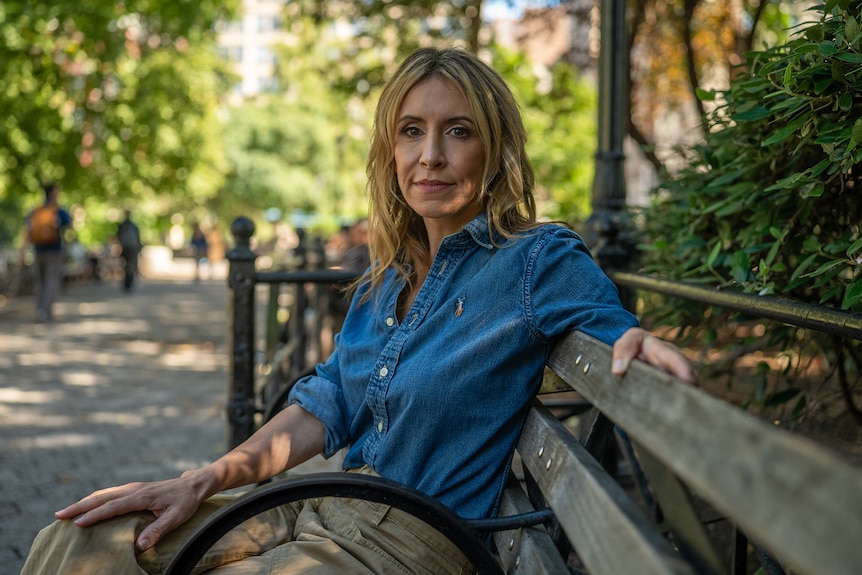
Kelly Ryerson is an advocate for pesticide regulation. (ABC News: Cameron Schwarz)
“That person is still there, but he can’t act on it.”
Since returning to the White House, the Trump administration has expanded domestic glyphosate production and provided a liability shield for companies that produce it.
More than 200 MAHA activists sent Mr Trump an open letter warning the issue could cost Republicans the House majority in the upcoming midterm elections.
Ms Ryerson says she also received hundreds of emails from people saying they now regret their vote.
Those votes, like hers, are now potentially up for grabs.
“I will vote for whoever the candidate is that is more willing to tackle these issues,” she said.
“I actually don’t care which party it is because in my mind, this is such a desperate crisis in our country that whoever’s willing to take it on, that’s fine.”
Now, some Democrats are trying to take it on.
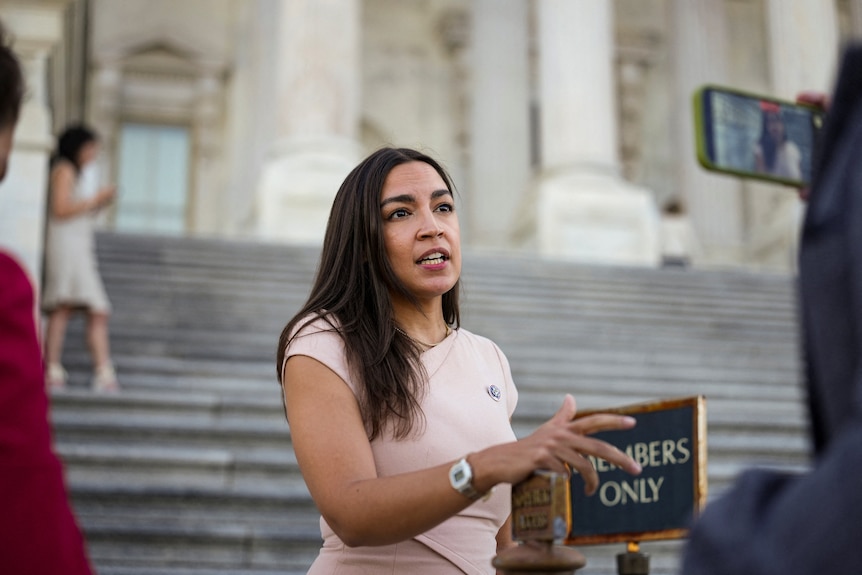
Alexandria Ocasio-Cortez has met with people in the Make America Healthy Again movement. (Reuters: Al Drago)
Left-wing Democrat Alexandria Ocasio-Cortez says she has met with MAHA figures and engaged in outreach, arguing that public frustration over corporate food corruption and toxic chemicals is a non-partisan issue.
“We do have extraordinary corruption in our agricultural system, in our big corporate system as well, you know?” she said in a July interview for The Majority Report.
“This is an area where both parties and our entire political system has been compromised.”
Michigan Democratic Senate nominee Abdul El-Sayed has appealed directly to disaffected MAHA voters.
Last month, he released his new health policy agenda, explicitly attacking Mr Kennedy for breaking promises to voters.
“He had the opportunity to stand up to the corporations … but he didn’t; he never was going to because he’s bought off by the same corporations who’ve been buying our food space for a long time,” he said.
Questions over corporate influence
The idea that Big Food and Big Pharma are too close to the government that should regulate them has also upset many in the movement.
The recent MAHA summit in Washington, DC, featured fewer of the women who built the movement, and more of the men who have seemingly taken it over.
The list of speakers included some controversial men, including convicted rapist Mike Tyson and Russell Brand, who faces rape charges in the UK, which he denies.
It also featured Lee Zeldon, the head of the Environmental Protection Agency, who some MAHA supporters wanted to see fired for his work to undo toxic chemical regulations and fast-track pesticide approvals, and Agriculture Secretary Brooke Rollins, who drew the ire of some for saying glyphosate was “proven safe when used correctly”.
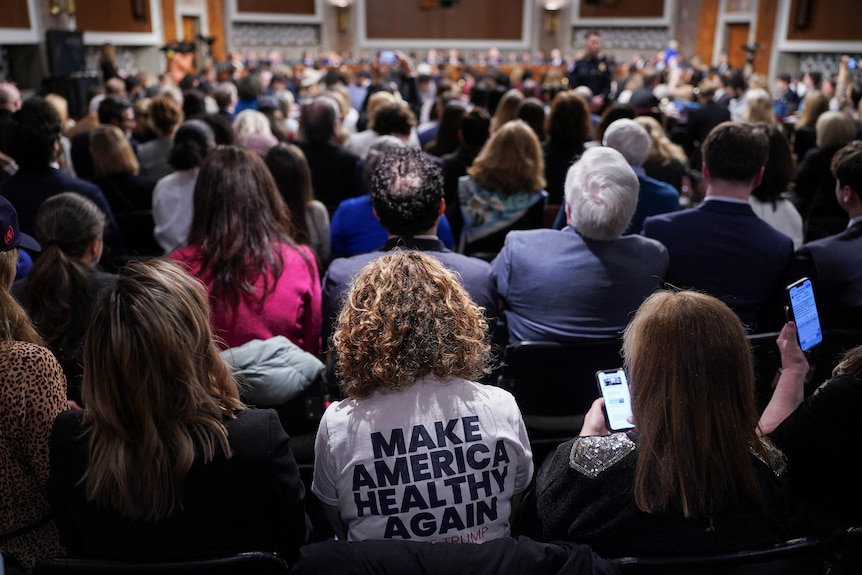
But what was most troubling for some was the presence of big corporate sponsors, selling everything from peptides and psychedelics to one of the country’s biggest purveyors of ultra-processed foods, Walmart.
Some followers believe corporate interests have taken over the MAHA movement. (Reuters: Nathan Howard)
Bloomberg reported that, in exchange, some sponsors got to attend a private dinner with summit speakers, including health officials from the Trump administration.
Ms Frost said she hoped Mr Kennedy’s presence would end what she describes as the Trump administration’s “pay-to-play game”.
“Would I love to see more of the Robin Hood spirit that we all loved from Bobby Kennedy brought into his position? Absolutely, but I also don’t think that he would survive in this environment with that attitude,” she said.
She believes Ohio’s disappointments within the MAHA community will yield mixed results at the polls.
Despite her misgivings, Ms Frost believes the movement itself will outlast any political cycle.
Elizabeth Frost believes the MAHA movement is here to stay. (Reuters: Nathan Howard)
“I think that MAHA as a movement will probably take many forms in its lifetime … but I think the ethos, the excitement and the drive behind it is what will be here to stay.”
Watch 7.30, Mondays to Thursdays 7:30pm on ABC iview and ABC TV
Contact 7.30
Do you know more about this story? Get in touch with 7.30 here.