
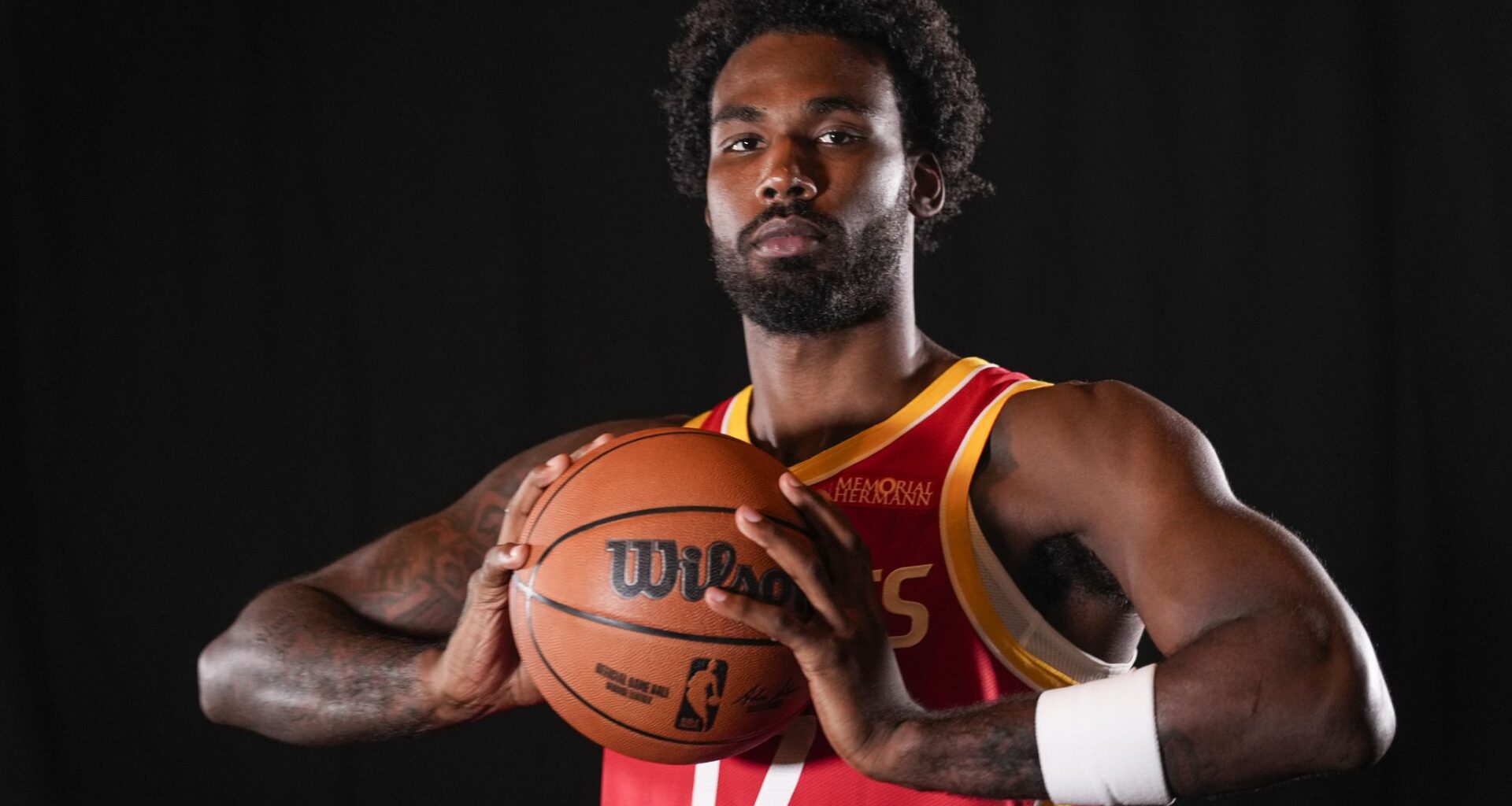
Houston Rockets forward Tari Eason earned a big contract in offseason because of his rebounding and defense.
Brett Coomer/Houston Chronicle
Last in a series of Rockets player previews ahead of the 2026-27 season.
Houston Rockets forward Tari Eason played the 2025-26 season with an anvil on his back — with pressure stemming from his impending restricted free agency.
Eason acknowledged after the Rockets’ last game that it was hard not to think about his contract status. Houston general manager Rafael Stone said at summer league that he didn’t like that Eason and the Rockets weren’t able to agree on a contract extension before last season because of the strain it can put on players looking for their first big contract.
Article continues below this ad
Even so, Eason still put together an impressive fourth season and earned a five-year, $81 million contract with a player option in the fifth season.
Oblique and ankle injuries limited the 24-year-old forward to 60 games, but that still marked the most he’d played since his rookie season. Eason started 34 games and averaged 10.5 points, 6.3 rebounds, 1.2 steals and half a block per game.
Eason remained one of the league’s better defensive and rebounding forwards. Coach Ime Udoka deployed him against superstars like Luka Dončić, Kawhi Leonard, Karl-Anthony Towns and Victor Wembanyama.
Eason’s block and steal rates dipped from previous seasons but still remained in the 75th and 78th percentile, respectively, among wings, per Cleaning the Glass. Eason grabbed about 8% of his own team’s missed shots, a mark in the 96th percentile at his position — he’s never been below the 95th percentile, per Cleaning the Glass.
Article continues below this ad
Offensively, Eason recorded his lowest effective field goal percentage (which factors the added value of 3-pointers) since his rookie season. Most of that stemmed from a sizable drop in his midrange efficiency and a change in his shot profile — a decrease in the percentage of his shots coming at the rim and an increase in 3-point attempts.
For the first part of the season, Eason’s long-range volume was a benefit for a Rockets team light on shooting. He made a scorching 46% of triples before the All-Star break. But that dipped to 21.8% after the break, a slump that seemed to affect the forward’s confidence and ultimately left him around his career numbers from deep.
Eason rebounded to have a strong postseason, averaging 13.8 points and 2.5 steals per game on decent efficiency.
With him on the floor in the regular season, the Rockets outscored opponents by 6.9 points per 100 possessions, per DataBallr, 2.2 points higher than they did in the minutes he sat — mostly a function of improved rebounding on both ends.
The predictive advanced metrics DARKO and Estimated Plus-Minus (EPM), which used on-off, box score and tracking data to estimate player performance, love Eason. Among forwards, DARKO put Eason in the 88th percentile in overall rating and in the 93rd percentile for defense. EPM rated him in the 82nd percentile in overall rating and in the 95th percentile among all players.
Article continues below this ad
This season, Eason will be one of Udoka’s key reserves, a role that should allow him to maximize his energy on the court to terrorize other ballhandlers and help the Rockets continue to dominate the possession battle.
Nerd stat
If Eason can stay relatively healthy and maintain his level of play, he should outproduce his new contract.
What to watch in the first 20 games?
How does Eason’s shot diet look with a Rockets team that has more shooting threats than it did last season?
Eason said he worked on improving his handle in the offseason and it has looked a bit sharper in the preseason. How real are those gains?
Article continues below this ad
A successful season for Eason is …
One where he continues to be an excellent defender and rebounder. That would be a successful season by itself. A home run season, however, could also include a couple steps forward on offense — namely ticking up that 3-point percentage and, if teams start closing out on him harder, attacking those closeouts with an improved handle to maintain the flow of Houston’s offense.
Previous
Article continues below this ad