
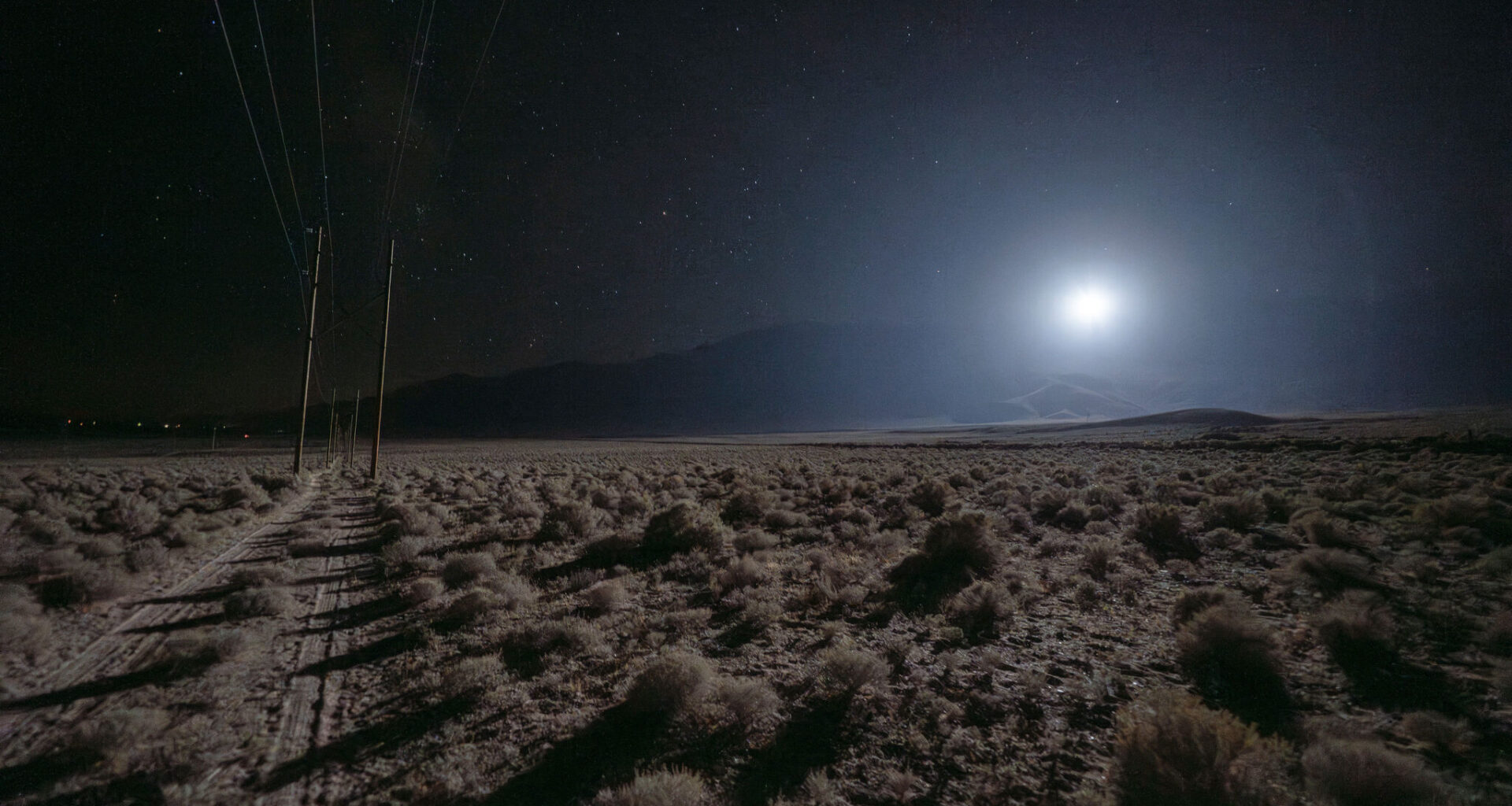
On Saturday night, residents of Lone Pine, a small Eastern Sierra town near Mount Whitney, were baffled by a pair of blinding lights illuminating the desert south of town. In what should have been a pitch-black sky, the beams seemed to come out of nowhere, casting a glow across the landscape.
The company wants to build a network of satellites that reflect sunlight onto specific locations on Earth at night, potentially illuminating everything from city streets to industrial sites. The proposal has drawn criticism from scientists and dark-sky advocates concerned about the effects of disrupting the natural nighttime environment.
On top of commercial uses, the company is also pitching an application of the technology that could save lives — helping search-and-rescue teams find people in the dark.
On Saturday, the company set up powerful spotlights along Horseshoe Meadows Road near Lone Pine to simulate the illumination its proposed satellites could provide. The test was conducted with China Lake Mountain Rescue and other volunteer search-and-rescue personnel, who practiced grid searches, stretcher carries and equipment rigging both in darkness and under the lights.
“We mounted powerful mobile lighting near the peak of Mt. Whitney to recreate the light spot our satellites will deliver,” Christopher Buscombe, a spokesman for the company, told SFGATE in an email. “The aim was a precise, realistic simulation of the spot, so emergency responders could see how our technology will perform in real scenarios.”
Phillip Cash, operations leader for China Lake Mountain Rescue, told the San Francisco Chronicle that the illumination was slightly brighter than a full moon, allowing searchers to see roughly 3 miles in every direction. (The Chronicle and SFGATE are both owned by Hearst but have separate newsrooms.)
Cash said the extra visibility made navigating terrain easier, though he stopped short of suggesting the technology would fundamentally change routine nighttime rescues. “We’re pretty good at working at night already,” he told the Chronicle.
The announcement doesn’t mean Reflect Orbital’s mirror satellites are ready to provide nighttime illumination, but it’s another step in securing the rockets needed to get them into space. Reflect Orbital said it has received Federal Communications Commission permission to operate its first spacecraft and expects search-and-rescue teams to be among its earliest customers.
The proposal has drawn criticism from astronomers, scientists and dark-sky advocates who warn that reflected sunlight could interfere with astronomical observations, disrupt wildlife migration and feeding patterns, and throw off the natural light-dark cycles that plants, animals and humans need. Some researchers have also raised concerns about the potential effects of artificial light on human sleep and long-term health.
In March, Ruskin Hartley, CEO of DarkSky International, told SFGATE that he was “extremely concerned” about the project moving forward. “This is clearly an unprecedented assault on the nighttime environment,” he said.