
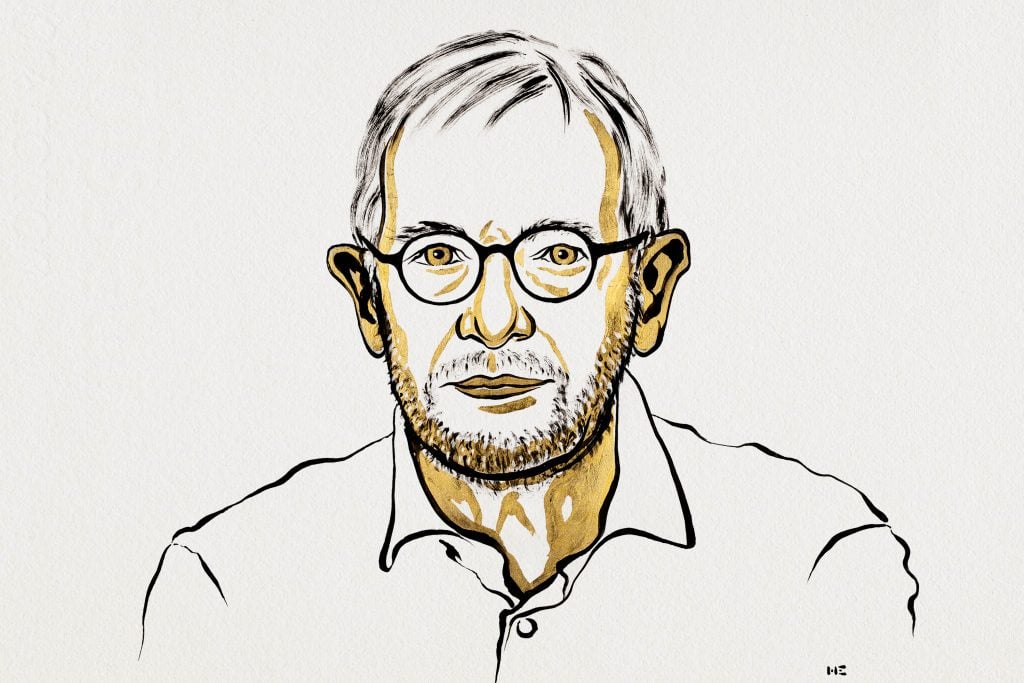
Francis Halzen: Hello?
Adam Smith: Oh, hello. Am I speaking with Francis Halzen?
FH: Speaking.
AS: Hello, my name is Adam Smith.
FH: You are lucky you’re talking to me because, I only answered because I thought it was a call from Sweden. But I’m glad to talk to you.
AS: I’m very glad to talk to you. Thank you very much indeed, and lucky me that you recognize the Swedish prefix. Thank you. May I just start by asking, how did the news actually reach you? How did you learn that you’d been awarded the Nobel Prize?
FH: You know, I am traveling. I travelled between, I was at a science festival in Bergamo over the weekend. I was sitting in my hotel room writing a proposal. As I joked in one of the meetings, I hope it helps to get it funded.
AS: Let’s hope so, because finding time to finish it is going to be hard, I’m afraid, yes.
FH: Yes, I’m afraid so too. You know, just like IceCube, I have talented collaborators, they always help me survive. I’ll come through this one as well.
AS: I mean, if we think of IceCube and its extraordinary beauty and size, there in the translucent ice under the South Pole, you and your collaborators must be very proud.
FH: Yeah, and in fact, my main reaction to this project over time was not proud, but was surprised. You know, I gave a talk very early in the project at a conference in Venice where I said, “This is a detector, Deo volente,” which means God willing. And I listed all the hurdles we had to overcome. And among these hurdles, we overcame them all, evidently, that’s why I’m here, but was the fact that we didn’t really know what the optics of the ice was, which is crucial because it’s a particle detector that detects light. So we made this incredible discovery that blue light that we detect can travel for hundreds of meters through this ice. And that was totally unexpected as well. So beyond all the other risks of, whether hot water drilling would work and whether we could beat the backgrounds, this was what really made the project possible and that was pure luck. After the fact that it’s totally normal, this is ancient snow that fell on Antarctica 50,000 years ago it’s ultra pure, and that’s why it’s so transparent. So we really didn’t have the guarantee of that.
AS: But I suppose fortune favors the bold, and in your case, everything fell into place.
FH: As I said, at every step, my reaction was surprised rather than pride.
AS: And now this ushers in this dawn of a new era of neutrino astronomy. I know that it’s early days, but what do these neutrinos allow us to see?
FH: Well, the first source we really identified by ourselves was an active galaxy. And the data of that active galaxy tell us that the neutrinos are produced very close to the black hole, at the center of that galaxy. And it’s an active galaxy, so it has a supermassive black hole, and the core of the galaxy is surrounded by plasma, which produces the target to produce these neutrinos. This is obviously a place from which light doesn’t escape. It can, with great difficulty, maybe be studied with radio telescopes. But so our first detection of a source is already an example of looking into the very close regions of the black hole, where presumably only neutrinos escape.
AS: That’s extraordinary.
FH: This is just one example of the concept for which we all thought that neutrino astronomy was promising. As someone mentioned in the press conference, it’s actually, in retrospect, the most amazing thing is that we got funded for this project. The National Science Foundation should take great credit for this.
AS: And also the environment that you were able to work in, Wisconsin, which has obviously been very supportive for you.
FH: Yes, incredibly, in two ways. Wisconsin has always been a place that has tolerated unconventional physics and unconventional ideas. We got instant support at the very early stages of the project where, as I said, this project, everybody thought is a cute idea that won’t work. We got the support from the council of the administration, and we were not just lucky in a sense that the University of Wisconsin had the decision to create a laboratory that could actually build equipment of the type, and the size and sophistication required for this project. It’s called the Physical Sciences Laboratory. It’s kind of a nonprofit, high tech lab. The very talented technicians, engineers that were available to us there played a major role. And that’s where, for instance, the hot water drilling equipment that was so critical for achieving the deployment of these sensors, that’s where it was designed and built. Most universities over the years had gotten rid of these labs, but Wisconsin was one of the few places which maintained this capability, and that’s what made IceCube possible there.
AS: I just wanted to finish by reflecting on this extraordinary thing that this new era will allow you to use neutrinos to look to the very edges of the universe and to the very beginnings of time. I mean, there is so much to be discovered, isn’t there?
FH: That’s right. Someone asked me what will neutrino astronomy be like 50 years from now? There’s no way to answer that question. I wouldn’t like to answer that question if you asked me one year from now. You know, we have been consistently making new discoveries over the 15 years that we have been taking data. That’s my real wish that this may continue, and it will.
AS: Young people around the world will be saying, “This is the field for me then.”
FH: I hope so.
AS: It’s been a joy speaking to you. Thank you very much indeed.
FH: Thank you very much.
AS: Thank you. Bye now.
Did you find any typos in this text? We would appreciate your assistance in identifying any errors and to let us know. Thank you for taking the time to report the errors by sending us an e-mail.