
The Pittsburgh Penguins were not supposed to be good during the 2025-26 season.
Expectations were so low, in fact, that prior to the season there was a perception around the league that they were the ONLY team in the NHL that wasn’t actually trying to win that season.
They were a preseason favorite to be in the running for Gavin McKenna and the No. 1 overall pick.
Whether it was by dumb luck, or outstanding coaching from a first-year head coach, or a bunch of future Hall of Famers coming together driven by an “F you, I’m not done yet” mindset, or (most likely) some combination of all three, they managed to put together an unexpected playoff season that shocked pretty much everybody.
That probably includes their own front office.
What was perhaps most surprising about it, is that it wasn’t really a fluke in terms of how they actually played.
They were the third-highest scoring team in the league, had an incredibly deep forward group, hit a lot of home runs with pretty much every roster move, were a really, really good 5-on-5 team and had outstanding special teams. They did not sneak into the playoffs. They earned it. They belonged. It was a deserved result.
That playoff run ultimately ended in six games, but you can’t change what happened prior to that.
That performance created a lot of confusion on where the organization is going into the 2026-27 season, and what this year’s roster is capable of.
I’m still not entirely sure.
The first nine games have not been great. There have been some good moments, but not enough of them. My preseason expectation was that, given their forward depth, I could see them scoring enough goals to get back into the playoffs if the young goalies could make enough saves and steal some games to cover up for a flawed defense.
On the flip side of that, I could also see a situation unfolding where the young goalies struggle, and maybe a few of the “what ifs” at forward don’t take a step forward, and it pushes them into the lottery.
It’s a wide gap between the floor and the ceiling.
After Saturday’s 6-2 loss in Vegas, which came just 24 hours after an equally ugly 5-2 loss in Colorado, things are not looking as promising as they did early in the 2025-26 season.
Given the current state of the roster, which still features a lot of older veterans, a lot of reclamation projects, and not a lot of youth, you are going to start seeing and reading a lot about how the Penguins have to fully commit to a rebuild, or choose a path, or stop hanging around in the middle of the league.
Even with last year’s playoff appearance, and even with the potential upside of this season’s team (that I still think exists), the Penguins have very clearly chosen a path, and very clearly chosen a direction, even if the current NHL roster does not totally reflect it.
This is not a team trying to win this season.
I don’t care what they say publicly.
I don’t care what the current roster looks like in terms of player age, status or who is still here.
I don’t care what those players in the locker room expect of themselves.
I care about what they are actually doing as an organization and how they are doing it.
Everything they are doing, have done, and have set themselves up to do, has all of the markings of a team that has set its focus on the long-term picture.
You see it in their spending, both now and in the future. You see it in their draft pick usage, both recently and for the future. You see it with the type of players they acquiring and taking their chances on.
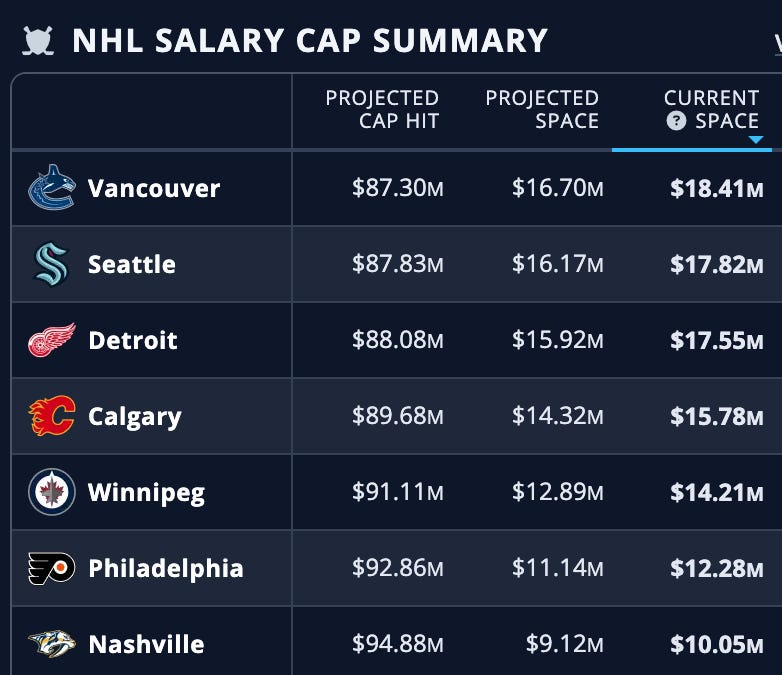
The Penguins entered this season with more than $8 million in unused salary cap space, which is a significant number that is typically only reserved for teams that are not really trying, or facing some other specific set of circumstances.
Just to put that into perspective, here are the teams in the NHL that, as of this writing, have at least $8 million in salary cap space this season.
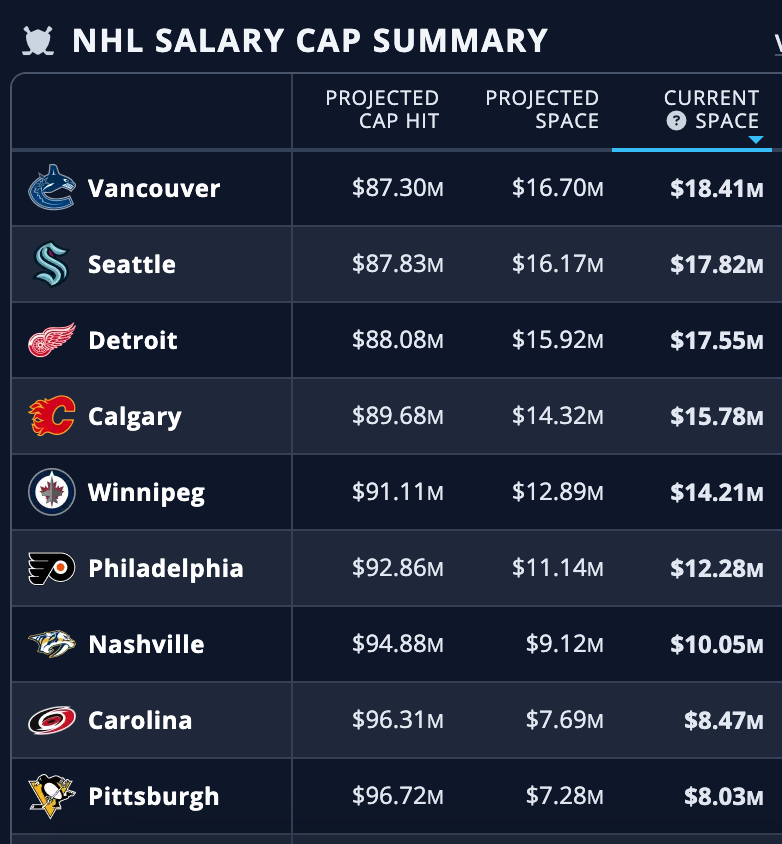
Carolina, Detroit and Winnipeg are three of the teams that have a unique set of circumstances.
Winnipeg’s number would only be around $6 million had it not been for the suspension of starting goalie Connor Hellebuyck. His $8.5 million cap number does not currently count against the cap as long as he is suspended, which unexpectedly puts them into this group (word is, his suspension ends on Friday so we will see what happens there).
Carolina, the defending Stanley Cup champions, is also an unexpected team to see here, but that salary cap space was almost certainly designated for restricted free agent defenseman Alexander Nikishin, who is currently unsigned. At some point that cap space is going to be filled by somebody significant (hell, maybe Hellebuyck).
Detroit is in a similar situation as restricted free agent defenseman Simon Edvinsson also remains unsigned. He figures to account for at least $9 or $10 million of that salary cap space. Detroit is also in the bizarre situation of not actually having a general manager since the middle of July, which has put all of its roster movement on hold. That is the very definition of a “unique” situation.
Outside of those three circumstances, what does every other team here have in common?
They are all teams either in the middle of ongoing rebuilds (Philadelphia; arguably Seattle), or teams that are are just starting extensive rebuilds (Vancouver, Calgary).
Things become even clearer for the Penguins when you look at their long-term spending, and their current long-term commitments.
Mostly because they have none.
They have created a completely clean slate into the future where they have less salary committed over the next five years than any other team in the NHL.
And it’s not even really close.
Look at their current commitments over the next five years, where that ranks in the NHL, and how far behind they are from every other NHL team.

That’s a team that doesn’t want to tie itself into anybody, and isn’t committing to anybody. Almost every roster move they have made at the NHL level over the past two or three years has been either a short-term signing that could potentially be flipped at the deadline, or a reclamation project/lottery ticket on a younger player that might need a fresh start or change of scenery.
They are not making trades for players with long-term contract commitments.
They are not making major free agent signings.
Those are the actions of a rebuilding team.
Their future cap commitments put them in the company of teams like Vancouver, Seattle, Calgary, the Islanders, Nashville and Chicago.
You probably don’t need me to tell you what category those teams are in.
The biggest problem people seem to have with the current state of the franchise is that it clearly isn’t a Stanley Cup contender, but also hasn’t quite bottomed out to get a premium lottery pick, which is keeping them from getting their next franchise cornerstone player.
And that’s certainly true.
That’s usually the best way to get that level of player, even if it requires a lot of luck and a long way back to the top.
But even without a top-10 pick, the Penguins have still made a LOT of draft picks over the past two years, and a lot of reasonably high picks.
More than most NHL teams.
Over the past two draft classes they have made 19 total selections. Only one team in the NHL (Los Angeles) has made more.
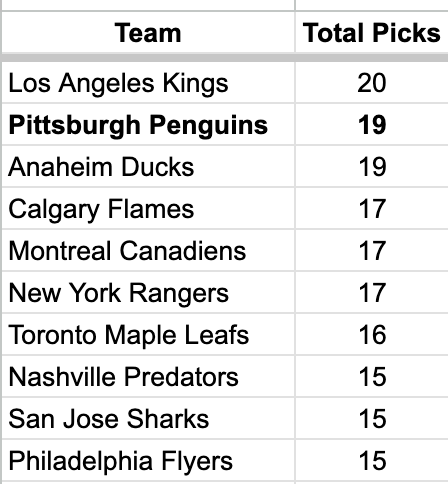
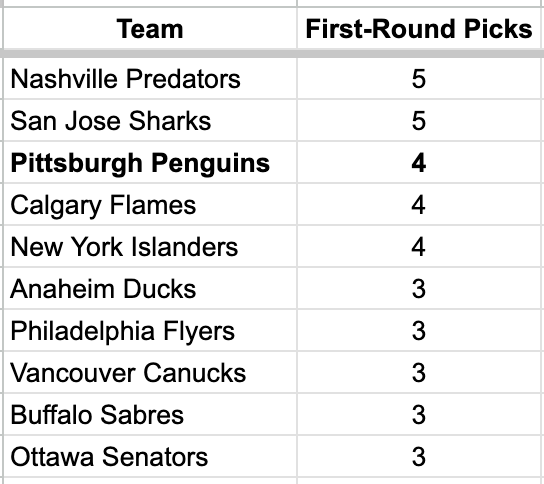
Among those picks, four of them have come in the first-round.
Only two teams (Nashville and San Jose) have made more (they have made five each).
They have made seven picks in the first two rounds of those draft classes, a number that has been topped by only two teams (Philadelphia and Calgary).
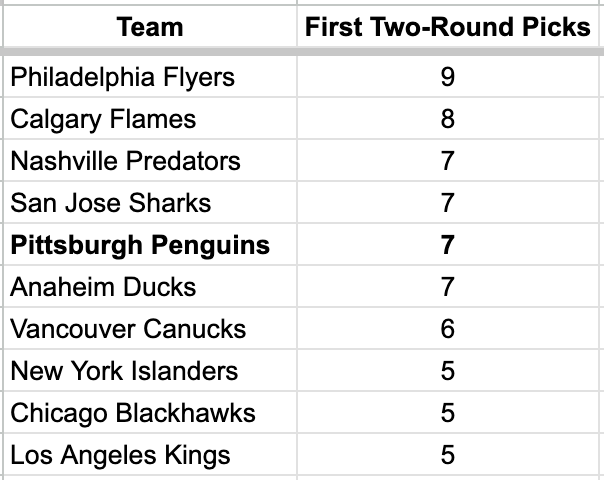
Of those picks within the first two rounds, six of them have come within the top-40 picks. Nobody in the NHL has made more of those, although Nashville and San Jose have matched them.
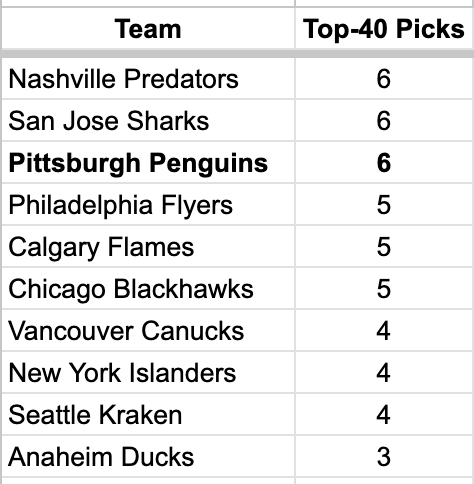
Look at the teams on those lists. Look at the teams they are keeping company with there.
It’s a who’s who of the NHL’s current rebuilding teams.
Teams that aren’t rebuilding aren’t making that many picks, and certainly not that many picks at the top of the draft.
Looking forward, they have 10 picks in the first two rounds of the next three NHL Draft classes.
Only one other team in the NHL (Chicago) has that many. There is also a high probability the Penguins add to that number rather than subtract from it in the coming months.
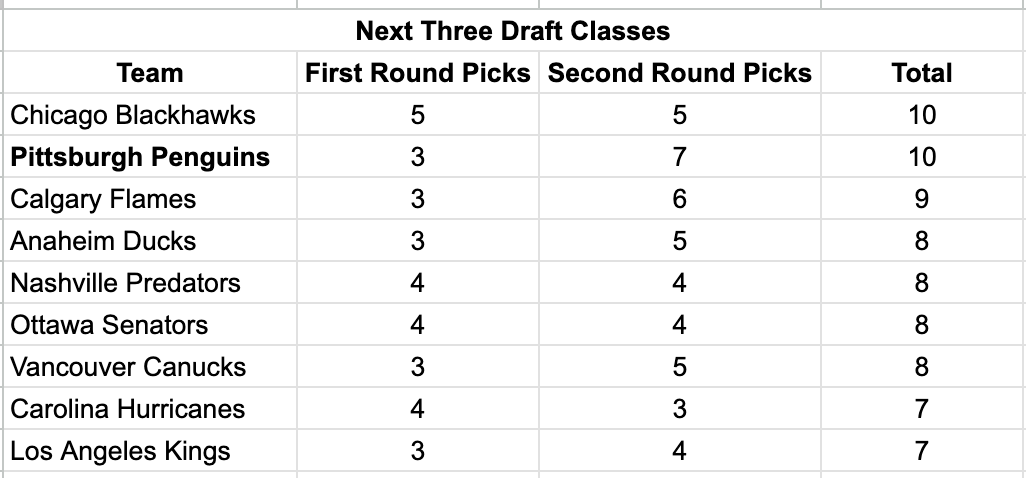
Again, look at some of the other teams on that list and where they are.
We are starting to get into “if it walks like a duck, and if it quacks like a duck…” territory.
If you’re keeping company with other rebuilding teams in terms of current spending, future spending, draft pick usage, and draft pick collection, you’re probably one of those teams.
I think, in the end, it just ultimately comes down to some circumstances.
Setting aside the big-three (Sidney Crosby, Evgeni Malkin and Kris Letang) and their desire to stay together, and I am guessing the organizations own sentimental feelings to keep them together, you simply have a lot of players that either A) have no-trade protections and the ability to control where, or if, they go, and B) a lot of players that simply may not have as much trade value as you might think. Or want.
I wrote about the Bryan Rust and Rickard Rakell situations back in the summer, and they just don’t strike me as the type of players that have a big demand on the trade market. Teams are simply not usually trading for mid-30s wingers that have term remaining on their contracts. Their early season play isn’t really changing my opinion on that, either. I think if the Penguins could have traded one, or both, they already would have.
You can’t force another GM to take your players.
You also still have to put an NHL team on the ice. The rebuild of the early 2000s was so long ago that I think a lot of Penguins fans forgot what a lot of those rosters actually looked like. There were a lot of young players, sure, but there were also a lot of Randy Robitailles, Kent Mandervilles, Lasse Pirjetas, Vladimir Vujteks, and Brian Holzingers. There were also a lot of holdovers from a previous core group before they were eventually, one-by-one, jettisoned away.
Currently, they are blending in some young players. Ben Kindel is 19. Sergei Murashov is 22. Ville Koivunen is 23. The farm system in two years has gone from the literal bottom of the league into, at worst, a middle of the pack system, and potentially even a fringe top-10 system.
Again: Not the action of a team that doesn’t know what it wants.
I also think there is a lot of value in taking chances on players like Egor Chinakhov, Nicholas Robertson, Kaedan Korczak, Elmer Soderblom and Hendrix Lapierre even if they don’t always work out. Maybe one or two stick and become players for the long-term. Maybe one or two become further trade assets. Maybe some just flop.
The perception of rebuilds is that they always have to begin with tearing a team down to the foundation, throwing a bunch of young guys out on to the ice, and just letting them lose for a couple of years while you stockpile lottery picks. That takes a long time to come back from, even if you are successful. And most of them are not successful anymore. Especially in the current NHL era, and with the current Draft Lottery rules that greatly reduce your odds of actually getting the No. 1 overall pick. You can potentially strip your team down to nothing, never get a top pick, or never have the luck of having a franchise-changing player fall into your lap, and never get out of that cycle.
It happens more often than not. Losing breeds losers. Losing tends to breed more losing. Especially when you start accepting that sort of result.
There is also the reality that while most Stanley Cup winning teams do have top picks on them, the overwhelming majority of those rosters are accumulated through trades and free agency. They have very few actual “home grown” players on them. Most prospects fail. Or are used as trade chips for other players.
Looking at the current Penguins roster and concluding that they don’t know what they are, or can’t decide on where to go, just doesn’t work for me.
They know what they are. They know what they have to do. They have chosen the path in getting there. It is going to take some time. I think a lot of it is just a waiting game on some contracts and players.
They still need to find their next franchise player, or somehow get into a position for it. Maybe this will be the year it happens.
In the meantime, they are clearing long-term cap space, stockpiling picks, and trying to find some hidden gems.
Do you know what that is? That is rebuilding.