
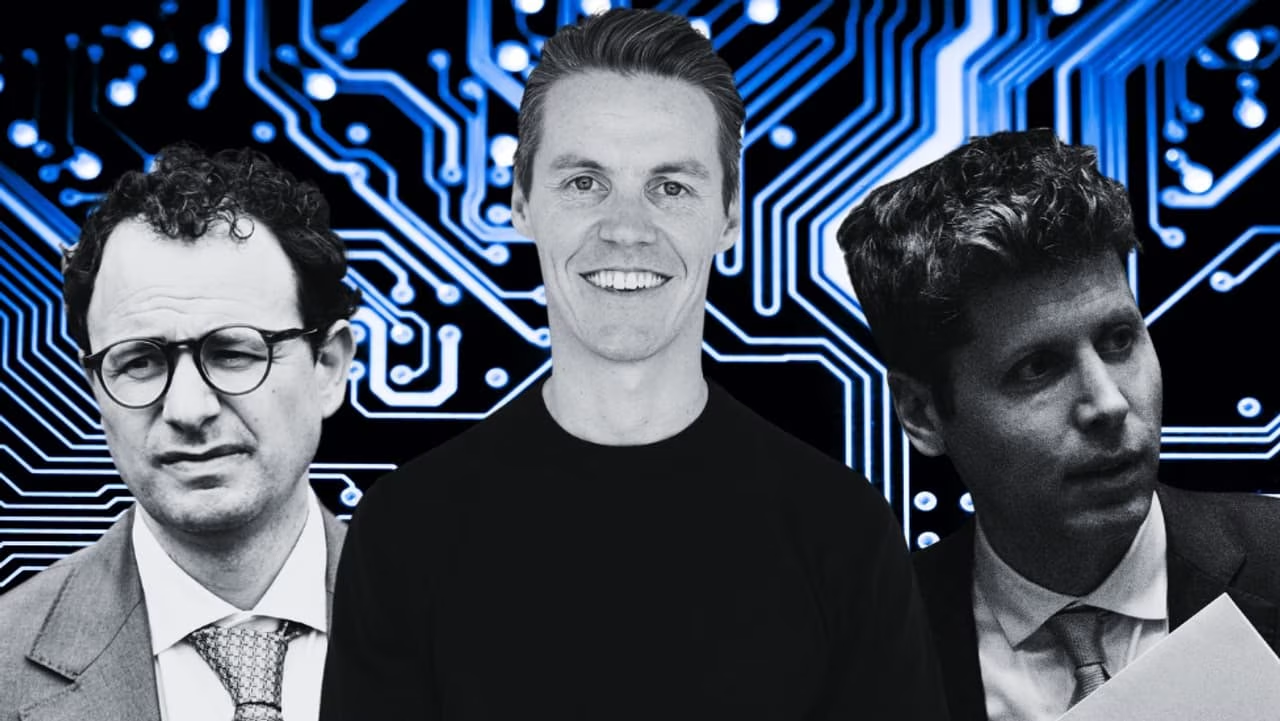
The spectacular failure of neocloud start-up Firmus, previously the darling of Australia’s AI scene, has exposed the “cracks” in a trillion-dollar industry largely built on imagination.
Firmus, an “AI factory” firm building data centres here and in Asia, this month pulled its Initial Public Offering (IPO) for the Australian stock market after investors baulked at an extraordinary $44 billion valuation.
Be the first to know when news breaks. Download our new app
Analysts had criticised its desired price as “greedy”, saying it was hard to see how a company with just two running data centres could demand such a high value.

But the high-profile flop has also raised questions about the enormous valuations placed on the mega AI players like Anthropic and OpenAI seeking to go public in coming months, and how investors will react when it comes to the crunch.
A similar story to Firmus’ has been playing out on the global scene, with several others in the data centre game recently pulling IPOs of their own or seeing stock prices crash.
Senior market analyst Henry Jennings told news.com.au there were question marks over the whole neocloud funding model, pointing to the “unravelling” of the debt-laden company Firmus had modelled itself on.
“Firmus’ playbook, what they were following … was a company in the US called CoreWeave,” he said. “Which is kind of in the same space.
“And (Firmus) said to all their investors, ‘Now look at the success of CoreWeave. If that’s so good, we will be even better’.
“But the problem with CoreWeave is that is unravelling very quickly as well.”
CoreWeave lost 15 per cent of its stock price in a single day last week, with its bond yields rising to the same figure as it languished in $US35.6 billion in debt.
‘Cracks’ appearing in market
The Wall Street Journal reported that an industry summit taking the pulse of community resistance to data centres and a new lack of investor confidence in the US last week included a discussion topic of “are we screwed?”
Reports on Nvidia-backed Firmus’ failure to reach its IPO goal cited unexpectedly soft demand from US investors.
Market analyst Michael Frazis asked after Firmus pulled its plans whether the failure would “blow up the global AI trade”.
“Is this the straw that breaks the camel’s back?” he asked.
“Has the market closed for these kinds of raises (there are a number in the pipeline) or was this Firmus-specific?”
Mr Jennings explained there were major concerns over the returns for chip makers and data centre builders spending billions on development in a high inflation environment.
“The question marks have been always: all this money being spent on AI, will they get the return on investment that is necessary?” he said.
“And with costs blowing out because of the debts getting more expensive, that’s certainly not helping the argument.”
He said big tech companies like Google, Amazon, Apple and Meta were “hanging in” and partially holding up the Nasdaq and the S&P 500.
“But there certainly are cracks appearing at the moment. And that is somewhat worrying,” he said.
Equity Mates co-founder Bryce Leske said Firmus made the right call in pulling its IPO, adding the data centre scene’s struggles proved investors were not willing to back AI “at all costs”.
“AI has given markets a big lift over the last few years and has provided investors with some phenomenal returns, but higher interest rates are now making some investors take a harder look at the companies that need to borrow a lot of money to build,” he said.
Asked how exposed the stock market currently was to AI, Mr Leske said the 10 biggest companies in the US made up 40 per cent of value on the top 500 firms.
“Most of them are tech giants that are betting big on AI – Nvidia, Microsoft, Alphabet, Meta, Broadcom, Amazon, Tesla,” he said.
“So if you’re holding a US index fund, you likely have a large exposure to AI.”
‘Blue sky’ valuations
Firmus’ $44 billion valuation, despite pulling in only $US50 million in revenue last year, would have made it the biggest float on the ASX since Telstra in the 1990s and taken it inside the nation’s top 20 biggest companies.
But that pales in comparison to the companies making the AI models Firmus hoped its proposed data centres would help to power in the coming years.
Anthropic plans to list on the US market in November with a slated value of $US2 trillion.
That’s despite its prospectus revealing the company made an operating loss of $US8 billion in 2025. The Claude-maker says its revenue is growing and had reached profitability this week.
OpenAI’s plans for an IPO are a little more clouded, with a public listing pushed to 2027.
The company behind ChatGPT revealed on October 9 its revenue was $US20 billion less than the $70 billion it had projected in the year to September. It has been eyeing a $US$1.4 trillion valuation.
Elon Musk’s SpaceX, which is partly an AI company, entered the US market as the biggest IPO ever this year and this week had a market cap of $US2.07 trillion.
Mr Jennings said the age of AI meant new metrics were needed to value the likes of these companies, similar to the dotcom boom of the 1990s.
“And a lot of that value is built through blue sky or even in some cases with SpaceX, missions to the moon and data centres on the moon and missions to Mars, which get the imagination stirred,” he said.
“But they could be a long way off.
“So there’s a lot of hope built into these valuations. It’s very hard to value that hope. And that is one of the risks.”
‘The very core of AI’
Josh Gilbert, lead analyst for APAC at eToro, believes the likes of Anthropic and OpenAI would not face the same issues as Firmus, saying they had “real demand and revenue”.
“They sit at the very core of AI,” he said.
Although he agreed valuations were still “the question mark when it comes to any huge AI listing”, and Anthropic’s valuation was now “more than double what private investors valued it at in May”.
“That shift from private to public pricing is exactly where Firmus stumbled,” he said.
“Firmus doesn’t really dent the AI trade, it just shows investors aren’t prepared to pay a sky-high valuation simply because a company is part of the biggest theme in markets for years, which is very astute at this stage of the cycle.
“The appetite for AI is still enormous, and Anthropic’s listing will show how deep it runs, but investors have already started separating the businesses monetising AI at scale from those still being priced on forecasts.”
Famous Wall St trader Steve Eisman, the basis for Steve Carrell’s character in The Big Short, recently spoke about the structural risks behind the AI build-out.
The man who made $US1 billion from picking the 2008 housing crash said he worried about a “concentration risk” where the “whole chain basically flows to Anthropic and OpenAI”.
“If there’s a problem with those two companies, then I think the whole chain is in trouble,” he said.
Mr Eisman also pointed out how some of the major tech firms, like Meta, were using private financing agreements to fund infrastructure off the balance sheet.
“There’s something like $500 billion worth of AI debt being raised this year. How much of that is off-balance sheet, I don’t know yet; I don’t think it’s insignificant,” he said.
“I think the reason why they’re doing some of these off-balance sheet shenanigans is they’re trying to preserve their credit ratings as much as possible.
“So if you can get it off-balance sheet it’s like poof, magic, it doesn’t exist, and the ratings agencies won’t count it. I’ve seen this movie before.
“It usually doesn’t end well.”