
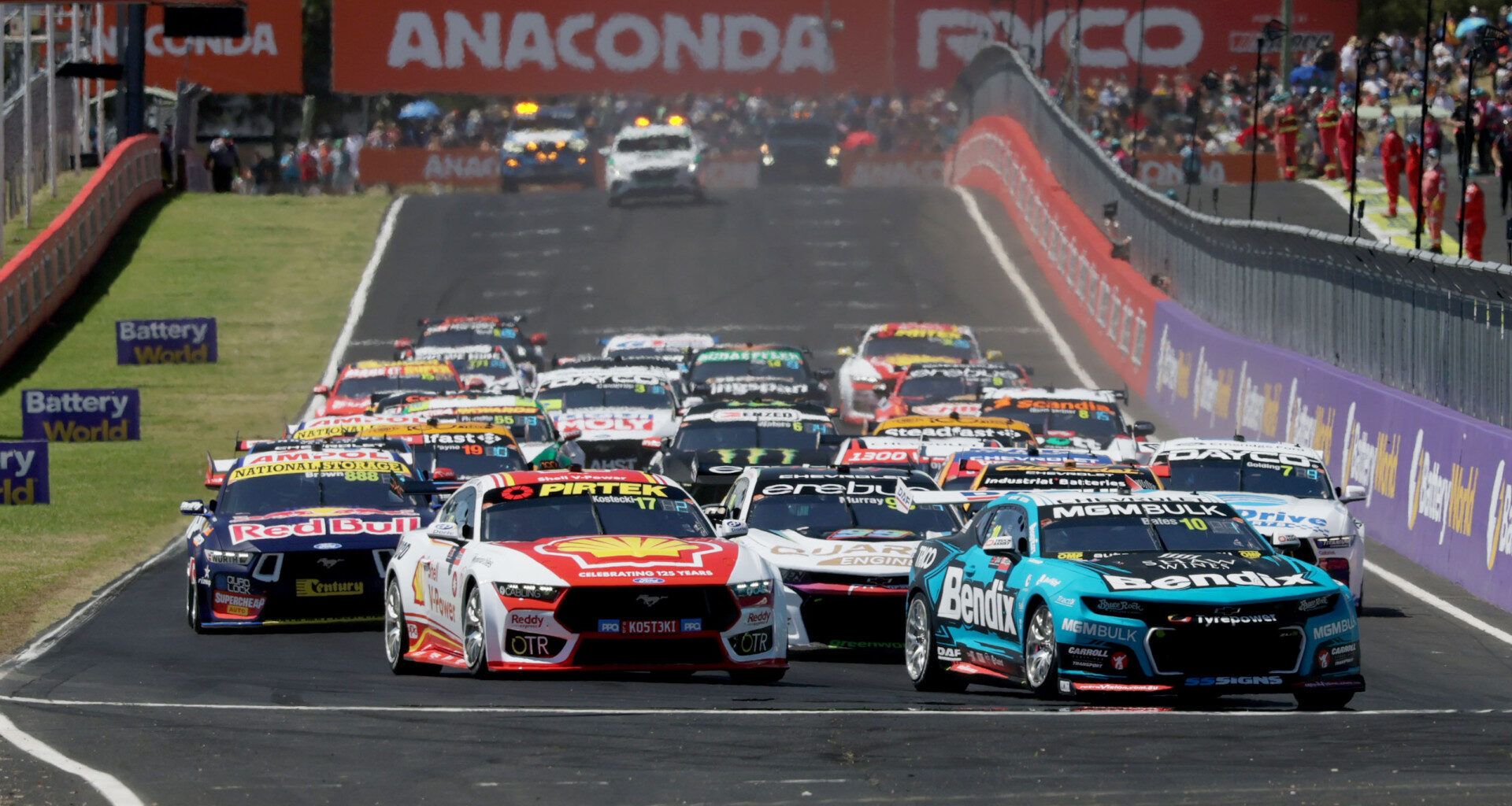
 Aaron Seton leads the field into Turn 1. Image: Supplied
The Bathurst 1000 took place in dry conditions and was devoid of any Safety Car periods during the co-driver stints, making for relatively clean data.
So who shone and who struggled? To take a closer look, we’re using lap time analysis compiled by The B-Pillar, averaging the best 50 percent of laps for each driver.
Matt Payne’s co-driver Will Davison was the man of the match on that metric, averaging 2:08.424s across the best 34 of his total 68 laps.
The #19 Grove Racing Mustang was one of the fastest cars in the field, but finished just fifth after being delayed by penalties and slow pit stops.
Davison was sublime in the wet at The Bend too, charging through the field after being turned around at the first corner, but ended the Enduro Cup without a trophy to show for it.
The fact Davison ranked 11th among all drivers at Bathurst on the 50 percent average lap metric showed this pairing was about as close to having two A-graders aboard as you could get.
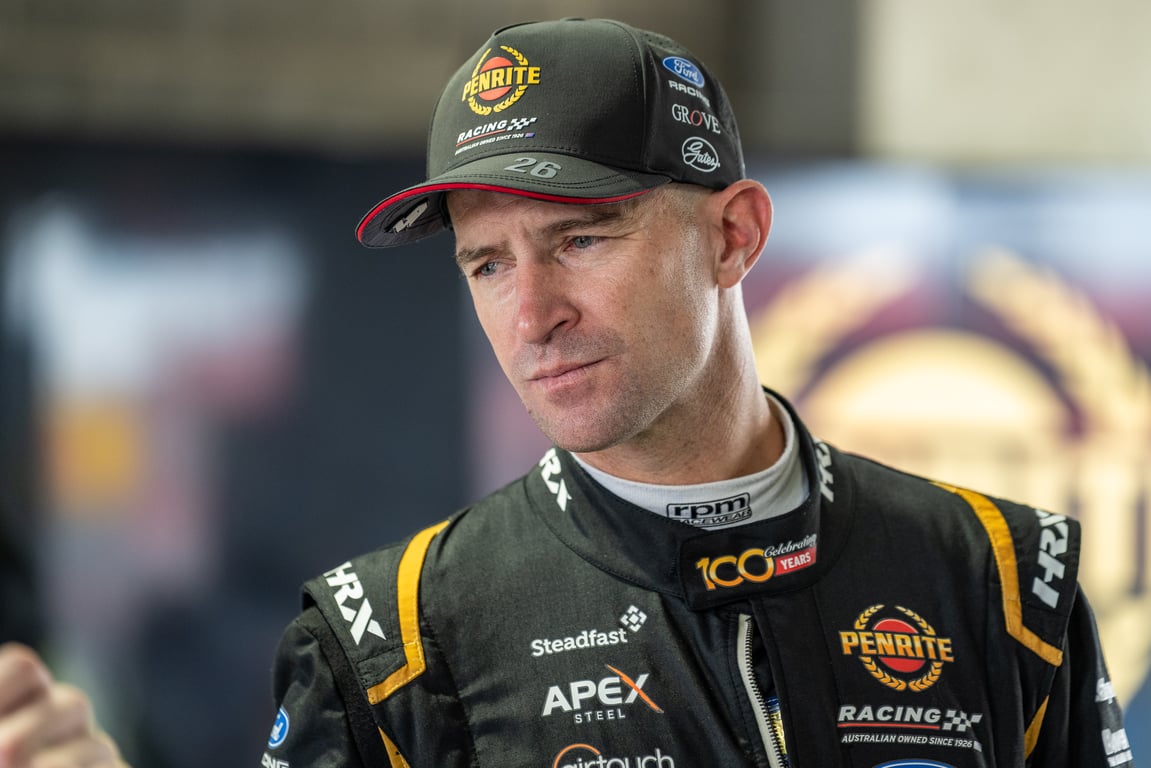
Will Davison. Photo: Richard Gresham
The next three drivers in the rankings – Todd Hazelwood, Aaron Seton and Lee Holdsworth – have already rightly received plenty of praise for their Bathurst efforts.
Hazelwood is now a two-time Great Race winner after his early stints put Brodie Kostecki in the box seat for victory (albeit before a bungled brake change threatened the result).
The South Aussie joins a rare group of drivers to have won the Great Race on both sides of the Ford/GM brand divide, having triumphed alongside Kostecki at Erebus in 2024.
Seton defied doubters by capitalising on the pole position achieved by Zach Bates, making a perfect getaway and holding the lead until the first stops.
The third-generation racer set the fastest lap of any co-driver (2:07.600s) and didn’t put a foot wrong in three stints – staking his claim for a permanent enduro gig.
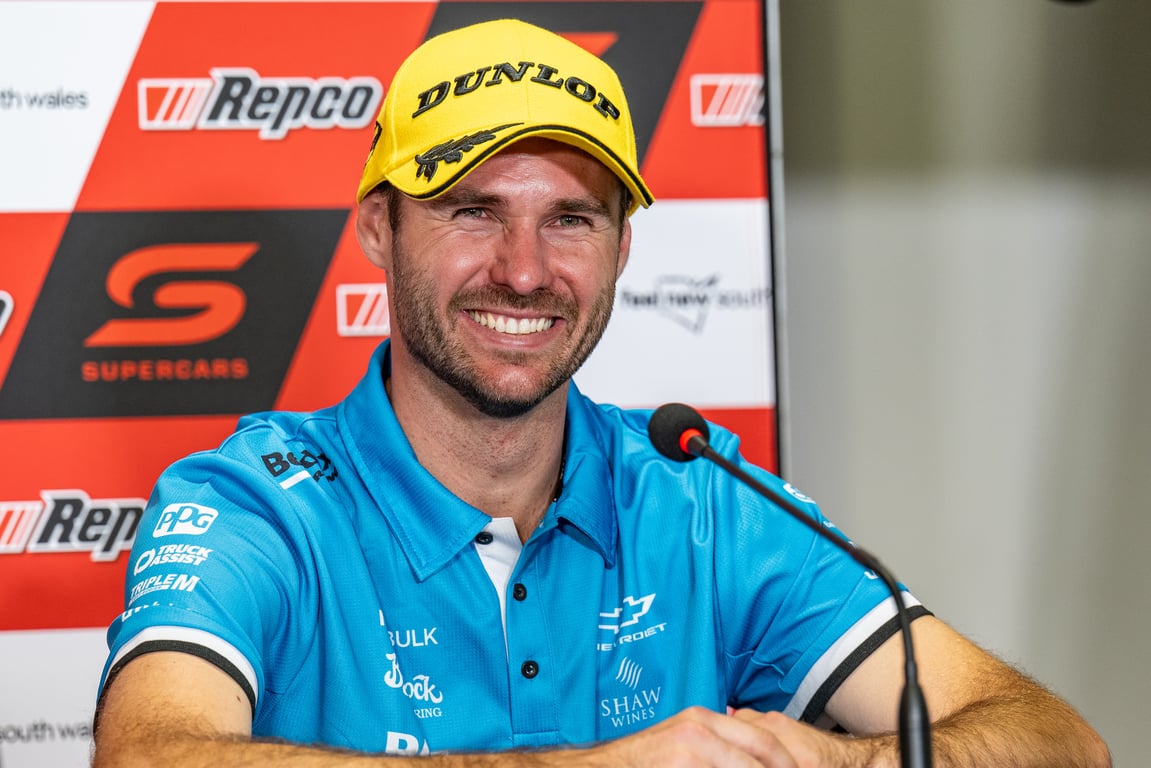
Aaron Seton. Photo: Richard Gresham
Holdsworth likewise did all that was required of him alongside Anton De Pasquale and should now be a two-time Bathurst winner, if not for Team 18’s highly-publicised mistake.
The 43-year-old’s ability to break from his regular job as a commercial real estate agent and race at this level twice a year is worthy of accolades regardless.
That Walkinshaw TWG let him go at the end of 2024 has very much been Team 18’s gain, having already netted a second place finished in 2025.
Scott Pye, the Enduro Cup winner alongside Will Brown, is ranked fifth here, having redeemed himself after a ropey start at The Bend that attracted two penalties.
Rank
Car
Driver
Average
1
#19
Will Davison
2:08.424
2
#17
Todd Hazelwood
2:08.519
3
#10
Aaron Seton
2:08.587
4
#18
Lee Holdsworth
2:08.593
5
#888
Scott Pye
2:08.611
6
#99
Lochie Dalton
2:08.652
7
#4
Harri Jones
2:08.702
8
#34
Nathan Herne
2:08.725
9
#26
Tim Slade
2:08.786
10
#777
Nash Morris
2:08.821
11
#20
James Courtney
2:08.881
12
#15
Bayley Hall
2:08.894
13
#55
Reuben Goodall
2:08.929
14
#31
David Russell
2:09.007
15
#99
Jarrod Hughes
2:09.037
16
#8
Bryce Fullwood
2:09.050
17
#88
Nick Percat
2:09.052
18
#777
Richie Stanaway
2:09.073
19
#3
Zak Best
2:09.075
20
#1
Fabian Coulthard
2:09.151
21
#15
Craig Lowndes
2:09.156
22
#14
Brad Vaughan
2:09.200
23
#6
Mark Winterbottom
2:09.205
24
#34
James Moffat
2:09.335
25
#2
Jaxon Evans
2:09.402
26
#96
Jordan Boys
2:09.452
27
#38
Tony D’Alberto
2:09.485
28
#11
Jack Perkins
2:09.653
Car performance naturally plays a key part in allowing co-drivers the opportunity to shine and it’s worth nothing that the same five cars also topped the primary driver speed rankings (see below).
All four wildcard drivers, regardless of their somewhat arbitrary nomination as primary or co-driver, are included in our co-driver list on the basis they are part-timers.
Elsewhere among co-drivers, Lochie Dalton (#99 Erebus) and Harri Jones (#4 MSR) backed up strong performances in tricky conditions at The Bend with impressive Bathurst stints.
Eighth on this ranking is Nathan Herne, who was nominated as the co-driver for Garry Rogers Motorsport’s entry, but was deployed as if he was the primary.
That meant he enjoyed better track conditions than most co-drivers as he was in the car for the end of the race, while he also had a healthy amount of clean air following James Moffat’s early tangle.
However, Herne’s numbers – and the fact he kept the Camaro straight all weekend – are impressive and should put the Trans Am star on the radar of Supercars squads for next year.
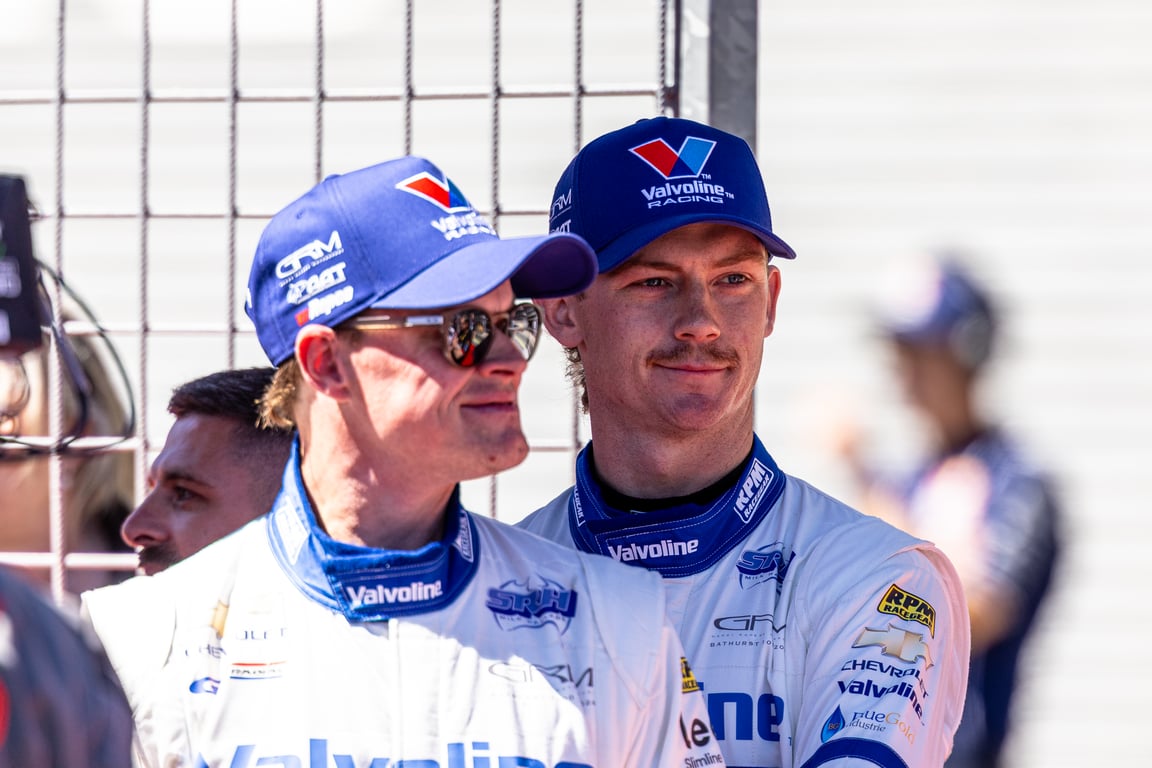
Nathan Herne, right, with James Moffat. Photo: Rhys Vandersyde/InSyde Media
Fellow wildcard Bayley Hall also enjoyed the benefit of effectively driving as a primary late in the race, but was nevertheless impressive to be ranked 12th.
Among other young guns to note was Nash Morris, who also enjoyed clean air after an early tangle, but made the most of it to rank 10th.
His average was 0.163s quicker than the #777 PremiAir Camaro’s primary driver Declan Fraser, who has lost his seat ahead of the Gold Coast.
Although Fraser’s ousting was on the cards ahead of the Great Race, such a direct comparison is nonetheless powerful.
Outside of this, the co-driver rankings largely reflect the relative speed – and user-friendliness – of the cars being driven.
Walkinshaw TWG duo Fabian Coulthard and Jaxon Evans were on the podium at The Bend and yet ranked just 20th and 25th at Bathurst, where the Toyotas struggled.
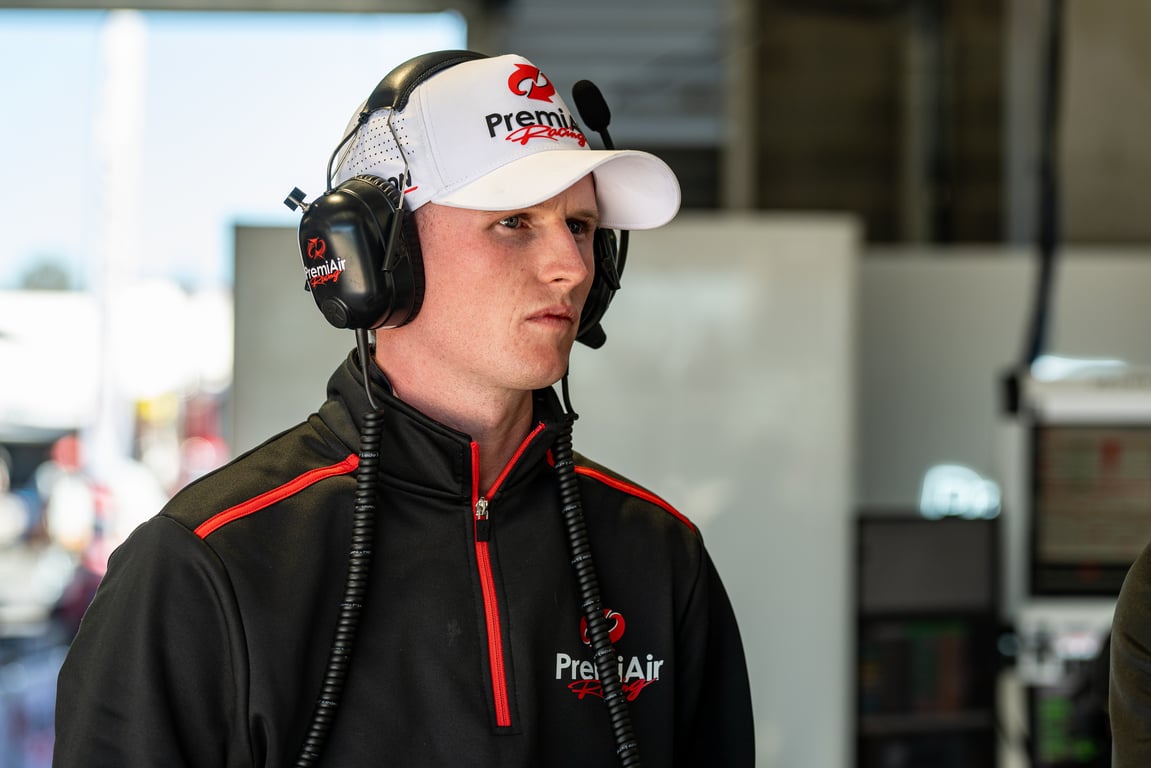
Nash Morris. Photo: Richard Gresham
To their credit, the two Kiwis managed to keep the Supras off the walls, which is more than can be said for their primary driver counterparts.
Former Bathurst winners Nick Percat (#88) and Mark Winterbottom (#6 Tickford) also battled with off-the-pace machinery, the former’s Ford suffering brake issues with its co-driver at the helm.
Craig Lowndes’ 21st place ranking is hardly stellar, but the seven-time winner did more than enough to suggest he’s got at least one more Bathurst tilt in him next year.
Overall, it was a sign of the quality of the co-driver field that the race ran green throughout the stints for the part-timers, and the spread between fastest and slowest is barely bigger than that for the primaries.
The only major incident was the three-car tangle on the opening lap involving Tony D’Alberto, Moffat and Morris, which added to DJR driver D’Alberto’s unfortunate crash earlier in the weekend.
We’ve included the primary driver rankings below for extra context and comparison. The standout here is Chaz Mostert, who was wringing the neck of his Supra before crashing out in the dying laps.
Rank
Car
Driver
Average
1
#17
Brodie Kostecki
2:08.006
2
#888
Will Brown
2:08.163
3
#19
Matthew Payne
2:08.166
4
#10
Zach Bates
2:08.224
5
#18
Anton De Paquale
2:08.242
6
#1
Chaz Mostert
2:08.301
7
#7
James Golding
2:08.317
8
#8
Andre Heimgartner
2:08.340
9
#99
Cooper Murray
2:08.354
10
#26
Kai Allen
2:08.365
11
#88
Broc Feeney
2:08.466
12
#3
Aaron Cameron
2:08.488
13
#31
Jayden Ojeda
2:08.552
14
#4
Jack Le Brocq
2:08.564
15
#9
Jobe Stewart
2:08.631
16
#55
Thomas Randle
2:08.632
17
#6
Cameron Waters
2:08.671
18
#20
David Reynolds
2:08.716
19
#2
Ryan Wood
2:08.787
20
#38
Rylan Gray
2:08.881
21
#777
Declan Fraser
2:08.984
22
#11
Jackson Walls
2:09.124
23
#96
Macauley Jones
2:09.125
24
#14
Cameron Hill
2:09.150
The B Pillar is a UK-based data analytics business, focusing primarily on GT and endurance racing, covering more than 40 series across six continents.
Their clients are drivers, teams, managers, and the media to provide discerning and applicable insights into driver and team performance.