
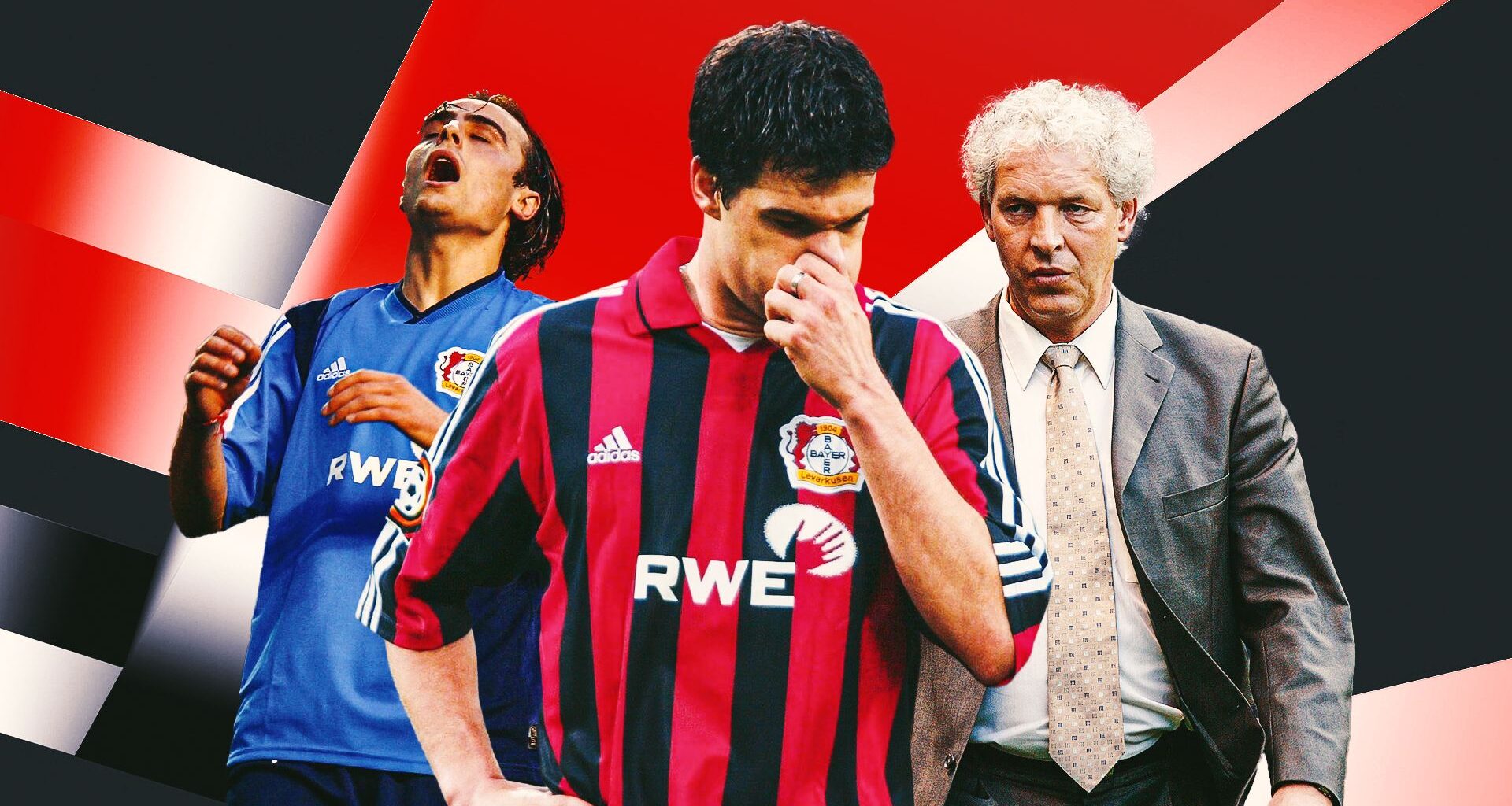
The only problem for Toppmoller after sneaking past United on the away goals rule was that by that stage of the season, Leverkusen were already starting to show signs of wear and tear, with back-to-back losses, at home to Werder Bremen and away to Nurnberg, having already allowed Dortmund to overhaul them at the top of the Bundesliga.
Leverkusen did manage to beat Hertha Berlin 2-1 in their final fixture, on May 4, 2002, thanks to a Ballack brace, but Dortmund defeated Bremen by the same scoreline to take the title by a solitary point, and consign ‘Neverkusen’ to a fourth second-placed finish in just six seasons.
Consequently, the pressure had been ramped up on Toppmoller’s team going into the DFB-Pokal final against Schalke the following weekend, and it proved far too heavy a burden for them to bear in Berlin. Despite taking the lead at the Olympic Stadium through Berbatov, they were 4-1 down by the time Kirsten pulled a goal back with just over a minute of normal time remaining.
Leverkusen’s double disappointment meant that the entire season suddenly hinged on upsetting Madrid in the Champions League final on May 15. Bild wrote at the time, “It must not be that this great team is left empty-handed at the end. That cannot be the will of the football gods…”
Toppmoller openly admitted beforehand, though, that Vicente Del Bosque’s ‘Galacticos’ were “better than Leverkusen at everything” – and the unavailability of two hugely influential players, Nowotny and Ze Roberto, through injury and suspension, respectively, came as a hammer blow to a squad that was already low on confidence after bottling the Bundesliga.
As a result, there were very real fears that Leverkusen might crumble after the concession of an eighth-minute goal at Hampden that enraged Toppmoller. “In the preparation for the match, I talked until I was blue in the face about throw-ins from Roberto Carlos. We knew about them,” he fumed. “And then we were caught out by a throw-in that led to Raul scoring to make it 1-0.”
However, Lucio, the brilliant Brazilian centre-back who had scored the decisive goal in the dramatic quarter-final win over Liverpool, levelled the match just six minutes later, and even after Zidane restored Real’s advantage just before the break with his wonder-strike, the underdogs kept coming.
“We were fitter than Real Madrid, which was strange,” Ballack claimed. “We were down to the bare bones in the semi-final second leg against Manchester United but, two weeks later, we felt fully refreshed in the final. You can’t always explain everything in football. But when I remember the last half-hour against Madrid, they were dead on their feet and we absolutely dominated the game. If we’d have levelled then, I’m sure we would have gone on to win in extra-time.”
As it was, though, Madrid held on to claim their second European Cup in three seasons, while Toppmoller was left with the thankless task of trying to pick up players shattered by three traumatic setbacks: “My first thought after the Champions League final was: ‘Damn it, we should have won the game as we were the better side’. But then I said to the team in the dressing room that they’d had a brilliant run. At that time we were playing the most attractive football in Europe. And we gained a lot of appreciation abroad.”
It ultimately didn’t count for the much, at least not in the eyes of his employers. Before Glasgow, Leverkusen sporting director Reiner Calmund had said that “You are worth nothing in this world without a title”, so Toppmoller’s dismissal in February 2003, after a poor run of results, maybe shouldn’t have come as that much of a surprise to outside observers.
All that really mattered to the powers that be at the BayArena was shedding their ‘Neverkusen’ nickname, particularly as Ballack subsequently admitted that the club’s history of failure weighed heavily on the players during the title run-in. Toppmoller, nonetheless, remains proud of his spell at the BayArena, and says he has no regrets about how it played out.
“I don’t yearn for any lost titles,” he said. “When I was young I always said: I’m not interested in trophies, I want to give people attractive matches. Football should be inspiring. And that’s what we achieved back then.”
Clearly, that didn’t take the edge off failing to collect a single piece of silverware, as Berbatov made clear in no uncertain terms, but while Toppmoller’s Leverkusen may not have been successful, they were undeniably exciting to watch, and maybe there’s a victory in that fact.