
A 165-million-year-old fossil from China reveals how an early mammal relative developed the throat structures needed for modern mammalian swallowing.
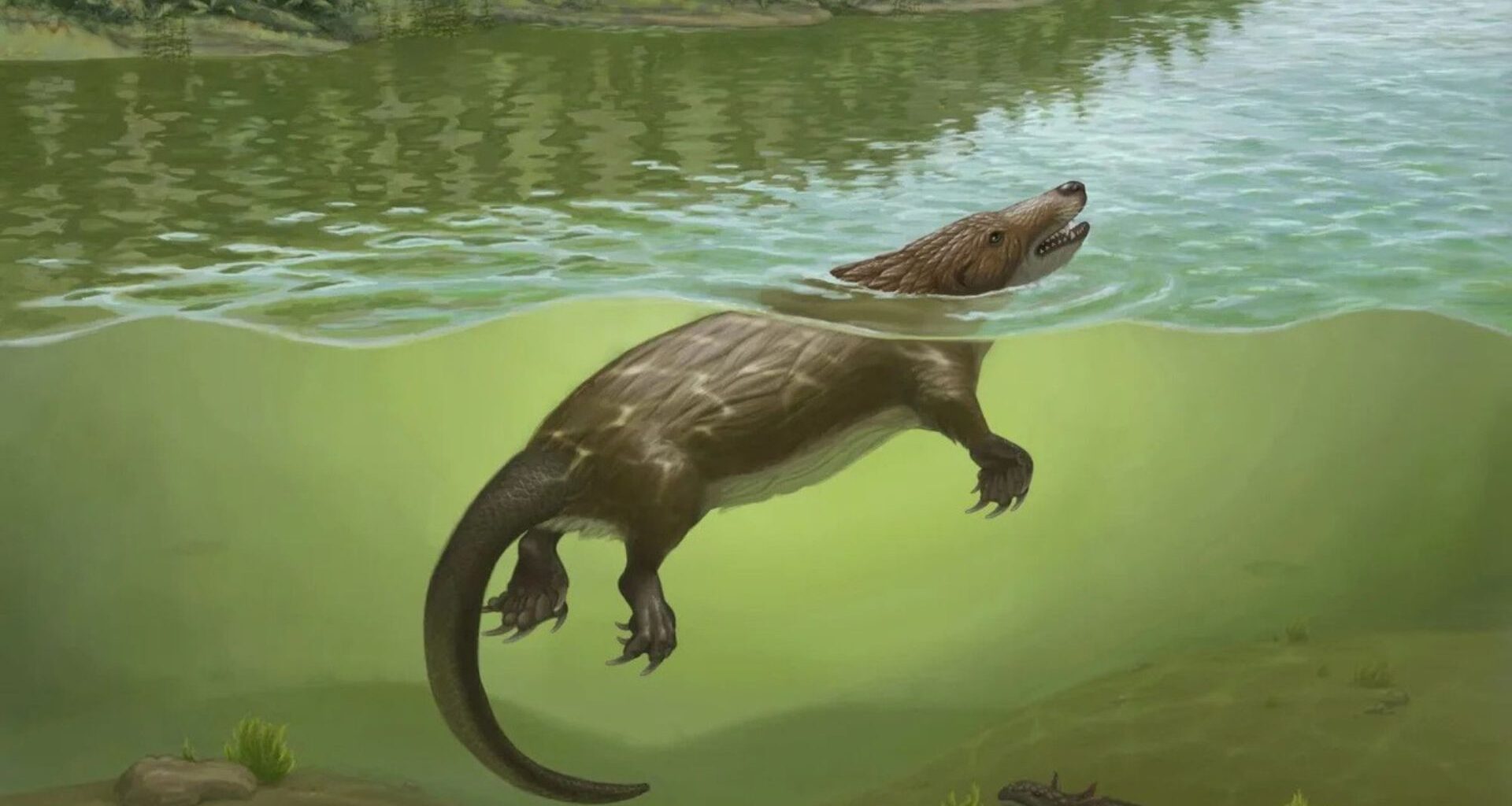
About 165 million years ago, a furry, beaver-tailed animal paddled through lakes and rivers in what is now northern China. It was not quite a mammal, but it already swallowed its food the way mammals do.
The animal, named Megacauda sungei, is described in a new study in the journal Nature. Its fossil preserves tiny throat bones, and they show that a key feature of mammal biology was taking shape while dinosaurs ruled the land.
An otter-like swimmer
Megacauda lived during the Middle Jurassic in what is now Inner Mongolia. It belonged to the docodonts, an extinct group of early mammal relatives known as mammaliaforms.
The animal was about 20 inches (50 centimeters) long from nose to tail and weighed up to about 4.4 pounds (2 kilograms), according to the University of Bonn. It is the largest mammaliaform found from the Jurassic so far.
Its name refers to its big tail, which was broad, flattened and covered in small scales like a beaver’s. Its pelvis and hind limbs resemble those of a modern platypus.
“It swam by using its front and hind legs for paddling,” said Thomas Martin, a paleontologist at the University of Bonn and a co-author of the study, as quoted by Reuters.
Built to hunt in water
Sharp, blade-like cheek teeth with backward-curved cusps would have helped Megacauda hold slippery prey. Researchers think it was a semiaquatic predator of small animals in fresh water.
Bone fragments preserved in its stomach area show that it ate small vertebrates, Reuters reported. Many salamander fossils have been found in the same rock layers.
“It is the earliest evidence of an aquatic lifestyle in mammals,” said Martin.
The animal also faced danger on land. “The predatory threat against Megacauda would likely be from the feathered theropod dinosaurs,” said Zhe-Xi Luo of the University of Chicago, the study’s senior author.
The bones behind swallowing
The most important part of the fossil is in its throat. It preserves a set of hyoid bones, which in living mammals anchor the muscles used to swallow.
It also has small bony hooks on the roof of the mouth, similar to those in living marsupials and placental mammals. In those animals, such structures support the soft palate and the muscles used in suckling and swallowing, according to Ohio University.
Together, these features suggest that Megacauda could chew its food and then swallow it, a pattern unique to mammals today.
“After mammals chew their food, be it plants or meat, they all swallow it in the same efficient and effortless way,” said Luo, as quoted by IFLScience. He described the swallowing system as “an incredibly important evolutionary innovation.”
A milestone in mammal evolution
A soft palate separates the mouth from the airway, so an animal can hold food in its mouth and still breathe. The researchers say Megacauda already had this arrangement.
“This fossil captures an important stage in mammalian evolution,” said Luo. “Structures involved in coordinating swallowing and sucking had already begun to evolve by the Middle Jurassic,” he added.
The bony hooks existed alongside older ridges in the same skull. That suggests the modern structures did not simply develop from the older ones, according to Ohio University.
“The whole setup looks more like what we see in modern mammals,” said Jessica Theodor, a paleontologist at the University of Calgary who was not involved in the research, as quoted by NPR.
A rare look at early mammals
Fossils of early mammals and their relatives are scarce, and Luo told NPR they are “exceedingly rare.” With Megacauda, “It’s all there in one remarkable fossil,” he said.
Docodonts first appeared about 200 million years ago and lasted for about 90 million years, Reuters reported. “Docodonts are the most speciose group of the stem mammals across North America, Europe, and China,” said Luo, as quoted by IFLScience.
The same era produced other experiments in feeding. Ancient armored fishes, for example, solved the problem of biting hard prey in several different ways.
Jurassic fossils keep changing the picture of that world, such as tail bones suggesting that Diplodocus lived in Europe.
Why it matters for us
Suckling is central to what makes a mammal a mammal. “That ability to suckle mother’s milk literally defined our biology,” Luo told NPR.
Martin goes further, linking efficient swallowing to later changes in the mammal brain. “It was this adaptation that made brain development, eventually leading to humans, possible,” he said.
“The Age of Dinosaurs was also a time of extraordinary evolutionary innovation among early mammals,” said co-author Peishu Li of Ohio University.
Research on the end of that age continues too, including a feather that may show why some birds survived the asteroid impact.
The full study was published in the journal Nature.
—–
Like what you read? Subscribe to our newsletter for engaging articles, exclusive content, and the latest updates.
Check us out on EarthSnap, a free app brought to you by Eric Ralls and Earth.com.
—–