
Follow us
Add us as a preferred source on Google
Newsletter
Subscribe to our newsletter
The Milky Way‘s supermassive black hole is surrounded by a surprising trove of heavy metals, according to new observations by the James Webb Space Telescope (JWST). The metals may offer new clues about how Earth got its share of heavy elements — but it could also make one of the greatest mysteries about our local black hole even harder to solve.
In astronomy, metals refer to any element heavier than hydrogen or helium, with common examples including oxygen, carbon, iron or gold. These elements are forged through nuclear fusion in the hearts of stars that are reaching the ends of their lives, before being sprayed into space and incorporated into new generations of stars.
Latest Videos FromLive Science
You may like
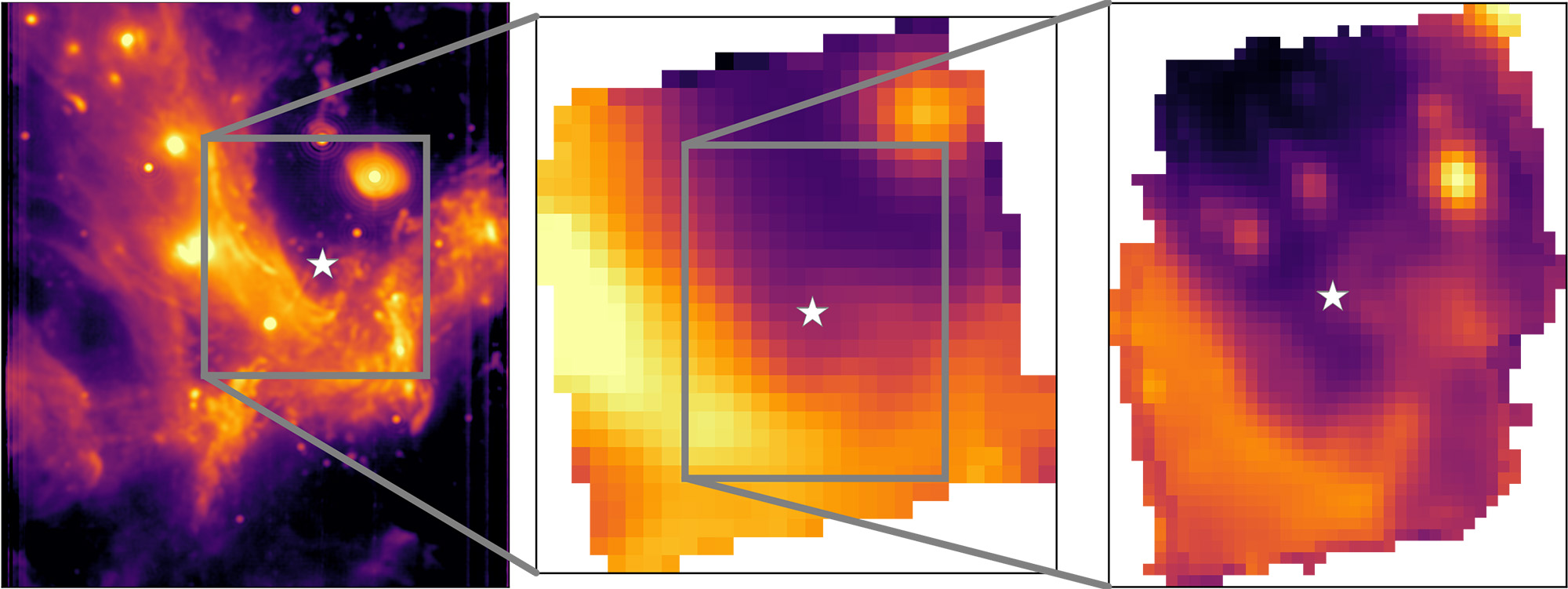
Three views of the galactic center in infrared light, with the location of the black hole Sagittarius A* marked by a white star. From left to right, the images zoom in and show the region at different wavelengths.
(Image credit: JWST, NASA, STScI, CSA, ESA, ESO/VLT)
Ford, N. M., Balakrishnan, M., Von Fellenberg, S. D., Haggard, D., Michail, J. M., Cui, Y., Hora, J. L., Neilsen, J., Principe, G., Roychowdhury, T., Sabha, N. B., Smith, H. A., Sumners, Z., & Willner, S. P. (2026). Ionization Structure and Metal Enrichment of the Galactic Center Minispiral Observed with JWST. The Astronomical Journal, 172(5), 267. https://doi.org/10.3847/1538-3881/ae994d
TOPICS