
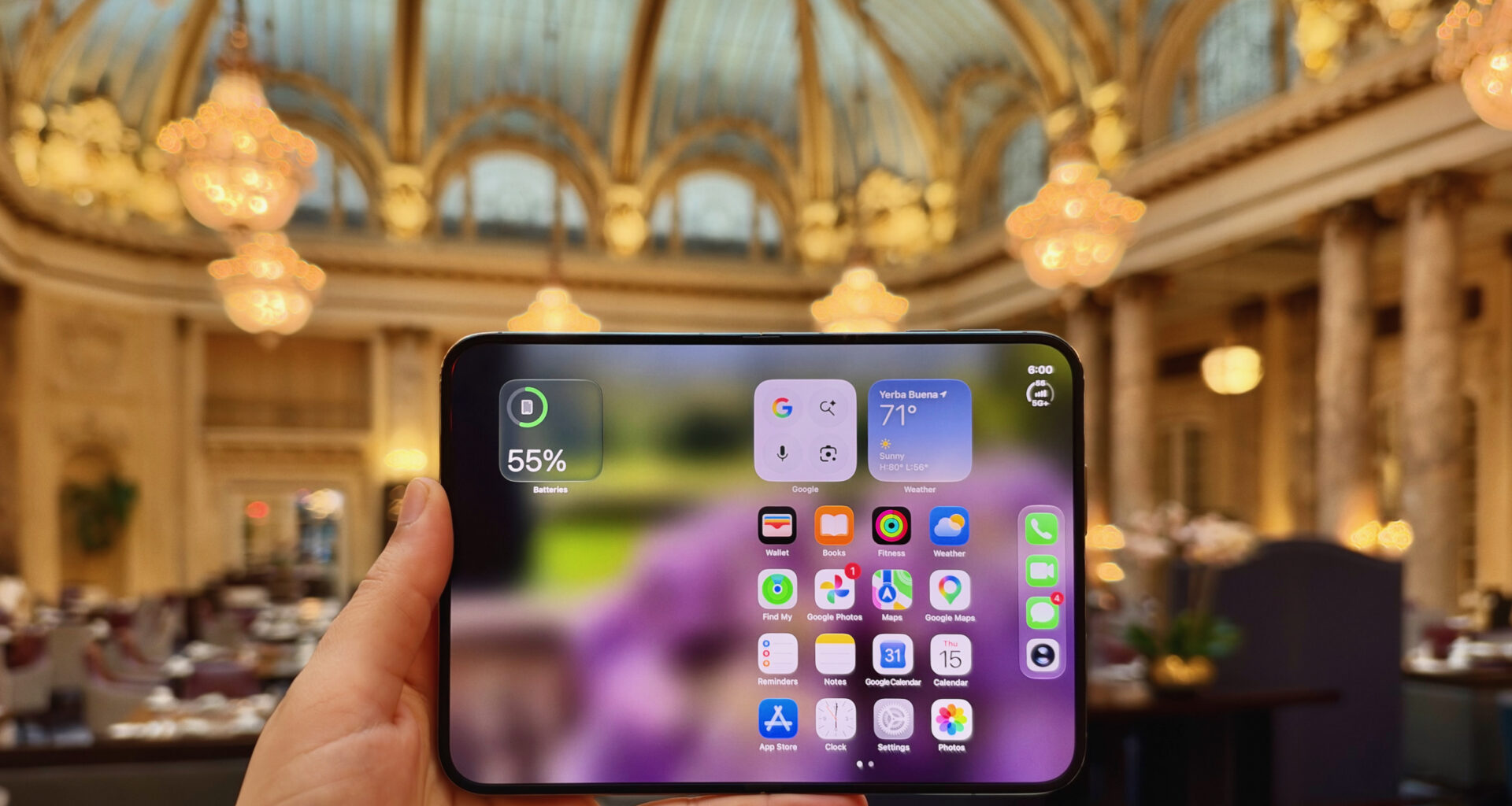
If you were hoping to score multiple iPhone Duo devices from Apple when the new foldable becomes available on Friday, we have some bad news for you: The tech giant is limiting sales of the phone to two per person.
As reported earlier this week by MacRumors, when we attempted to add more than two to our bag on the Apple Store, we got the following message: “A maximum of 2 iPhone Duo can be purchased per customer. Please adjust the total quantity of iPhone Duo in your order before checking out.”
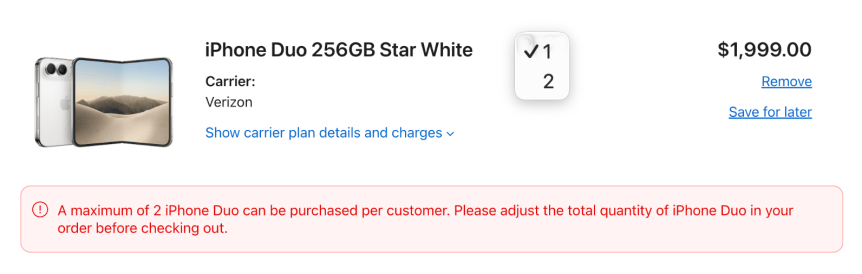 Screenshot by Corinne Reichert/CNET
The limit of two foldables per purchase will presumably also apply to those shopping in-store when the phone finally launches on Friday.
While preorders are backed up until the end of January — our estimated delivery when adding two to our bag is Jan. 25, as of the time of publication — Apple will have limited stock of the iPhone Duo in stores, though you may have to wait in line overnight to be one of the few people able to get their hands on one (or two).
While companies may limit the number of devices in each order, especially for stock-scarce products like game consoles, it’s been a while since Apple has restricted how many phones people can buy at once. Nearly two decades ago, the company launched the original iPhone to great fanfare in September 2007, but limited buyers to two per order (later easing it to five by the holidays). The restriction returned in 2012, when Apple limited orders to two iPhone 5 preorders per customer.
If you do want to buy more than one iPhone Duo, we found that we could add multiple to our carts while shopping at Verizon, AT&T, T-Mobile and Best Buy, though all of those purchases require you to sign up for a line of service with a carrier. Preorders are likewise back-ordered until the end of January, however.
The iPhone Duo is Apple’s first foldable phone, entering the mobile niche that Samsung and Motorola have been fighting over since 2020, with Google entering the fray with the first Pixel Fold in 2023. Chinese phonemakers like Huawei and Xiaomi have also released their own foldables, though none have been sold widely in the US.
Despite refined devices like the Samsung Galaxy Z Fold 8 Ultra, Motorola Razr Ultra 2026 and Google Pixel 11 Pro Fold releasing earlier this year, analysts predict that Apple’s new device will carve out a significant chunk of the market: The International Data Corporation expects the Duo to amount to 31% of the foldable share of the phones market by the end of the year, growing to 40% in 2027.
Customer preorders seem to have followed those predictions, though we’ll have to wait and see whether that appetite continues throughout the holidays and into the new year. Early reviews have been positive, with CNET Senior Reporter Abrar Al-Heeti noting that despite some downsides attributable to a first-generation device, the Apple foldable’s finer details make the experience feel fluid and cohesive.
“Personally, I have no plans of switching back to a slab phone anytime soon,” Al-Heeti said in her review.

Corinne Reichert
Senior Editor
Corinne Reichert (she/her) grew up in Sydney, Australia and moved to California in 2019. She holds degrees in law and communications, and currently writes news, analysis and features for CNET across the topics of electric vehicles, broadband networks, mobile devices, big tech, artificial intelligence, home technology and entertainment. In her spare time, she watches soccer games and F1 races, and goes to Disneyland as often as possible.
See full bio

David Lumb
Managing Editor, Mobile
David Lumb is a managing editor for the mobile team, covering mobile and gaming spaces. Before CNET, he covered tech, gaming, and culture for TechRadar, Engadget, Popular Mechanics, NBC Asian America, Increment, Fast Company and others. As a true Californian, he lives for coffee, beaches and burritos.
See full bio