
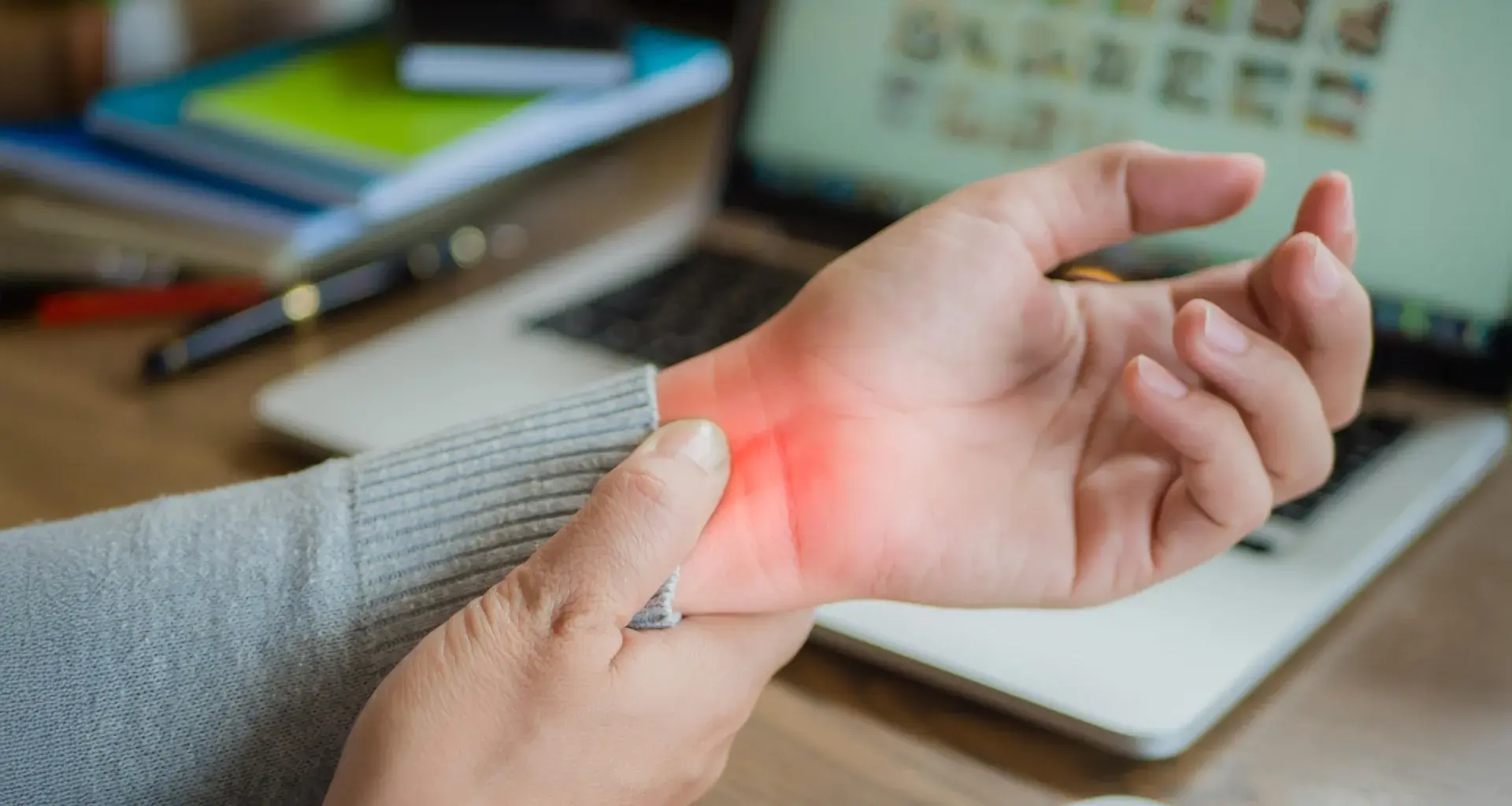
A simple procedure that takes about 15 minutes could offer lasting relief to people with carpal tunnel syndrome, a painful condition that can cause numbness, tingling, and weakness in the hands. A new study suggests that the treatment, which uses ultrasound to guide an injection of ordinary saline around a compressed nerve, provides longer-lasting benefits than traditional steroid injections, without the risks associated with steroids.
The findings, published in Radiology, a journal of the Radiological Society of North America (RSNA), point to a promising alternative for patients whose symptoms have not improved with conventional treatments. Researchers say the minimally invasive technique could also help some patients delay or avoid surgery.
Why Carpal Tunnel Syndrome Can Be So Difficult to Treat
Carpal tunnel syndrome develops when the median nerve, which extends from the forearm into the hand, becomes compressed as it passes through a narrow channel in the wrist called the carpal tunnel. Pressure on this nerve can cause pain, tingling, numbness, and muscle weakness, sometimes making everyday activities difficult.
The condition is commonly associated with repetitive hand and wrist movements. Studies suggest that approximately 5% to 10% of people develop carpal tunnel syndrome during their lifetime, and the number of cases is increasing.
One common treatment involves injecting corticosteroids to reduce inflammation and relieve pressure on the nerve. Although these injections can ease symptoms, the benefits often fade, and repeated treatments may be necessary.
“Traditional steroid injection for carpal tunnel syndrome often provides only temporary relief, thus requiring repeats of the procedure,” said study co-author Anupama Tandon, M.D., professor in the Department of Radiodiagnosis and Imaging at University College of Medical Sciences and Guru Teg Bahadur Hospital in Delhi, India. “Further, steroids carry risk of localized skin changes, fat thinning and tendon weakening.”
A Simple Procedure That Frees a Compressed Nerve
Researchers investigated an alternative technique known as nerve hydrodissection. Rather than relying on medication to reduce inflammation, this approach uses carefully placed fluid to separate the affected nerve from nearby tissues that may be restricting its movement.
Doctors use real-time ultrasound imaging to see the nerve and guide the injection precisely. The fluid helps loosen adhesions, which are areas where tissues stick together, allowing the nerve to move more freely.
Hydrodissection is often performed alongside steroid treatment. However, researchers have had limited evidence about whether the procedure can provide lasting relief without adding steroids.
To investigate, Dr. Tandon joined study lead author Anindita Bose, M.D., assistant professor in the Department of Radiology at Mahatma Gandhi Medical College and Hospital in Jaipur, India, and other researchers in conducting a randomized controlled trial involving 63 patients.
All participants had confirmed carpal tunnel syndrome and had continued experiencing symptoms despite conventional treatment.
The researchers randomly assigned patients to three equally sized groups. One received ultrasound-guided hydrodissection using normal saline, a sterile saltwater solution. Another underwent the same procedure with both saline and corticosteroids. The third received an ultrasound-guided corticosteroid injection without hydrodissection.
Carpal Tunnel Relief Lasted Longer Without Steroids
Researchers tracked each patient’s progress using standardized measurements of pain, symptom severity, and hand function. They also performed ultrasound examinations to measure the size of the median nerve, an indicator of swelling.
These evaluations took place four weeks, 12 weeks, and 24 weeks after treatment.
After four weeks, all three groups showed significant improvements. However, differences became increasingly apparent as the study continued.
Patients who underwent hydrodissection continued to experience improvements in their symptoms and hand function. Those who received steroid injections alone initially improved but began experiencing recurring symptoms during later follow-up visits.
“At 12 weeks and 6 months, both hydrodissection groups demonstrated further improvement in clinical symptoms and function, whereas patients who received corticosteroid injection alone experienced a recurrence of the symptoms, suggesting that the initial benefit was short-lived,” Dr. Tandon said.
Surprisingly, adding corticosteroids to the hydrodissection fluid did not produce a statistically significant additional long-term benefit. Using ordinary saline alone appeared to work just as well over the six-month follow-up period.
Ultrasound measurements provided additional evidence of the treatment’s effectiveness. In patients who underwent hydrodissection, the cross-sectional area of the median nerve decreased by approximately 43% to 45%. Among those treated with corticosteroid injections alone, the reduction was only about 15%.
The greater decrease in nerve size suggested that hydrodissection was more effective at reducing swelling around the compressed nerve.
“Most of our patients had been suffering from carpal tunnel syndrome for months to years and did not get much relief despite trying various treatments like pain medications, splints, lifestyle modification and corticosteroids,” Dr. Tandon said. “It came as a pleasant surprise to find that a simple procedure of dissecting the median nerve under ultrasound guidance with normal saline provided them long-term relief.”
A 15-Minute Treatment That Could Help Patients Avoid Surgery
Beyond providing sustained symptom relief, hydrodissection offered several practical advantages.
The procedure lasted just 15 minutes on average and was generally well tolerated. Researchers observed no significant complications, either immediately afterward or during the follow-up period.
Patients also reported high satisfaction with their treatment. The procedure was inexpensive, required neither anesthesia nor hospitalization, and allowed participants to return to work within an hour.
These advantages could make hydrodissection an attractive option for people seeking relief without undergoing surgery or receiving repeated steroid injections.
The findings are particularly relevant as carpal tunnel syndrome becomes more common worldwide.
“Overall, the study suggests that ultrasound-guided saline hydrodissection is a safe, minimally invasive treatment that can provide sustained clinical and morphological improvement in patients with refractory carpal tunnel syndrome,” Dr. Tandon said. “Thus, hydrodissection merits to be a minimally invasive option for mild to moderate carpal tunnel syndrome and can defer and even alleviate the need for surgery.”
Larger Studies Will Test How Long the Benefits Last
Although the findings are encouraging, the researchers emphasize that additional studies are needed before the treatment’s long-term effectiveness can be fully established.
The trial included only 63 participants, and patients were monitored for six months. Larger studies involving multiple medical centers and longer observation periods could help determine how consistently hydrodissection works and whether its benefits continue beyond the initial follow-up period.
The research team has already begun another investigation comparing different fluids used during hydrodissection, including saline and dextrose, a form of sugar.
The goal is to identify which approach produces the most durable improvements for people with carpal tunnel syndrome.
“This trial features an extended follow-up period to track long-term patient outcomes and establish the true durability of the treatment,” Dr. Tandon said.
The study, “Efficacy of US-guided Hydrodissection for Carpal Tunnel Syndrome: A Prospective Randomized Controlled Trial,” was conducted by Anupama Tandon, M.D., Anindita Bose, M.D., Gopesh Mehrotra, M.D., Siddharth Maheshwari, M.D., and Ayush Khandelwal, M.D.