
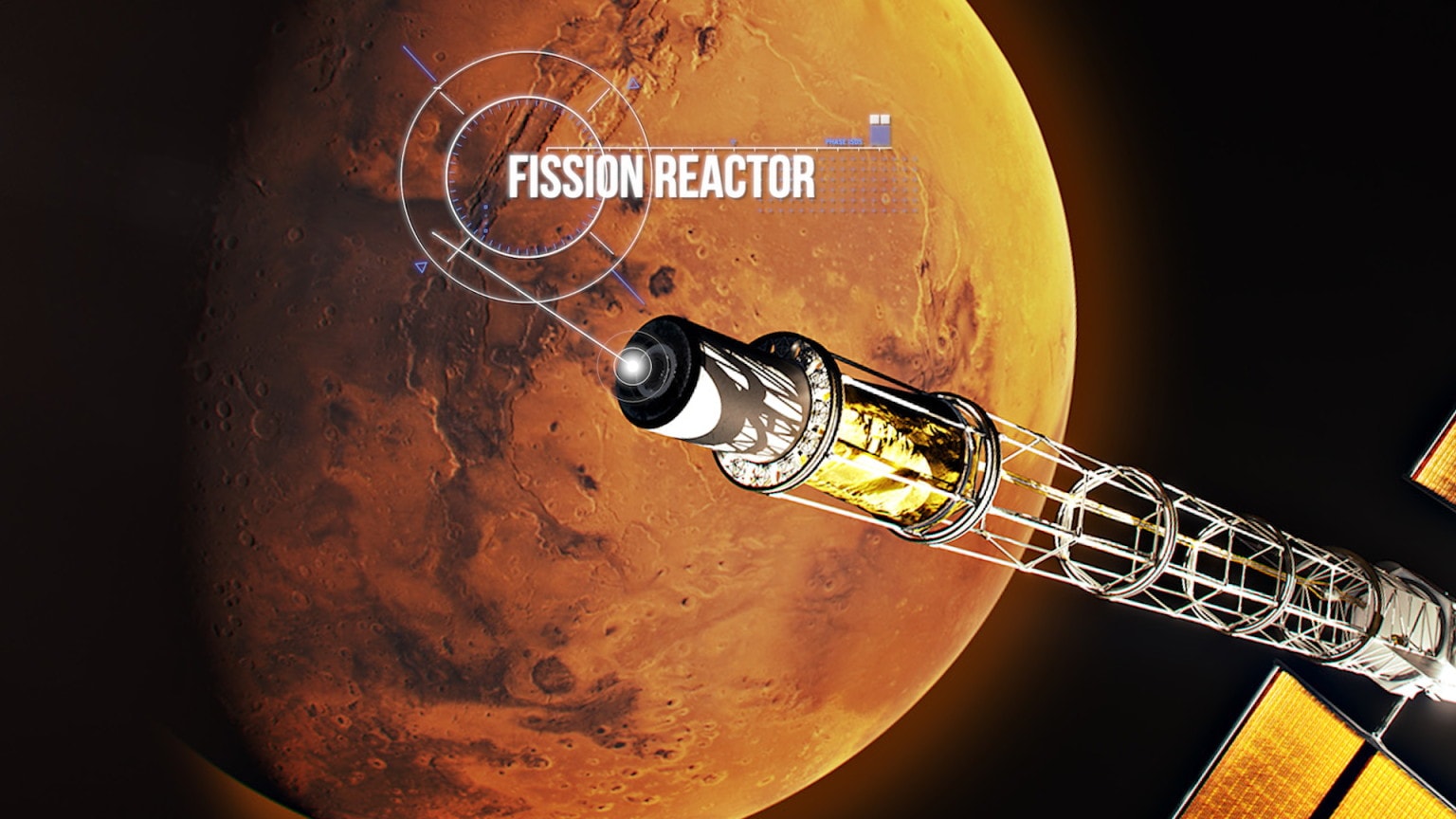
In the spring of this year, American space agency NASA held an event that would go down in history as Ignition. It was the moment when the world learned of a change in plans for the Artemis Moon exploration program, of the scrapping of the Gateway Moon space station, and of plans to launch our species’ first nuclear fission-powered interplanetary spacecraft.
It is this spacecraft that brings us here now, after NASA updated the world on the progress being made. Officially called the Space Reactor-1 (SR-1) Freedom, the piece of tech is now in a pretty advanced stage of planning, targeting launch as soon as 2028.
SR-1 is both the name of the reactor and the spacecraft that will be used to deliver to the surface of the Red Planet a trio of exploration helicopters collectively called SkyFall. Its main and key element, the nuclear power module, is what now comes under the spotlight.
Installed at the back of the spacecraft’s boom, the nuclear reactor, whose exact components and features are still kept under wraps, will be used to generate heat through nuclear fission. A conversion system is then used to convert the resulting heat into electricity, which will be to power the ship’s power systems and electric propulsion.
The conversion system in question is of the Brayton cycle variety, a thermodynamic arrangement that uses a gas as a working fluid to convert thermal energy into electrical power. This part of the ship is now being put together by a company called Sierra Lobo.

Photo: AeroVironment
This element will be integrated with the fission reactor itself, presently in the works over at the Department of Energy (DOE)’s Idaho National Laboratory. NASA says it is now working with the DOE to make the reactor as safe to operate as possible.
As humanity’s first fission-powered spacecraft to travel outside Earth’s orbit, Freedom will head for Mars, but its projected success is likely to change designs for future spacecraft heading elsewhere in the solar system as well.
Closer to our time, that would be the development of something called the Lunar Reactor-1 (LR-1), a surface power system that will be attached to the upcoming Moon Base to keep it going when the Moon goes through its long periods of darkness and cold.
That setup will be a tad more complex, and that’s why NASA decided it would fly the reactor first, without having to devise a lander that would be required to place the hardware on the surface of the Moon.

Photo: AeroVironment
As said, the nuclear fission reactor that’s now in the process of being built will deliver to Mars three exploration helicopters. Inspired by the tiny Ingenuity, a tiny helicopter-like drone that proved, for the first time, that powered, controlled flight on another planet is possible.
The helos are being developed by NASA with help from American company AeroVironment, which was also involved in the Ingenuity project, and they will be deployed on the Red Planet mid-air from inside an entry capsule.
Without having to rely on a lander to get them to the surface, each of the three helos will be equipped with quite a lot of instruments, including ground-penetrating radar, imagers, and cameras to snap photos of the surface of the planet below.
These tools will be deployed to measure air temperature, wind speed and direction, and data about subsurface features. The bits of info will then be used to map the terrain and characterize features of Mars that have never been studied before, including at different elevations.

Photo: AeroVironment
The goal of the SkyFall mission is to identify potential water sources, subsurface ice, and generate a meteorological data set.
NASA is presently in the process of identifying a suitable landing place for the helicopters, which, despite being deployed directly into the atmosphere, will have to land now and then. The agency says it is looking for flat, low-elevation areas that are free of geological obstacles, from where the three machines could technically operate for years on end.
The three machines are in a pretty advanced stage of development as well. The last time we heard anything about them was back in the summer of this year, when we were told a thing or two about the testing currently taking place.
As for the piece of tech that inspired the SkyFall mission, and, indirectly, Space Reactor-1 Freedom, the little Ingenuity drone that could flew for a total of 10.5 miles (17.0 km) over the course of 72 flights, covering a distance of 10.5 miles (17.0 km) and spending a combined two hours in the thin Martian air.
We are not told, at least for now, anything about the capabilities of the nuclear tech that forms the backbone of the Space Reactor-1 Freedom spacecraft. That means, among other things, that we don’t know how fast it will go, and how much time it will spend en route to the Red Planet, a distance that’s presently covered in about nine months.
Editor’s note: Gallery shows images of the SkyFall mission.