
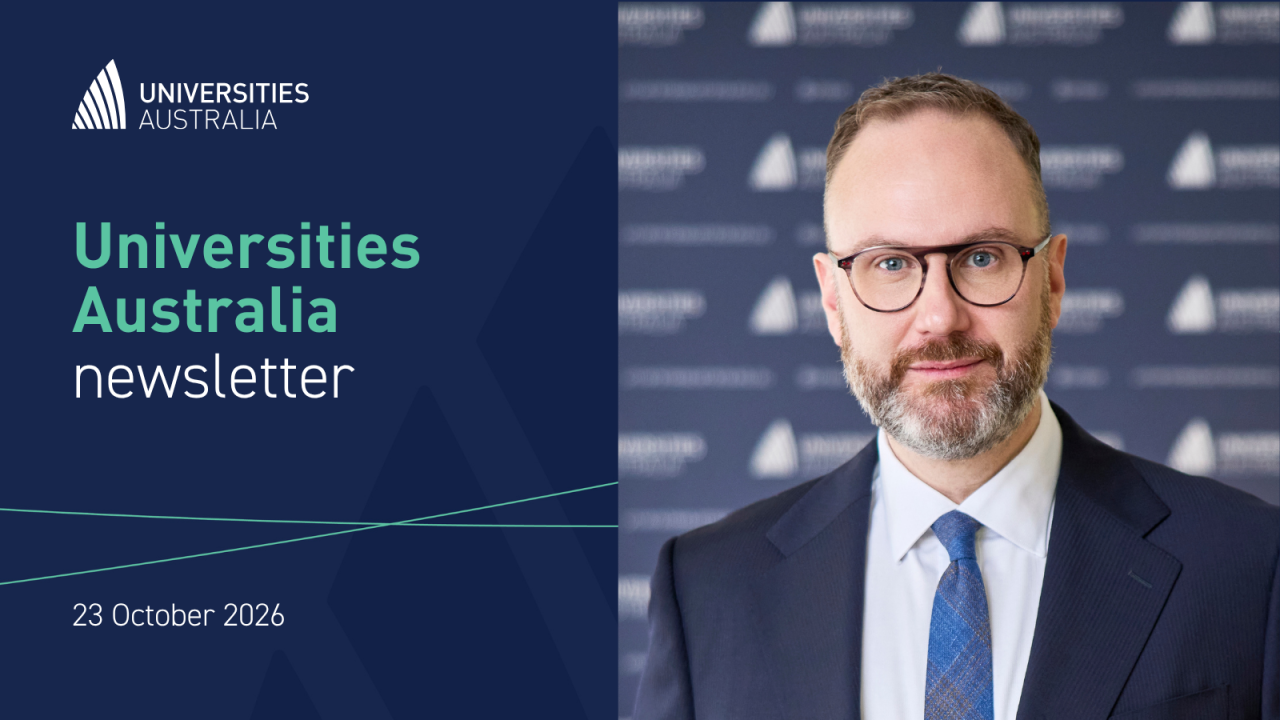
From our Chief Executive Officer
It’s always good to have fresh evidence of what our universities deliver for Australia. And this week, the latest graduate outcomes data gave us plenty to talk about. University graduates are finding work, earning more as their careers progress and putting their skills to use across the economy. Three years after finishing university, more than nine in 10 graduates are in full-time employment, with their earnings growing substantially over that period.
Those are impressive results. They reinforce the value of a university education as an investment in an individual’s future. But Australia benefits, too. Our universities produce the teachers in our classrooms, nurses in our hospitals, engineers delivering major projects and skilled professionals supporting communities right across the country. All of them are reminders of the contribution our institutions make to the country. We took that message into the public debate this week, making the case that universities are delivering the skilled graduates Australia needs.
The results are particularly significant alongside
Jobs and Skills Australia
’s latest findings of persistent shortages in professions that rely on university qualifications. Of course, the transition from university into work is not seamless for every graduate, and we shouldn’t pretend otherwise. Entry-level opportunities, changing employer expectations and the experience of graduates entering the workforce all deserve serious attention. The Senate inquiry into Australian university graduates, due to report on 20 November, is an important opportunity to examine those issues. But the national conversation needs to start with the evidence. Our universities are producing highly skilled people who find work, build careers and make a difference.
The timing is also important. Just last week, Parliament passed the Universities Accord (Opening the Doors of Opportunity) Bill 2026, strengthened through sustained UA advocacy. We now have a stronger framework for expanding access to university. The next challenge is making sure the funding follows. The Government, through its attainment targets, can’t keep asking universities to educate more people, address skills shortages and support national productivity without providing the sustainable investment needed to deliver. The latest results show what universities are achieving. Imagine what we could do with the funding certainty and capacity to grow.
We also had an important conversation this week about the responsibilities universities carry beyond teaching and research. On Tuesday, I sat down with Australia’s Special Envoy to Combat Islamophobia, Mr Aftab Malik, for our latest Solutions Series: In Conversation event. It was a thoughtful and timely discussion about Islamophobia, social cohesion and the role universities play in creating safe, respectful and inclusive communities.
Aftab made an important point about the Government’s proposed changes to the Higher Education Threshold Standards. He questioned whether universities could realistically meet the 1 January deadline for adopting definitions of Islamophobia, antisemitism and First Nations racism, particularly given the need for meaningful consultation with affected communities. His concerns echo those we’ve been raising with government about compressed consultation and implementation timeframes. Universities are committed to tackling racism in all its forms, but getting this right requires time to engage properly, develop workable approaches and ensure the changes lead to meaningful action.
Aftab also reminded us that definitions must be practical tools, not ends in themselves. The real test is whether students and staff are safe, supported and confident that their concerns will be heard and addressed. I’m grateful to Aftab for joining us and for his constructive engagement with our sector. Stay tuned for details about our next In Conversation session!
Looking ahead, Parliament returns next week, with the House of Representatives sitting and the Senate turning its attention to estimates. The education portfolio is scheduled for Thursday, but we’ll be watching proceedings across the week. Universities have a stake in decisions well beyond education – from migration and skills to research, industry, health and the economy. We’ll keep members briefed on the developments that matter.
I’ll also be attending the Australian International Education Conference next week, at an important time for our sector. International education remains one of Australia’s great success stories, but the policy settings governing it are creating real uncertainty for universities, students and our international partners. Getting those settings right is critical to maintaining Australia’s reputation as a welcoming, high-quality study destination and protecting the enormous economic, social and diplomatic benefits international education delivers. We’ll continue making that case to government and advocating for a more stable, sustainable and predictable approach.
I’m also looking forward to seeing Vice-Chancellors in Brisbane next week for our last Plenary of 2026. It will be an important opportunity to take stock of the policy environment, discuss our priorities for 2027 and build on the work underway to strengthen our collective voice. And when we next come together for Plenary in 2027, we’ll be joined by Chancellors for the first time under UA’s new governance arrangements – an exciting next step for our organisation and the sector.
An important part of those arrangements is our new University Governance Committee, chaired by Chancellor Deputy Chair
John Hood
. The Committee will bring Chancellor and Vice-Chancellor perspectives together, with Chancellors forming a majority of its membership. John is seeking nominations, and I encourage those interested in contributing to put themselves forward. We’re aiming to convene the Committee before the end of the year to agree its priorities and shape its work ahead.
On a final note, registrations are now open for UA’s 2027 Solutions Summit, to be held in Canberra on 23-24 February. This event is always a fantastic opportunity to reconnect with colleagues, build relationships across government and industry, exchange ideas and help set the national agenda for higher education. I’m looking forward to bringing everyone together again for two days of important conversations about Australia’s future and the role our universities play in shaping it. I hope to see many of you there.
I’ll leave it there for today. I hope you all have a wonderful and relaxing weekend.
Luke Sheehy