
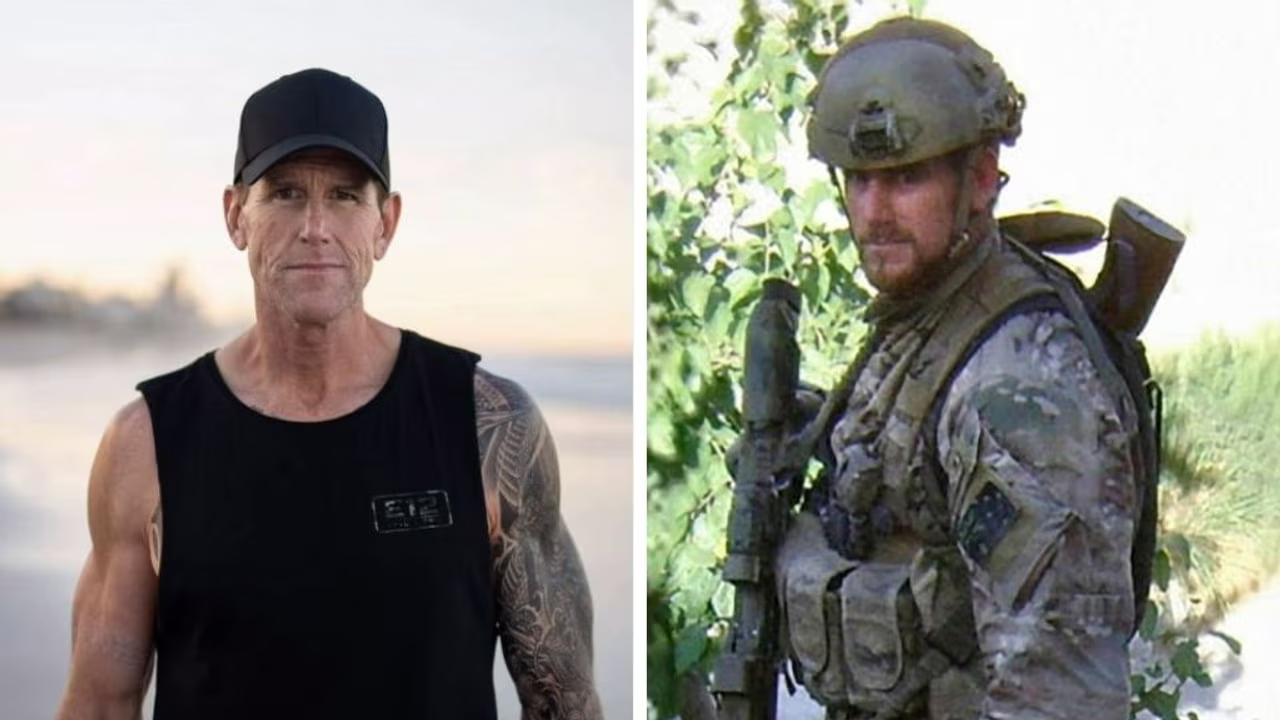
Standing two metres tall, Ben Roberts-Smith remains an unmistakable, imposing figure.
But the thick, heavy mass that once defined Australia’s most famous modern soldier on the battlefields of Afghanistan has quietly transformed under the weight of a decade-long legal war.
Looking at him today, the shift is noticeable – it is as though the years of unrelenting pressure have slowly drawn the bulk out of his frame, leaving him leaner, aged, and stripped of his former combat weight.
Be the first to know when news breaks. Download our new app
Yet far from appearing worn down, his frame carries the tight, vascular definition of a man surviving on raw physical discipline.
For the 47-year-old Victoria Cross recipient, daily cardio and pool laps are no longer about military readiness, but a vital psychological valve to withstand a legal storm that pushed him to the brink.
Following a joint investigation by the Australian Federal Police and the Office of the Special Investigator, the Commonwealth Director of Public Prosecutions charged Roberts-Smith with five counts of war crimes murder.
The criminal charges allege that during SAS deployments in Afghanistan between 2009 and 2012, he killed or ordered the execution of five unarmed Afghan detainees.
While restricted from commenting on individual allegations until he faces court, Roberts-Smith maintains that every engagement was legitimate, involved members of the Taliban or their associates, and that no civilians were killed.
Roberts Smith’s current approach to training is a stark contrast to his peak SAS days.
Back then, surviving brutal Special Forces selection and high-intensity deployments required soldiers to be strong, fit, muscular, and fast.
Downtime at camp was spent grinding through heavy military training regimes and doing Brazilian Jiu-Jitsu with his comrades to stay fight-ready.
“I don’t do any heavy weight training anymore,” Roberts-Smith says of his routine under strict bail conditions.
“It’s mostly swimming and high-volume training now … you just maintain a routine, focus on getting through, and use the workouts to clear your head.”
Years of legal battles, electronic surveillance, and the prospect of life behind bars on five murder charges stemming from his deployments in Afghanistan have carved a visible line through his physique.
After a decade of watching media outlets, authors and documentary filmmakers profit off his name while corporate employment doors slammed shut, Australia’s most decorated living soldier has launched a commercial fightback.
Now, as the media fallout reverberates nationwide, commentators, newsrooms, and legal experts are chiming in from every angle following his first sit-down interview in years, given to news.com.au.
Adding to the firestorm, his partner Sarah Matulin sat down for an interview with Roberts-Smith for the first time ever, speaking exclusively to news.com.au about a relationship forged entirely in the centre of a storm.
His decision to step out of the shadows – and take back ownership of his military radio call sign to launch his new commercial brand, EPIC 1 TWO – has triggered an intense wave of reaction across the media landscape.
For Roberts-Smith, taking back control of his identity and call sign isn’t just about shaping the public narrative – it is a matter of financial survival as he faces a five to seven-year wait on bail before stepping inside a criminal courtroom.
“Part of my reason for starting the brand is I’ve spent a decade trying not to do the media, and then finding the millions of dollars they’ve made off my name,” Roberts-Smith explained.
“At the end of the day, there is too much pressure from media outlets on organisations that want to support me … I’ve gotta try and find some way to make money for my family.”
Behind the national media debate sits a domestic anchor few ever see: his life in Brisbane with Matulin.
When the psychological toll initially pushed Roberts-Smith to “absolute rock bottom” – planning his death to spare his family from the fallout and the presumption of guilt – he attempted to end his relationship with Matulin to protect her.
She flatly refused to go.
“Unless you’re out of love with me, there’s no reason to break up,” Matulin told him. “If it’s just because life isn’t the way that you saw it was going to be, that’s not a good enough excuse.”
Matulin, who stands in immediate physical contrast to the giant at her side, revealed to news.com.au that she never experienced the national spotlight or high-society events that once surrounded the decorated soldier, having met him after civil defamation proceedings were already underway.
“She actually didn’t even know who I was when we met, which I loved,” Roberts-Smith recalled.
While commentators across the country debate his motives and media strategy, Matulin sees a very different man behind closed doors – laughing with his twin teenage daughters and relying on quiet domestic calm to navigate the noise.
“He puts on a strong facade and a lot of people don’t get to see that side, but I do,” Matulin said. “I really love that he’s just a goofy guy.”
From surviving nine nights in Silverwater prison, where he was doing push-ups on the floor of a suicide cell within hours, to building a new commercial path, Roberts-Smith insists he will not be forced into hiding by public scrutiny or media commentary.
“I get up every day because I haven’t done the wrong thing,” Roberts-Smith said. “I go to bed knowing that I gave everything I had to that job. I wouldn’t change a thing.”