
Welcome back to the Friday mailbag. I’m still working on the backlog of questions, where we got over 50 submitted via email.
(If you have one to submit, you can email me at contact@bravestoday.com – premium subscribers should have an email in their inbox from me, soliciting their questions.)
Paid subscribers get first priority, but I’ll pull questions from email and social media too.
Let’s talk about it.
I think the consensus amongst most Braves fans is that the offensive struggles aren’t completely Tim Hyers’ fault, however most would still like to see a move made to get a different hitting coach who would bring a new voice and fresh perspective. Can the same logic be applied to the training staff? I don’t think anyone would necessarily blame them for the rash of injuries the team has suffered over the past few seasons, but would a fresh approach to conditioning and injury prevention be the right move?
Dave
(emphasis added)
I get Dave’s idea here, and it’s hard to argue with it. George Poulis joined the Braves as Head Athletic Trainer in December of 2017, coming off a 15-season run as head athletic trainer of the Toronto Blue Jays. He’s incredibly qualified, having a master’s degree in sports medicine from the University of Alabama, and just completed his 37th season in professional baseball. His assistants are all immensely qualified as well, with Assistant Athletic Trainers Jeff Stevenson having worked in professional baseball since 1992 and Nick Flynn since 2007. Poulis’ eight-person staff was named MLB Athletic Training Staff of the Year in 2021.
But something has to change, right?
I reached out to Rotowire to discuss Atlanta’s injury issues with their team, and for 2026, it wasn’t actually that bad compared to the other teams in the league, coming in at 12th out of 30 teams in Rotowire’s proprietary “Severity Score” at 66 points.
And when you look at the aggregate numbers for the league, they might be right. There were 523 players on the injured list this season, an average of 17 per team. The Braves had…fifteen go on the injured list during the season, with ten opening the season on the IL due to either offseason or prior season injuries. Atlanta saw 6 MLB players hit the 60-day IL and lost a combined 1,609 days of the season to injuries, representing 1,386 games.
But it certainly doesn’t feel like we’ve been average when it comes to health, and I think that’s due to a concentration of injuries in the rotation. The Braves had five pitchers go down with elbow issues this calendar year: Spencer Schwellenbach (bone spurs), Hurston Waldrep (bone spurs, then Tommy John), Robert Suarez (elbow inflammation), Spencer Strider (elbow inflammation), and Tyler Kinley (elbow inflammation).
Guess what the most common injured list placement was this year? An elbow injury, naturally. Subtracting the two pitchers who started the season on the IL as they recovered from their elbow surgeries, AJ Smith-Shawver and Danny Young, Atlanta’s five elbow injuries don’t look wildly out of line with a league that recorded 134 elbow-related IL placements.
I do also think it’s important to point out that the Braves are not out of the norm in baseball when it comes to UCL injuries. Since the start of 2024, 201 professionals have needed Tommy John, per an industry database that Braves Today has access to.
Going back to 2024, Atlanta’s had Strider, Smith-Shawver, Waldrep, and Ray Kerr go down from the MLB level, as well as prospects Owen Murphy, Raudy Reyes, and position player David McCabe. (JR Ritchie’s UCL repair was in early 2023.)
That’s an average of 6.7 per team, and Atlanta had seven.
Again, I think Dave drew a great parallel to the hitting coach situation here: a change could be made here, and a new voice might end up doing something different that ends up working for a while, but I don’t think this is entirely on the training staff.
Would the Braves benefit from the proposed salary cap? Looks to knock our payroll down a touch and would force Miami to spend and retain, but would more severely limit Dodgers / Mets.
Does it lead to NFL level parity if enacted where teams regularly go worst to first and vice versa?
Collins
I honestly think it’s a bit of a wash. The Braves typically don’t play in that upper realm of free agency, and those players are theoretically the most hurt by a salary cap preventing the same teams from accumulating the highly-paid stars.
But at the same time, Atlanta runs a pretty high payroll already – 2026 was technically their highest-ever payroll at $263M, per Cot’s Contracts – and so it’s not like they’ll automatically have a ton of salary cap room to grab those players that are not signing with LA or Philly or one of the New York teams if a cap is in place.
The difference to me is something that both Collins and my last sentence hinted at – who is hit the hardest by a cap. Two of the league’s perennial top spenders, the Phillies and the Mets, are in the same division as Atlanta, and the Dodgers are the team that just knocked Atlanta out of the postseason. Those teams being constrained in their spending is a benefit to the Braves, all things being equal.
I don’t know if it leads to NFL-style parity, though, because I’m not convinced that the NFL is the paragon of championship parity. Going back to 2000, MLB actually has the most unique champions with 16, and it’ll be a 17th team this year as neither the Brewers or Rays have ever won a World Series. In those 26 years, only the Dodgers (3), Red Sox (4), Giants (3), Cardinals (2), Astros (2) and Yankees (2) have won multiple titles.
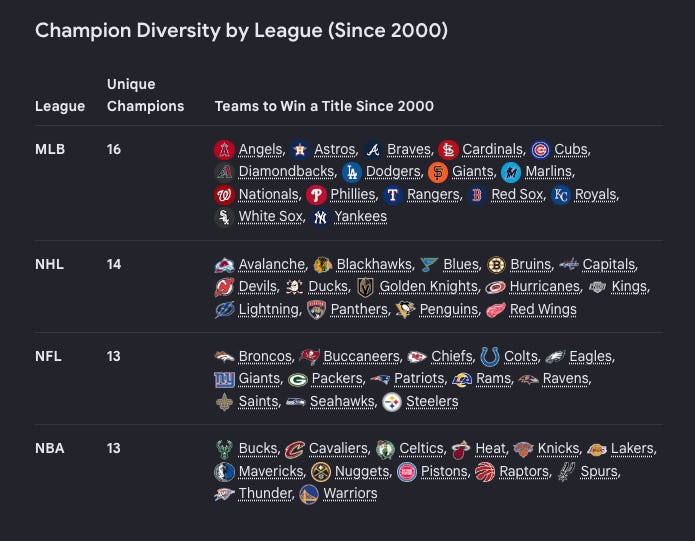
But the NFL’s had only 13 different champions in that same span, with eight teams winning multiple, led by New England’s six. The NBA’s 13 different winners feature five multi-title teams, while the NHL’s 14 champions feature nine multi-title teams.
Since the Yankees completed their three-peat in 2000, only the 2024-25 Dodgers have successfully repeated as World Series champions. The NFL had two back-to-back winners, the NBA had three (including the Lakers winning three consecutive), and the NHL had three.
I’m not arguing that championships are the best way to define parity, or that the league doesn’t have competitive balance problems, because it does. Per MLB’s Anthony Castrovince, going back to 1995 shows us that 62.9% of World Series participants had a top ten payroll, and 89% had a top fifteen payroll.
(Important to note that this is from October 14th, before this World Series was set, so those numbers are slightly lower at the moment.)
And I do think the final part of the question, going worst-to-first, will still be rare simply because it’s harder to turn over a 26-player roster and bring in more talented guys given the very nature of baseball – multiple years in the minors before debuting, the length of the season, and how hard it is for even one MVP-level player to carry a team to the postseason.
Could you discuss the low attendance of the Rome Emperors and Gwinnett Stripers? How are they making it?
David
If it helps, I’ve heard rumors (that I haven’t been able to confirm) that the Rome Emperors are potentially going to be moved sometime soon, so that might change things.
But David’s right, both teams struggled to draw this season. Gwinnett’s attendance this year was 171,365, an average of 2,414 across their 71 games. That’s down nearly 280 fans per game from last season. Rome drew 69,795 across their 63 games, an average of 1,108 and about 47 fans per game less than last year.
(The real scary point of Atlanta’s system was Columbus, which saw its attendance drop by 505 fans per game, although some of that can be attributed to last season being the inaugural year and the fan curiosity that comes with that.)
But I’ll also point out a few things here.
The first is that attendance for almost everyone was down – just 36 of the 120 minor league teams reported higher attendance this season, and total attendance across the minors was less than 30 million. It’s the third consecutive season that minor league attendance has dropped, since a high-water mark of 32.148M in 2023. The average team lost 53 fans per game, so Rome was actually better than average in this area.
The second thing is that minor league teams have pivoted away from the old strategy of maxing out the ballpark to make money and have instead instituted new ways to drive revenue – dynamic pricing, premium dining options, club and luxury seating, and more package promotions.
So while they weren’t getting more fans in the door, we don’t know if they were making more money or not. And as all four teams are owned by Diamond Baseball Holdings, who now own 48 of the 120 full-season affiliates, they’re able to harness economies of scale and integrated marketing arrangements to make money more efficiently.
(A representative of Diamond Baseball Holdings declined comment.)
So attendance was down, yes, but we don’t know if revenue was.
If Atlanta needed an outfielder, which prospect — regardless of current position — has the best chance to become the Braves’ next big star in 2027?
Tommy
I think it depends on the definition of “star”.
If we are looking for someone who could conceivably make a Rookie of the Year run if they get up soon enough, there are a few options – Patrick Clohisy spent over a month in Gwinnett and has the type of game-breaking speed (and requisite aggressiveness when it comes to using it) that a best-case scenario is a Chandler Simpson-esque “speed and defense” season.
But if you want pure “star”, a “contend for MVP”-level performance, the only real answer is Eric Hartman. He’s Atlanta’s #1 overall prospect for a reason, as he has a combo of speed and power that could lead him to a 40/40 season if he hit his 99th-percentile outcome.
That being said, he also struggled with the transition to Double-A, hitting .182/.312/.265 in his 34 games at the level. From folks I spoke with, he’s still needing work on secondary pitches and can seemingly get stuck in a pull-happy approach, leaving him vulnerable to pitches on the outer third. High ceiling, absolutely, but enough to work on that it’s hard to see where he would be up early enough in 2027 to have that sort of impact.
Why are batting averages so much lower now than they seemed to be in the 1980s?
Yonnie
Yonnie sent in 16 questions, and I’m going to get to all of them, promise.
But this one comes back to pitching, and how much better it is than the 1980s. That manifests in a few different ways – the pure “stuff” for starters being better, on average, than it was in the 1980s, in both movement and velocity. But also how good the bullpens are now, and because of it, starters are taught to go max effort for shorter outings than in the 1980s, where pitchers were routinely pitching more often and much deeper in games.
The 1980 Braves used just eleven pitchers all season, with Phil Niekro leading baseball with 38 starts and covering 275 innings. They needed just six starters, with Preston Hanna’s two spot starts (in 32 appearances) being the only instance where someone started fewer than 26 games.
But Atlanta also had only two pitchers with more than 100 strikeouts in 1980, with Niekro logging 176 (in 275 innings) and Doyle Alexander with 114 (in 231.2 innings). The 2026 Braves had four starters over 100 strikeouts, with Chris Sale putting up 200 in his 162.2 innings. Reliever Didier Fuentes threw 73.1 innings and struck out 92, as well, so they were close to having five.
More velocity, more movement and fewer plate appearances against a tiring starter all mean fewer hittable pitches and, consequently, fewer hits.
It’s just a different game, for better and for worse. The athletes are much better in this generation, but the game itself has regressed into a three-true-outcomes fest. That’s why I’m so excited for this World Series.
Is it time for Michael Harris II to lead off in 2027?
Emmanuel
Emmanuel’s one of our very first premium subscribers, and had a birthday just this week. Happy birthday, pal.
I could buy it, although he’s not the best fit, given his seemingly allergic reaction to drawing a walk. He still makes enough contact to fill the role, putting up a .321 on-base percentage that ended up being third on the team among qualifiers this season, but on this roster? That’s like being the prettiest pig in the pigpen.
I do think that we’ve seen Walt Weiss not be married to the insistence that Ronald Acuña Jr. needs to lead off and, barring either a big righty bat being added in free agency or Austin Riley figuring it back out, using Harris at leadoff and Acuña behind him might be needed to prevent a three-lefty streak of Harris, Drake Baldwin, and Matt Olson in some order. I’d be for it.
Why did the knuckleballer disappear? Wouldn’t a durable 200-inning, 4.00-ERA knuckleballer still have enormous value?
Yonnie
Because throwing a knuckleball is hard. There are always a few hanging around the league, and we were lucky enough to see one in Truist Park this year when Matt Waldron of the Padres covered two innings in late July.
But yeah, it’s an exceptionally hard pitch to feature, for a few reasons. The first is the lack of qualified teachers of it – Tim Wakefield passed in 2023, Niekro in 2020, and Charlie Hough – another of the modern knuckleball’s great practitioners – retired from coaching back in 2010. With how much of modern pitching is focused on power and generating spin, there’s just not many people who can pass along the secrets of the knuckler. (And honestly, not enough scouts who can project a pitcher’s ability to harness a knuckler, either.)
That also means there aren’t enough catchers who have both the oversized mitt (think Doug Mirabelli, Wakefield’s personal catcher) and the ability to consistently block the unpredictable pitch. We haven’t seen a full-time knuckler since MLB instituted rule changes to juice the running game, either, but the frequent passed balls and slow time to the plate would be a nightmare for modern defenses.
And the last thing is that the risk/reward with it is so extreme. When a knuckleballer’s on, they’re practically unhittable. But if they’re not, either because of altitude, cold weather, or an off day by the pitcher, the knuckler becomes a batting-practice fastball and gets destroyed.
There just aren’t enough modern front offices and organizations with the patience, confidence, knowledge, and job security to lean into it.
Which title is the true top dog? The World Heavyweight Championship or the Undisputed WWE Championship. #TeamRoman or #TeamZayn
Taylor
Historically, the Undisputed WWE Championship is the direct descendant of the inaugural WWWF title from 1963, but for me, the World Heavyweight Championship feels like the one that matters. Maybe some of that is recency bias, with Roman Reigns holding the World Heavyweight and Sami Zayn holding the Undisputed, and I say that as someone who hates that a part-timer held the strap when they could have easily dropped it on LA Knight. Roman would still have had time to get it back before facing Oba Femi at (I’m guessing) Wrestlemania, maybe chasing Knight and winning it at the Royal Rumble or something.
This feels like me betraying a fellow ginger in Zayn, though.
Guess we’ll find out which one’s better at Crown Jewel, as Reigns/Zayn is now official.
(For those of you that scoff at wrestling, it’s becoming a surprising way for me to spend time with my 11-year-old daughter, even if she only cares about women’s matches and luchador matches. We’re big Tiffany Stratton fans over here because of it, although this upcoming heel turn’s gonna break her heart, I just know it.)
We know you’re a fan of the Braves, what other sports do you follow (that isn’t Auburn in College Baseball lol) and who are your favorite teams there and why?
L33ry
The Atlanta Falcons, I guess, but I don’t watch any of their games until after the Braves are eliminated. I’m still dead inside from 28-3, honestly.
I used to watch a lot more NFL and college football than I do, but it’s mostly just my teams in those two sports and that’s about it, outside of the biggest games of the year.
But I watch a lot of baseball – I typically tune in to a lot of winter ball, partly to catch some of our players but mostly because I just like baseball. I’ll check out LIDOM (Dominican Winter League) fairly often, as they typically stream a game or two a night – SS John Gil is one of two notable MLB prospects playing for Leones del Escogido, while Aiven Cabral was drafted by Estrellas Orientales but has not yet reported and may not play this winter.
Also, shout out to Puerto Rican bureau chief Emmanuel for noticing that Joe Jiménez is playing winter ball in Puerto Rico this year.
What is it that made you fall in love with baseball? Was it a moment you saw as a kid or maybe a particular player?
Double A
Dale Murphy, 100%. I wore #3 growing up because of him, and the only signed jersey I have is a framed Murphy (baby blue, of course).
I keep hinting to my wife to send me to the Dale Murphy Experience one weekend, but she never remembers it before they sell out for the season. ¯\_(ツ)_/¯