
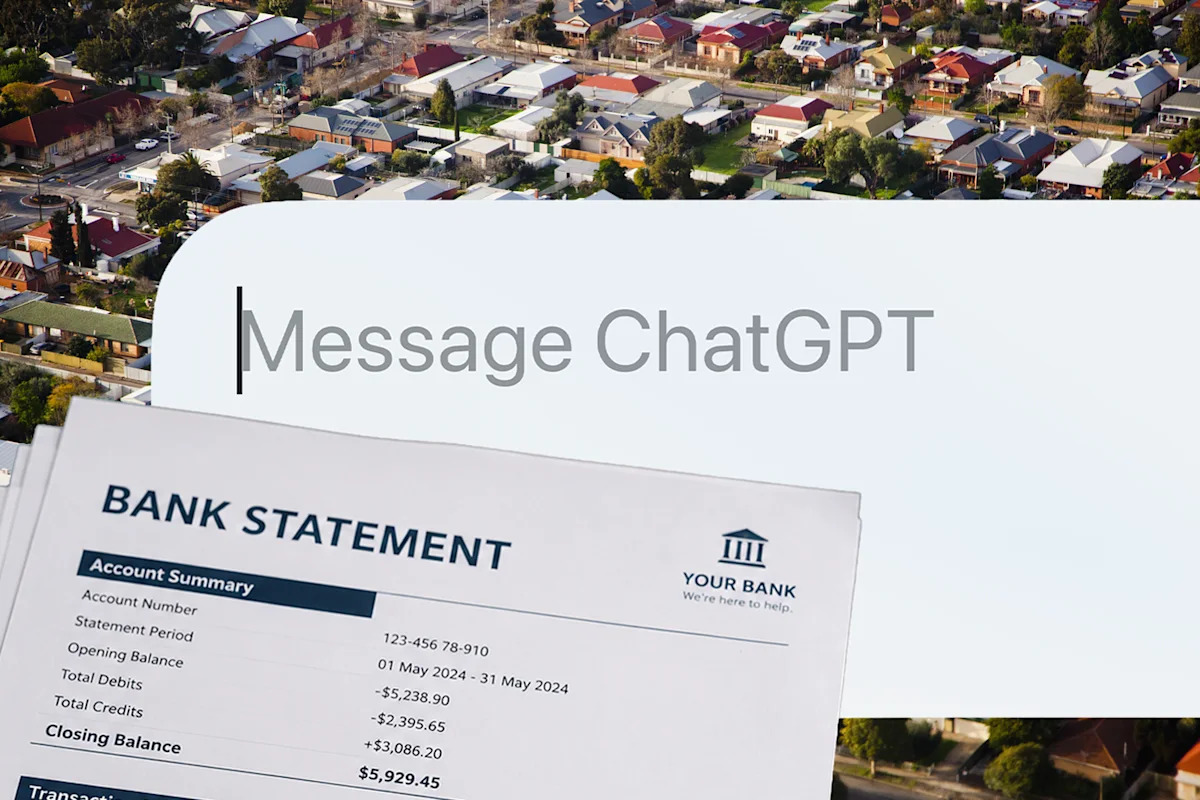
Artificial intelligence has found a way into our everyday lives, and for some, it’s turned into a tool to commit financial fraud – although they may not realise it. Aussies are being warned about the increasing use of AI to provide fraudulent documents when applying for a home loan.
Nearly one in five Australians (18 per cent) have admitted to using AI to create or alter the necessary documents they supply to lenders, to increase their chances of being approved. Research from brokerage comparison site OurTop10 found that figure jumps significantly for Gen Zs, with 56 per cent saying they have tampered with their bank statements when applying with a bank.
“Applicants of credit seem to treat their application in the same way they view a resumé, so they think they can embellish,” Head of Research Mansour Soltani told Yahoo Finance.
“But it’s financial fraud.”
RELATED
When undergoing the research, Soltani himself admitted he believed it would be a “waste of time”.
“I kept thinking… who would admit to committing financial fraud?,” he asked himself.
As it turns out, many actually did.
While 56 per cent of Gen Z admitted to doing it, 36 per cent of Millennials also did.
Commonly, AI had been used to tamper with bank statements (10 per cent), employee documents (9 per cent), payslips or proof of income (6 per cent) and competing lender’s offers (3 per cent).
“They think they can get away with it,” Soltani said, “and that the bank won’t be any wiser.”
“But what they don’t realise is that banks are using technology to look for any changes in the text, and pick these things up.”
When a bank can see AI has been used, or a document has been tampered with in any way, they then simply decline the application.
MORE: Push for major banking and ATO change to combat billions in fraudulent mortgage loans
 Some AI tools are even promoting the use of their software to alter bank statements. · ImageGPT Fraud goes unreported
When lenders decline the application due to AI forgery, they usually don’t take it any further by reporting it as fraud, Soltani explained.
“It’s become a bit of an industry secret,” he said.
“A lot of lenders don’t want to make it public that this fraud is systemic, but with the lenders we’re talking to, they have said it’s very widespread.
“It’s a real problem.”
Soltani pointed to a specific example of an unnamed lender he had spoken to.
“They were explaining that with their wholesale funding, so where they get their money from, they would have to declare that their fraud has increased to the lender,” Soltani said.
Doing so could limit the amount of funding they then receive.
 The findings in the research even came as a surprise to Soltani himself. · Supplied
Since it is illegal to forge these documents, an act of financial fraud, Soltani said a way for the industry to crack down on its occurrence would be to actually report it. Each of those files could go to the police, he argued.
“But we’re not seeing cases of fraud being taken any further than a decline.”
Banks dealing with surge in dodgy documents
In March this year, the Commonwealth Bank of Australia (CBA) alerted authorities that approximately $1 billion had been lent out for illegitimate home loans – including those that were doctored using AI.
CBA reported itself to the police and the corporate watchdog after two whistleblowers in 2025 had lodged complaints, according to the Australian Financial Review.
The complaints had accused a mortgage broker and a lender in CBA’s private banking division of forging income statements.
 A man walks past a branch of the Commonwealth Bank of Australia (CBA) in Melbourne on February 11, 2026, after the bank posted a cash net profit after tax of 5.4 billion Australian dollars (3.85 billion US) for the first half of the 2025-26 financial year, up 6% compared to the same period last year. (Photo by William WEST / AFP via Getty Images) · WILLIAM WEST via Getty Images
Speaking with Information Age, founder of information security company Dvuln Jamieson O’Reilly, said CBA’s case likely marked “the first at this scale where AI-generated documentation appears to have been a primary mechanism”.
While 15 years ago it would have been “science fiction”, the AI tools being used to generate fake documents today have “changed beyond recognition”, O’Reilly said.
“But the playbook – and reliance on someone inside with just enough knowledge and just enough deniability – I don’t think that part has changed at all.
“Technology doesn’t defeat institutional trust, it just makes exploiting it faster and harder to trace.”
Get the latest Yahoo Finance news – follow us on Facebook, LinkedIn and Instagram.