
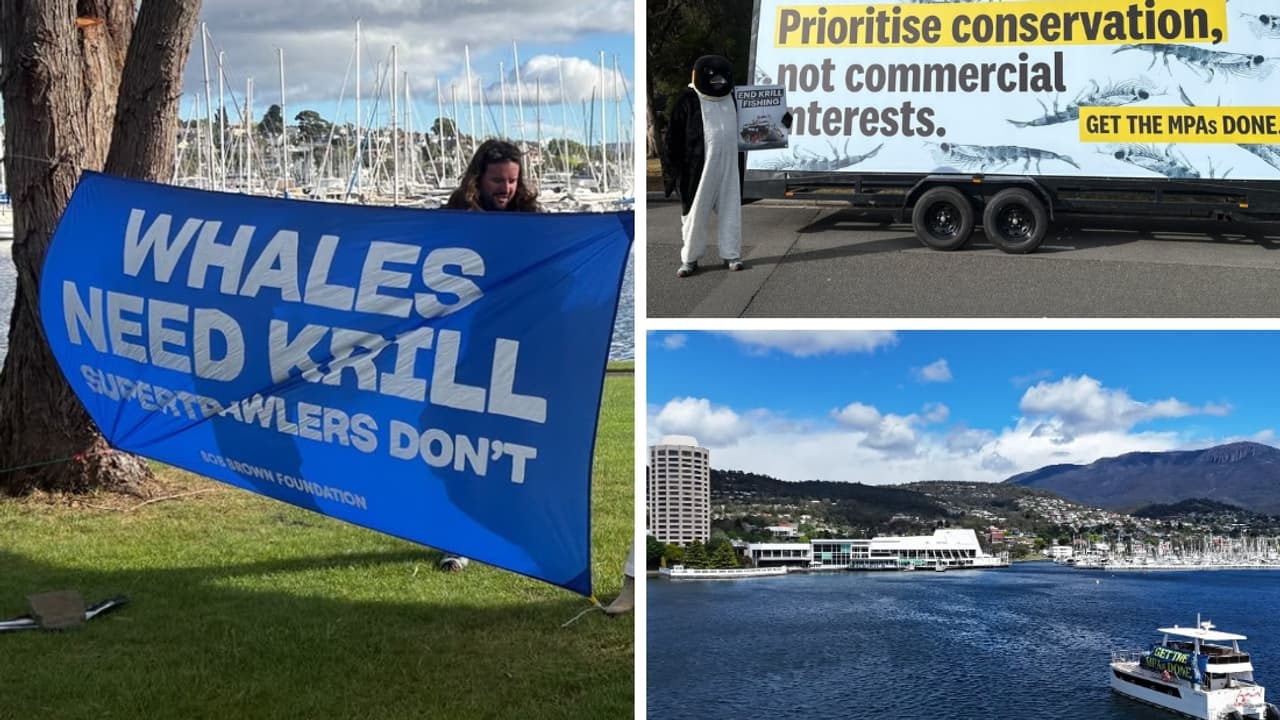
The “Antarctic Avengers” have descended on Hobart to do battle with their arch-nemesis: Norway, the world’s leading harvester of krill.
The unlikely setting for the high-stakes stoush is Wrest Point Hotel and Casino, where the 45th annual conference of the Commission for the Conservation of Antarctic Marine Living Resources (CCAMLR) is taking place from October 19-30.
Our Antarctica, an international campaign uniting some of the globe’s foremost scientists and ocean experts – dubbed the Antarctic Avengers – co-ordinated a protest at the riverside Sandy Bay venue on Monday.
Activists from the Bob Brown Foundation were also present, waving banners emblazoned with slogans, including ‘Whales need krill, supertrawlers don’t’, while a boat carrying a large billboard also cruised past the casino.
Antarctic krill, considered the most crucial component of the Southern Ocean’s food chain, are now under pressure on two fronts, facing the double threat of climate change and industrial fishing.
Norway is known as the major player in krill fishing, with campaigners noting it accounted for about 63 per cent of global Antarctic krill harvesting between 2013-23.
Dr Sylvia Earle, a marine biologist and founder of Mission Blue, warned that further reductions in the krill population would have catastrophic ecological consequences.
“Krill are not a commodity to be extracted at scale for aquaculture feed, consumer supplements and cosmetics,” she said. “They are the foundation of the Southern Ocean, and industry is treating them as expendable in pursuit of profit.”
Norwegian company Aker QRILL, the biggest krill harvester on the planet, claimed earlier this year that it wanted additional marine conservation measures implemented in Antarctica and was not interested in expanding its fishing activity.
A mobile billboard parked at the road into Wrest Point from Sandy Bay Rd read ‘This year, NORWAY! Prioritise conservation, not commercial interests. Get the MPAs done’.
MPA stands for marine protected area, an officially designated zone where certain activities by humans are restricted in order to preserve and protect marine life and habitats.
There are three current MPA proposals under consideration by CCAMLR, including the Antarctic Peninsula (Domain 1) MPA, which was first presented to the body’s scientific committee by Argentina and Chile in 2017 and is supported by Australia.
At this year’s conference, the CCAMLR will again consider the proposals, while also assessing the advice of its scientific committee regarding krill fishery management.
The CCAMLR is headquartered in Hobart.