
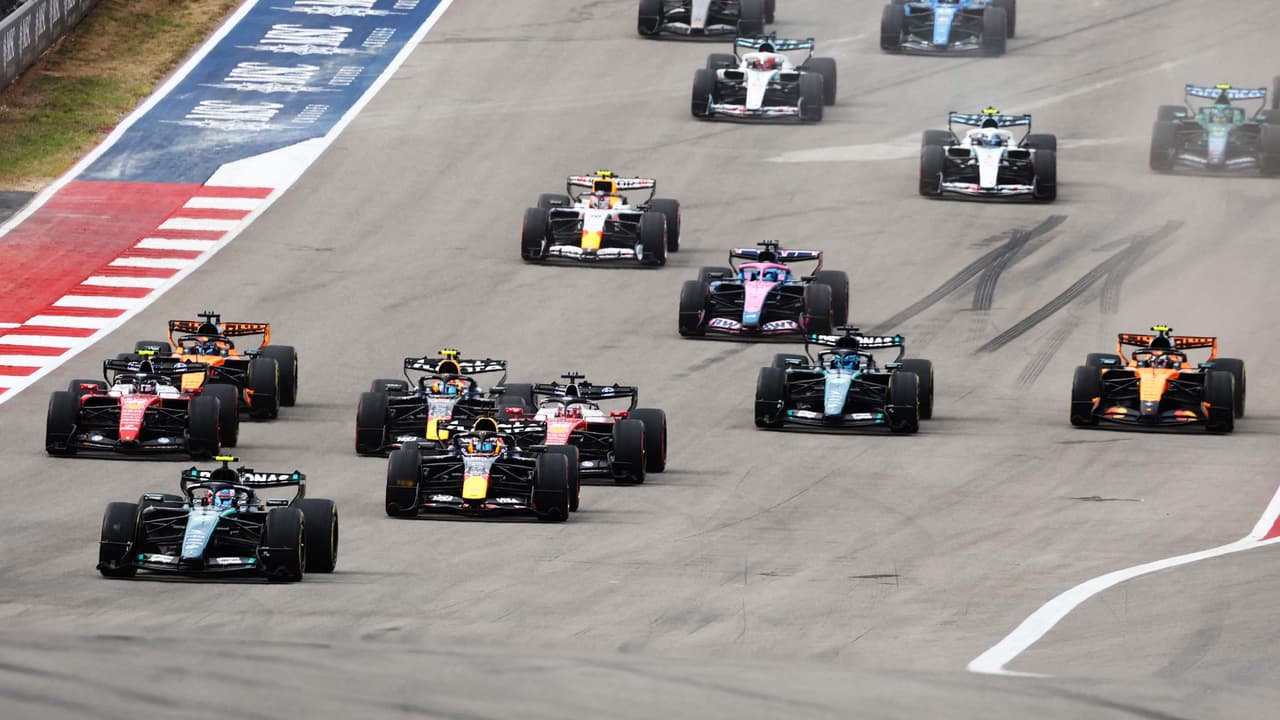
Formula 1 governing body the FIA has formally proposed a return to V8 engines in 2030 or 2031, but the new power plant will not be naturally aspirated as originally suggested.
According to the BBC, the proposal is for a V8 engine of up to 2.3 litres capacity with a turbocharger and a hybrid system.
The proposal document was written after consultation between the FIA and all six engine manufacturers individually and will now be debated collectively in a bid to reach agreement before the end of the year.
Fox Sports, available on Kayo Sports, is the only place to watch every practice, qualifying session and race in the 2026 FIA Formula One World Championship™ LIVE in 4K | Get Kayo now.
The current engine rules, brought into force this year, expire at the end of 2030, after which the FIA is free to dictate the regulations.
However, FIA president Mohammed Ben Sulayem would prefer to fast-track the rules to 2030, which would require agreement between all six manufacturers: Mercedes, Ferrari, Red Bull Powertrains, Honda, Audi and Cadillac, which has committed to using its own engines by the end of the decade.
The proposed new engine regulations target cheaper, simpler and lighter engines that will produce louder, more visceral noise.
Ben Sulayem had originally hinted that he would prefer a naturally aspirated engine, which would satisfy all four criteria.
A less complex engine would also address widespread criticism of the current 1.6-litre V6 turbo-hybrid power unit, which has been panned for relying too heavily on electrical energy.
PIT TALK PODCAST: Andrea Kimi Antonelli puts one hand and four fingers on the title trophy after dominating the United States Grand Prix. | Listen to Pit Talk here >
Nominally split 50-50 between electrical and combustion power, the new engine has fundamentally changed the challenge of Formula 1 by incentivising drivers to manage battery charge rather than seek the limit of grip, particularly at some of the sport’s best-known fast corners.
When the battery runs flat, the car falls back onto its combustion engine, which produces roughly half of the nominal 750kW, leaving cars badly underpowered.
However, naturally aspirated engines are rare in the real world, where they are often paired with at least one turbocharger. Hybrid engines are also increasingly common.
Though Ben Sulayem originally attempted to broker a compromise that would include one or the other but not both on weight and noise grounds, such a deal appears to have been beyond reach.
Audi made clear early and publicly that it would not accept an engine without a turbocharger, and Mercedes was similarly committed to having some sort of hybrid system.
Brock Feeney claims maiden win at GC | 02:51
Instead the compromise has been to the significance of both elements. The proposed turbocharger would be smaller and run with reduced boost pressure than the current one, and the significance of the hybrid motor would be greatly diminished.
Unlike today’s hybrid motor, which produces 350kW, the proposed engine would rely on the electronics for only 100kW of its roughly 670kW total. The previous hybrid engine, in use between 2014 and 2025, comprised around 120kW of electrical energy.
The proposed rules would also have a further 100kW available to drivers as a push-to-pass aid, similar to the current overtake mode.
The proposal aims to reduce engine weight by around 80kg as part of the sport’s push to cut the overall mass of the cars. Much of this gain will come from the requirement for a smaller turbo and much smaller battery, along with other dimensional constraints.
This year’s rules, which also brought big changes to aerodynamics, were the first in a generation to reduce the minimum weight, which peaked at 800kg last year but was cut back to 768kg this season.
The governing body is targeting a minimum weight below 700kg for the next set of regulations.
Though the final number would likely land above the 642kg minimum used during the previous V8 era that ended in 2013, on full tanks the car would almost certainly be lighter owing to the more efficient engine.
In 2013 the cars could be over 800kg with a full tank of around 160kg of fuel; that number was reduced to 110kg in the first hybrid era and is around 90kg today.
A traditional wheelie from Jack Miller | 00:53
WHAT’S THE NEXT STEP?
The BBC has reported that the six manufacturers agree in principle with the proposed changes, though there are several areas of dispute when it comes to implementation.
The first is over a further proposal from the FIA to standardise the engine and have it designed and supplied by an external business. Some scope for modification would then be allowed by the individual manufacturers.
This was never likely to find broad consensus, particularly among the better established manufacturers, who have invested considerably in engine infrastructure.
Alternatively, the FIA has proposed effectively adding two cylinders to the current V6 block, growing its capacity from 1.6 litres to 2.1 litres, to which the smaller turbo and diminished hybrid motor would be attached.
The FIA had opened an investigation into the prospect of bringing back refuelling as part of its bid to reduce weight. This was attached to a proposal for naturally aspirated engines, which would have to carry more fuel, negating weight savings elsewhere.
Refuelling, however, does not feature in the new proposal, with the efficiency delivered by the turbocharger and the hybrid motor reducing fuel consumption and therefore starting weight when on full tanks.
The new engines would still be powered by synthetic fuels.
The governing body is also proposing to slash the engine cost cap in half, to $135 million, down from its current US$190 million (A$270 million).
A transition down to the number over several years will likely be required given that achieving a dramatically smaller figure will inevitably mean workforce redundancies.
‘Don’t understand what the issue is!’ | 06:52
It is also yet to be decided how resources would be managed and governed for development of a new engine while manufacturers are still upgrading their current power units.
The 2026 engine rules were announced in 2022, giving manufacturers three years to prepare. A 2030 rule change would need to be agreed this year if the sport intends to follow a similar time frame.
The FIA intends for agreement to be reached in time for December’s meeting of the FIA World Motorsport Council, where the regulations could be formally ratified.
The maligned current engine will be modified over the next two seasons to move to a 60-40 balance between combustion and electrical energy, reducing the reliance on the battery.
This will be done mostly through increasing fuel flow and thereby petrol power.
Though this will address some of the problems of the current power unit, drivers agree that only a wholesale hardware change will fix the driving issues created by the current motor.
Formula 1 last used V8 engines in 2006–13, when the 2.4-litre block was naturally aspirated. From 2010 it featured the kinetic energy recovery system (KERS) module, the sport’s first experiment with hybridisation, which produced around 60kW on demand.
V10 motors were regulated in 2000–05, with motors featuring up to 12 cylinders in use before that, with a variety of different capacities and induction methods mandated from year to year.