

Analysis: As the All Blacks prepare to depart to the United Kingdom for the conclusion of the Nations Championship, it is difficult to escape the feeling that the final improvement head coach Dave Rennie is looking for is a consistency brought about by a ruthlessness his men have shown only glimpses of this year.
The All Blacks’ Bledisloe Cup campaign was marked by a better set piece, a more cohesive attack – led by Cam Roigard and Damian McKenzie – and a more connected defence, but the final piece of the puzzle has yet to be found.
Go back to Rennie’s comments after his team’s 43-21 victory over the Wallabies in Sydney recently.
“Disappointing” and “frustrating” are not words usually associated with an outstanding attacking performance that had the All Blacks up six tries to one at halftime.
A week earlier they defended their Eden Park record with a similarly dominant second half that reaped five tries in a 50-point victory.
The All Blacks probably came closest to a complete performance in their first test victory over the Springboks in Johannesburg in August (before losing their next three tests).
Perhaps the good news for Rennie and his men ahead of their upcoming trip is that they probably need three consistently high-quality performances against Scotland, Wales and England to make the top playoff game against the leading northern nation.
If necessity is the mother of invention, the knowledge that the South Africa have a +30 points differential advantage over the All Blacks in the inaugural competition ahead of the world champions’ tests against France, Ireland and Italy should be a powerful motivator for Rennie’s men to keep what their head coach likes to call “the foot on the throat”.
“Brutality” is a word Rennie often uses when talking about his ideal approach to the game, and his teams (the title-winning Chiefs of 2012 and 2013 immediately come to mind) are generally known for it. This may also explain his recent frustration.
Rennie has spoken about Scotland’s threat at Murrayfield, although the attacking instincts of the home side, ranked sixth in the world (and less than a point behind fifth-placed England), could also provide the All Blacks with opportunities when they meet on 8 November.

Will Jordan, left, and Quinn Tupaea celebrate retaining the Bledisloe Cup at Eden Park recently.
Andrew Cornaga/www.photosport.nz
The prize of beating England at Twickenham remains a valuable one for the All Blacks, especially in the wake of their disappointing defeat to the men in white last November.
One of the tougher mental challenges may come in between times in Cardiff against the 11th-ranked Wales.
Rennie is likely to shake up his selections for this test, with Richie Mo’unga and Leicester Fainga’anuku possibilities to make appearances after sitting out the test in Edinburgh, but this is the match in which the All Blacks should be targeting the high score that could help cancel out South Africa’s points advantage – assuming the two southern teams keep winning.
After the three pool games next month the top southern team will play the top northern team in the grand final at Twickenham.
Rennie’s observations in Sydney, despite the mitigations of injuries and a yellow card which left his men playing the final five minutes with 13 on the field, will be a reflection of what he has seen during his time in the top job.
He oversaw uneven Nations Championship victories in July over France and Italy before a better one against Ireland, a powerful second half in a win over South Africa in Johannesburg before three straight losses to the Boks, an excellent second half against the Wallabies in Auckland and a first half in Sydney that could not be maintained.
It is a little presumptuous to worry about the margin of victory ahead of the tour but Rennie and company should be factoring it into their preparations.
“You know there’s a prize at the end of it but it’s a weekly process,” he said after naming his squad of 36 on Tuesday. “We can’t necessarily influence what’s happening for instance with South Africa. This is just about us getting better.
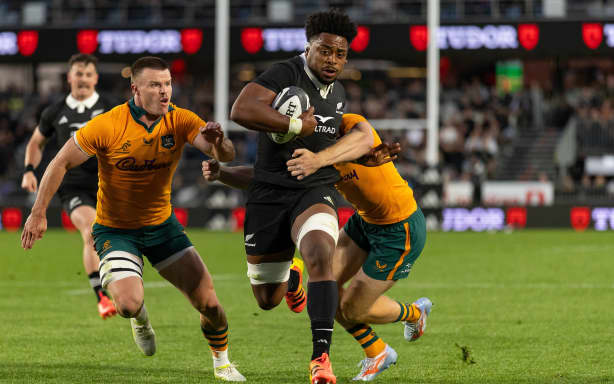
Peter Lakai, on the charge against the Wallabies at Eden Park, has flourished in the absence of injured skipper Ardie Savea.
Joshua Devenie / www.photosport.nz
“Scotland are a high-quality side that we’ve got first up. They’re very experienced and they play a really good brand of footy – probably a little bit different to other sides up there. We’re well aware of the threat they pose.
“You get to the last weekend I guess and everyone will know what they need to do.”
The injury toll this year which includes skipper Ardie Savea, No.10 Ruben Love and prop Tyrel Lomax provides an inconvenient backdrop to the tour.
A squad of 44 left for South Africa in August and required five replacements but Rennie feels that has merely given a wider group an experience of the harsh realities of test rugby at the top level.
He also felt Savea’s shoulder surgery may have a silver lining ahead of next year’s World Cup because it has forced him to rest and, privately, may feel it has opened the door for Peter Lakai to flourish in the absence of such an influential figure.
“We’re in a really good spot,” Rennie said. “We’ve got a strong understanding of our players and the players have an understanding of what’s important to us and the game we’re trying to play.”
Now to put it all together three times in a row.