
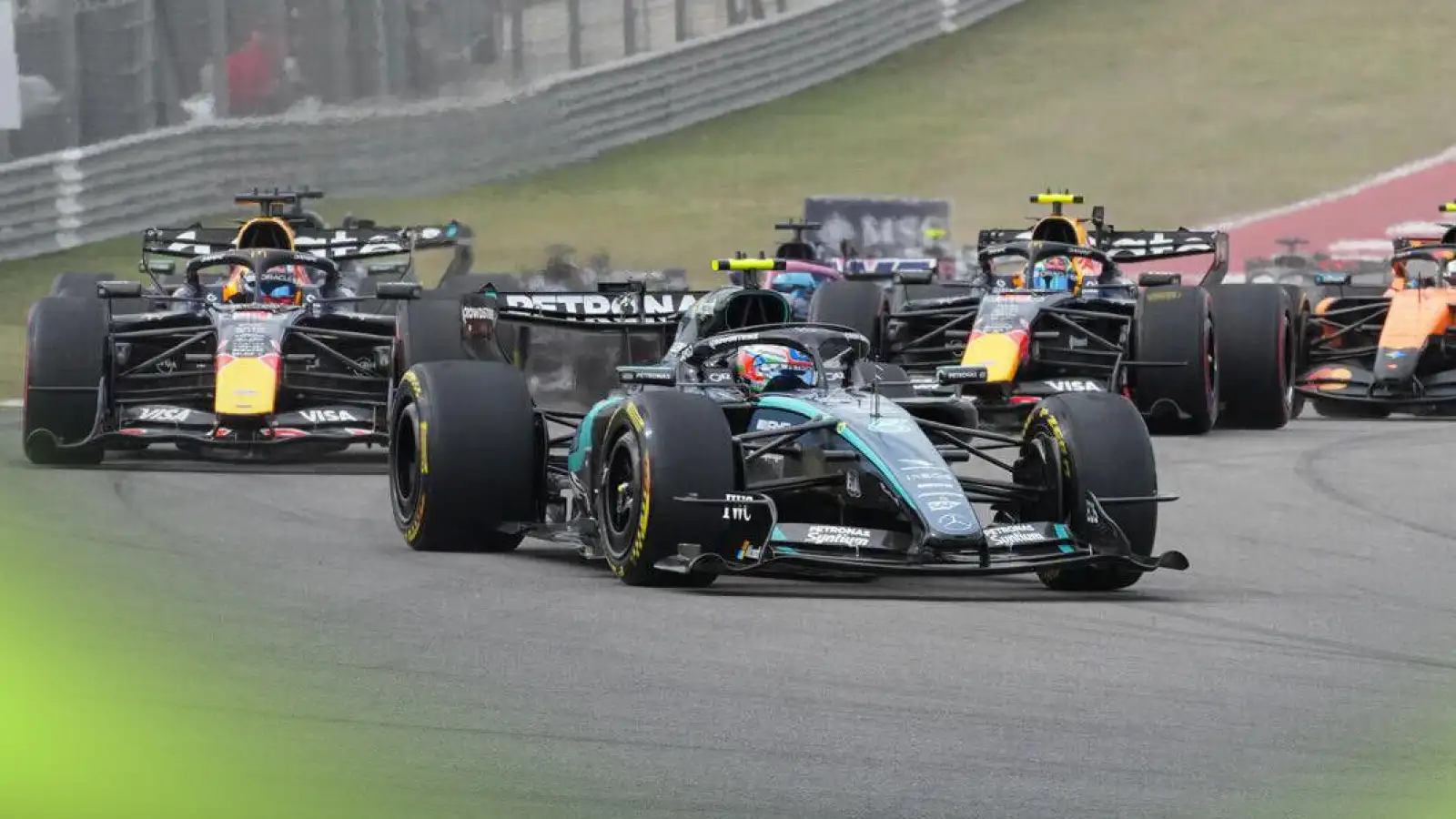
Ferrari and McLaren will endure tough weekends at the Mexico City Grand Prix with Mercedes and Red Bull likely to once again duke it out for victory.
That’s the forecast based off data gathered across recent races which highlights the relative strengths and weaknesses of the Top 4 teams, and how that’s likely to impact the order in Mexico.
Mexico City: What the Track Asks of a Car
Autodromo Hermanos Rodriguez sits at 2,240 metres above sea level, where the air is roughly 25% thinner, which completely alters the operational baseline for a modern Formula 1 car.
Aerodynamics rely entirely on air density; thinner air generates significantly less downforce as well as less drag, altering the fundamental handling characteristics of the car.
During the ground-effect era, when circuit-specific aero adjustments were far more visible, teams routinely ran maximum downforce setups despite the massive main straight.
The layout is made up of long straights and slow-speed corners. There are virtually no true high-speed sweeps, meaning engineers will focus heavily on low-speed mechanical grip and traction, while active aerodynamics and thin air do the work down the straights.
On top of that, cooling poses an even greater challenge this year, as teams have never tested their new power units under these specific atmospheric conditions.
Under the 2026 regulations, the absence of the MGU-H places a much heavier burden on the turbocharger at high altitude, making this weekend the ultimate reliability test for power unit manufacturers.
Which car is best suited to Mexico?
As the fastest car overall this season, you might expect Mercedes to hold the upper hand given their potent power unit, but the picture isn’t quite that straightforward.
The primary concern could be power unit reliability—it has suffered multiple technical issues and retirements over the course of the season. Another failure at this altitude would hardly come as a surprise.
Furthermore, while it boasts exceptional top speeds, low-speed corner performance remains a weak point, meaning their ultimate result will hinge entirely on how effectively its engineers manage that setup compromise.
Red Bull meanwhile is enjoying a renaissance of sorts.
Over the past four races, it has amassed the highest points tally on the grid—14 more than Ferrari and 18 more than Mercedes.
Much like Mercedes, the Red Bull package has performed strongly thanks to a fine balance: competent enough through the corners while remaining exceptionally fast down the straights.
Red Bull Ford Powertrains has undoubtedly delivered an impressive debut season, but the ultimate endurance test for their engine lies ahead this weekend.
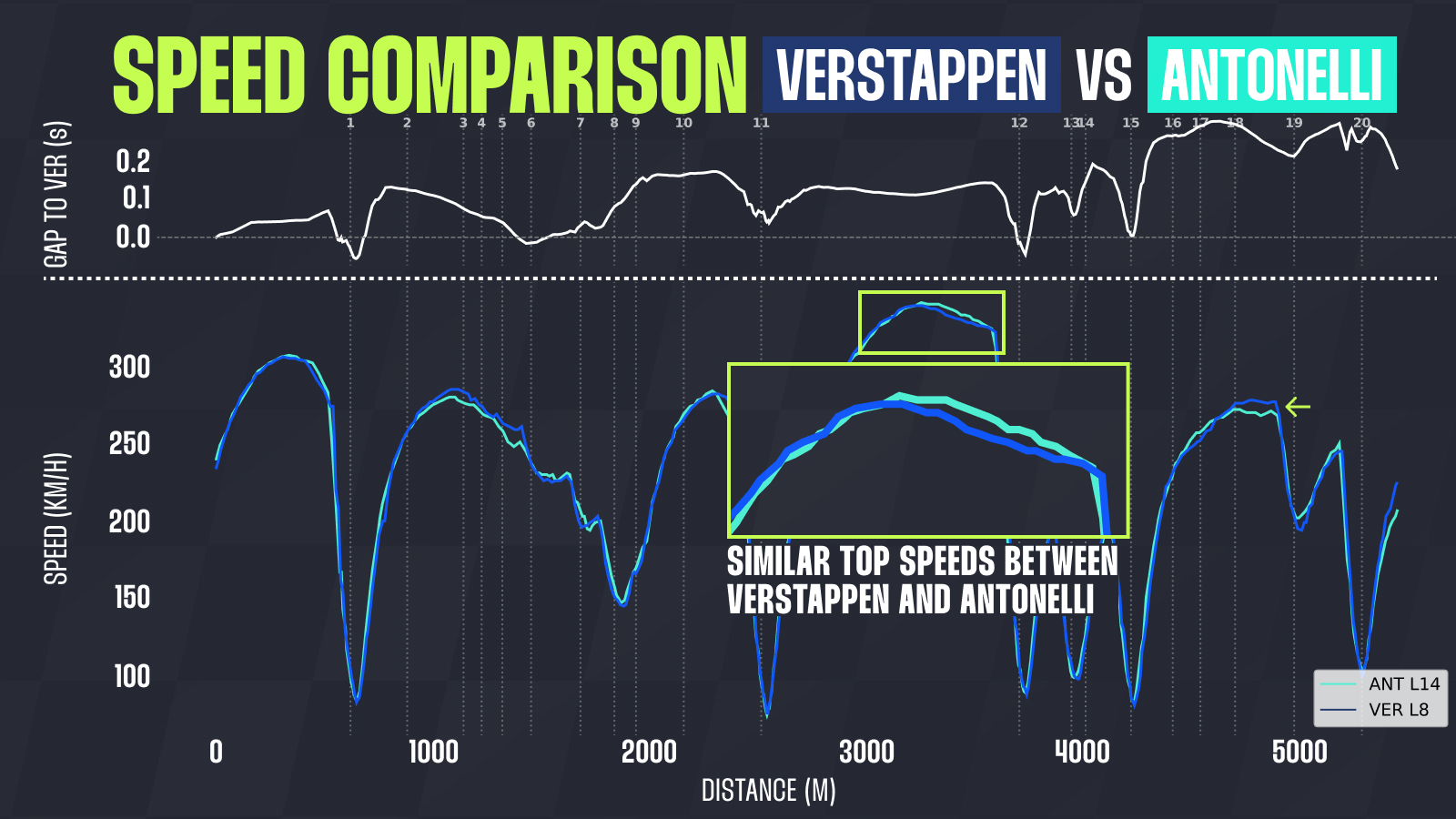
Speed comparison between Antonelli and Verstappen in Austin
During the United States Grand Prix, Red Bull surrendered roughly 0.4 seconds purely through low-speed corners—not an encouraging sign heading into Mexico. Another noticeable flaw is its launch performance.
In Mexico, the run down to Turn 1 is exceptionally long; another poor launch will cost Max Verstappen multiple positions before you even reach the braking zone.
Ferrari, on the other hand, shines brightest through low-speed corners.
By some metrics, the Scuderia’s chassis and aerodynamic package currently represent the benchmark on the grid, but a power deficit continues to keep it out of regular victory contention.
We can therefore reasonably predict the Maranello squad to lead the way through the turns again this weekend, particularly in Sector 3. However, thin air won’t do it any favours when it comes to bridging its straight-line speed deficit.
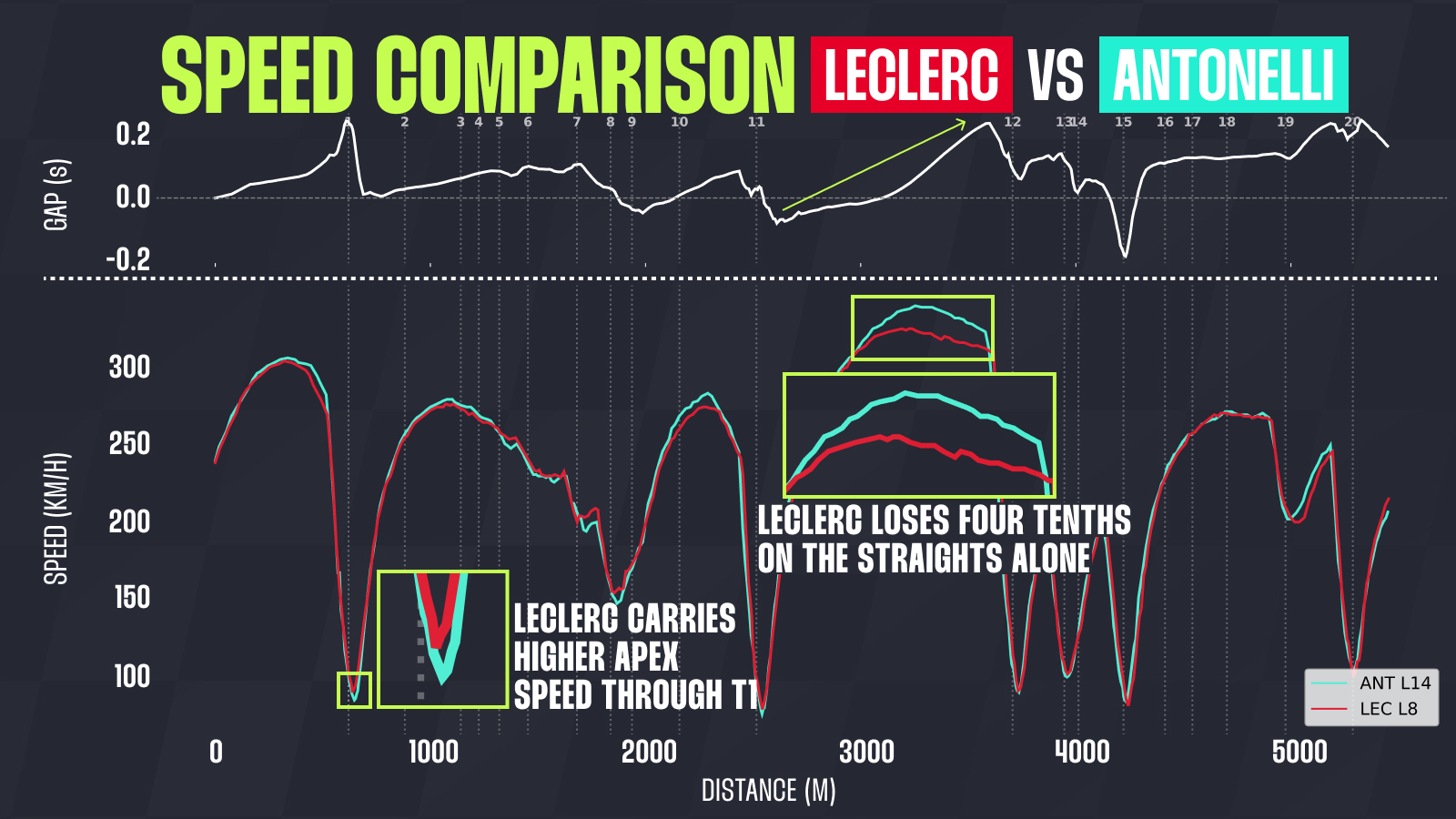
Speed comparisons between Antonelli and Leclerc in Austin
One clear advantage for Ferrari will be tyre management. Ambient temperatures in Mexico City will be high, and thin air provides far less thermal cooling for the tyres.
Finally, we come to McLaren, which looks the least prepared of the front-runners. While rival teams possess clear strengths to lean on, McLaren lacks a clear, defining trait here. Despite strong form in Hungary and Zandvoort, it continues to bleed time both down the straights and through slow corners.
Over the last four races, it has picked up just 48 points as a team—less than half of Red Bull’s 117-point haul over the same period. McLaren’s best hope this weekend may simply be picking up the pieces if any of the teams ahead stumble.
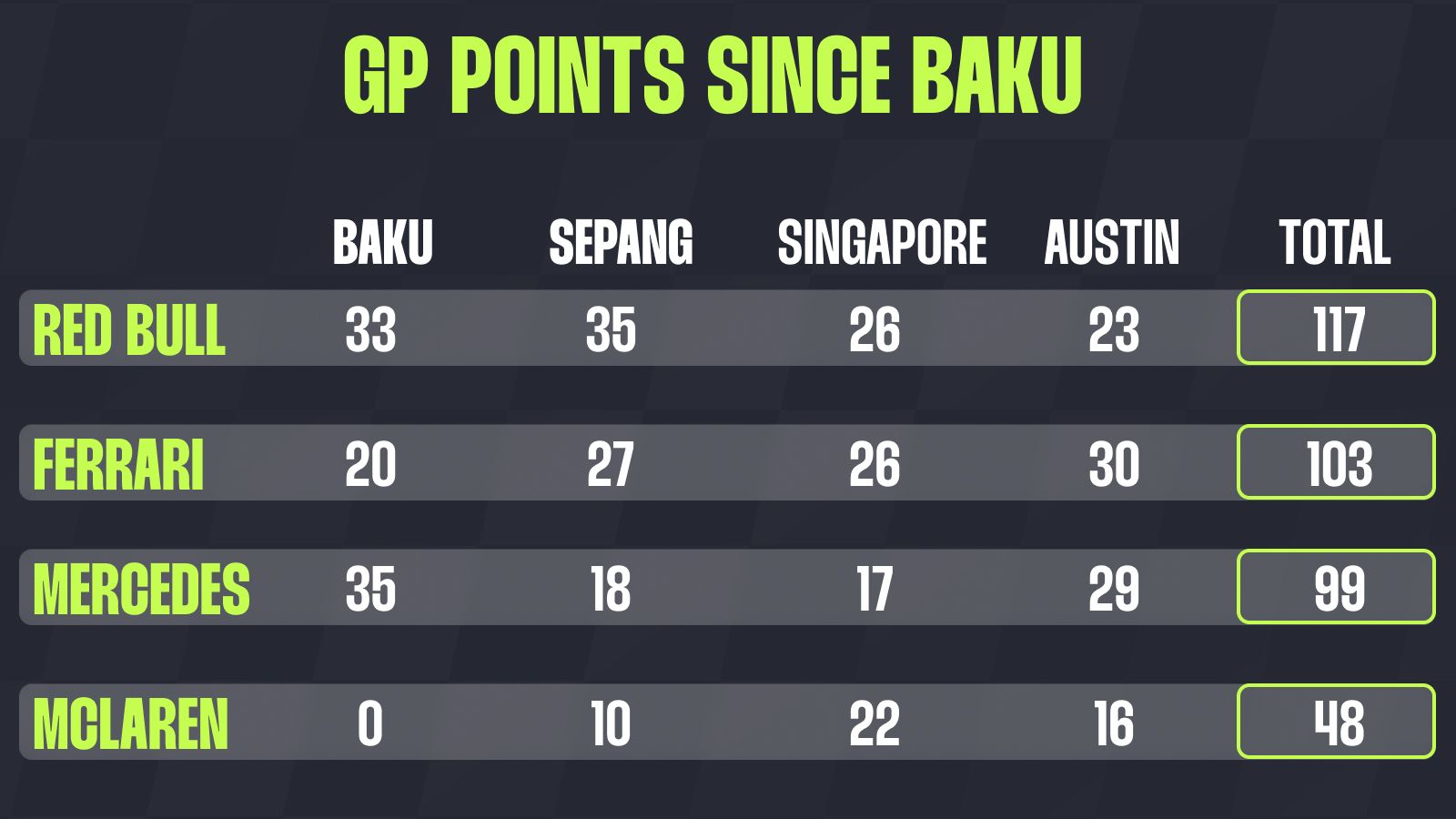
Points since Azerbaijan GP (Sprint excluded)
Who to watch for in Mexico
Despite its chassis strength, Ferrari seems unlikely to recover enough time in the corners to offset its losses down the straights, leaving the fight for victory centered around Mercedes and Red Bull—and specifically Kimi Antonelli and Verstappen, just as we saw last weekend.
From there, it comes down to a battle between two power unit manufacturers, with the defining element perhaps which has the confidence to push their engine to the limit. Whichever squad manages that balance will hold the winning hand on track.
Read Next: Laurent Mekies addresses Aston Martin speculation over a potential Red Bull engine deal