
A red giant’s past mass gain could make its oscillations more sensitive to internal magnetic fields.Stellar models show that weaker fields can explain some signals previously associated with much stronger magnetism.Two candidate stars support the approach, but imperfect model matches leave their histories and field estimates uncertain.
A star can carry the structure of its earlier life beneath a misleading exterior. After gaining material from a companion, a red giant may resemble an ordinary star of the same mass while responding differently to magnetism inside. That hidden history could change how astronomers interpret its vibrations and estimate the strength of its internal magnetic field.
The findings offer an alternative explanation for magnetic signatures in some red giants, rather than proof that every unusual star swallowed a companion. They also distinguish two effects that could otherwise be confused. Gaining mass can alter how strongly a star’s oscillations respond to a field, without the study establishing that the event strengthened the field itself.
Astrophysicist at ISTA. First author and PhD student Nicolas Muntean (left) and Assistant Professor Lisa Bugnet (right). (CREDIT: ISTA) Listening for a star’s missing vibrations
Astronomers cannot directly inspect the deep interiors of distant stars. Instead, they measure tiny changes in brightness caused by stellar oscillations, using a technique called asteroseismology. The patterns depend on internal conditions, allowing researchers to investigate regions hidden beneath a star’s visible surface.
Red giants are evolved stars whose central hydrogen fuel has been exhausted, leaving a helium core surrounded by a hydrogen-burning shell. Their oscillations include dipole mixed modes, which connect behavior in the outer layers with conditions deeper inside. These modes behave like pressure waves in the envelope and gravity waves, restored by buoyancy, in the core.
Some red giants show unusually faint dipole modes, a phenomenon called dipole-mode suppression. Strong internal magnetic fields offer an explanation because they can convert the gravity-wave component into magnetic waves, reducing the visible signal. However, conventional stellar models sometimes require extremely strong fields to account for the observations, raising questions about how those fields arose.
The same mass can hide a different past
Muntean tested whether mass gain could change that interpretation using MESA, an open-source program for modeling stellar evolution. The models compared ordinary single-star histories with histories in which stars acquired material after entering the red giant branch. Their final masses spanned approximately 1.1 to two times the Sun’s mass.
Suppressed dipole modes. This illustration highlights dipole mixed modes (left) and suppressed dipole modes (right), which might be caused by strong magnetic fields near the star’s core region. (CREDIT: Nicolas Muntean/ISTA)
The timing of the modeled event was essential. By this stage, the stars had developed dense cores supported by electron degeneracy, a quantum effect that helps resist compression. Adding material primarily changed the outer envelope while leaving much of the existing core structure intact, creating a mismatch between the star’s present mass and its internal history.
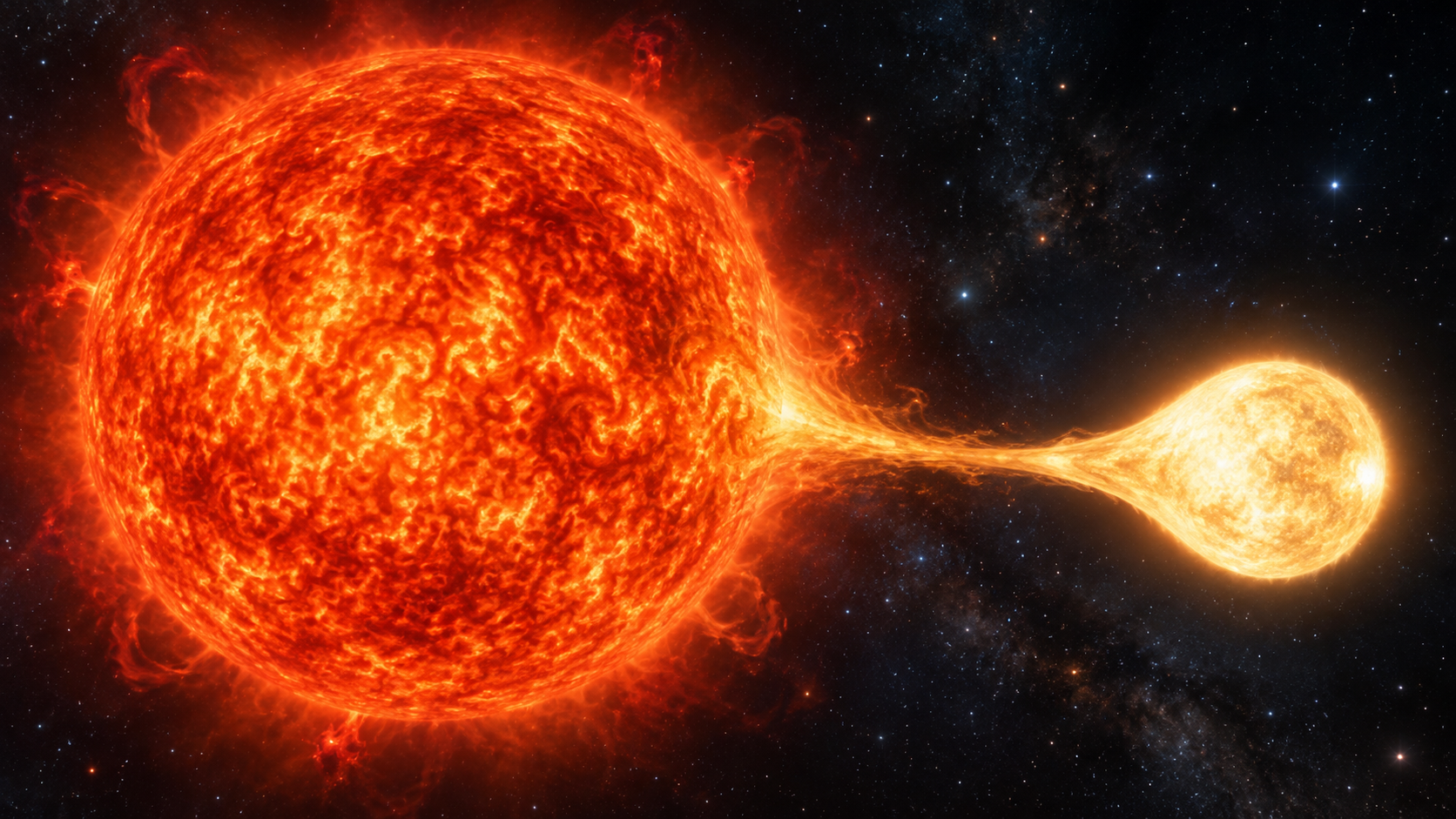
A star that grew this way could therefore have a different interior from one born with the same total mass. Its visible properties alone would not necessarily reveal that difference. The team focused on how this altered structure changed the magnetic sensitivity of oscillations, rather than simulating every physical detail of a collision between two stars.
That distinction limits the scope of the result. The calculations used a simplified mass-accretion prescription and did not include rotation in the stellar models. They also do not imply that mass gained at any earlier stage would have the same effect, because a less evolved core can readjust differently when material arrives.
Weaker fields can produce stronger signatures
The researchers examined two magnetic regimes with different observational consequences. Relatively weak fields shift oscillation frequencies without removing the modes, while stronger fields can suppress their gravity-wave component. In both cases, translating the observed signal into a field strength requires assumptions about the star’s internal structure.
For the frequency-shift comparison, the team imposed the same illustrative shift and mode frequency across models. This isolated differences in magnetic sensitivity rather than differences in the measured signal. Above roughly 1.5 solar masses in that comparison, mass-gain models required weaker fields than ordinary single-star models, although the precise transition depended on the evolutionary stage being compared.
Magnetic fields in stars. The illustration shows the range of magnetic field strengths inferred from observations of apparently similar single stars and merger stars. (CREDIT: Nicolas Muntean/ISTA)
The suppression calculations produced a particularly striking result. In the most extreme modeled case, a mass-gain history lowered the minimum field strength needed for suppression by about 80%. This was a reduction in the calculated threshold, not a measurement showing that an actual star’s magnetic field had weakened by that amount.
For some higher-mass red giants, the required threshold fell from more than one million gauss to below roughly 600,000 gauss. Gauss is a unit of magnetic field strength. These remain powerful fields, but the lower requirements provide another way to explain signals that otherwise appear to demand unusually intense internal magnetism.
When comparisons instead constrained the cores through their oscillation period spacing, inferred weak-field strengths differed by up to 25%. The size of the discrepancy depended on the models being compared. That dependence reinforces why a single correction cannot automatically apply to every red giant.
Two stars provide a reality check
The team then applied the approach to two red giants already discussed in the literature as possible merger products: KIC 4350501 and KIC 9508757. Their oscillation measurements combine information about both the core and envelope. Standard single-star models struggled to match those properties together, making them useful candidates for testing a different evolutionary history.
For this comparison, the researchers calculated 1,320 mass-gain evolutionary tracks and 300 single-star tracks. Several mass-gain models met their fitting criteria, although one target required a looser acceptance threshold. Within this modeling framework, including mass gain narrowed the range of possible magnetic field estimates compared with single-star fits that only loosely constrained the envelope.
Grand Theft Astro. Illustration of a single star gaining mass, becoming a merger star. (CREDIT: Nicolas Muntean/ISTA)
Those narrower ranges do not establish that the new estimates are more accurate. The models predicted surface temperatures higher than observed, with a particularly substantial discrepancy for KIC 4350501. Muntean and his colleagues explicitly caution that their simplified treatment of mass gain prevents them from claiming improved accuracy over earlier published field measurements.
Why stellar histories belong in the calculation
“The idea is that our previous interpretation may be biased because we assume that a star evolved on its own,” Bugnet said. “If we instead suppose that it gained mass, the observed oscillations become more sensitive to a magnetic field.” Her explanation captures the study’s central problem: similar signals can support different field estimates when the assumed histories differ.
This matters because stellar evolution models underpin efforts to determine stars’ ages and understand their internal changes. Magnetic fields influence processes such as the movement of angular momentum and chemical material. Misreading their strength makes it harder to build a consistent account of how stars evolve, although this study does not deliver revised ages for an entire stellar population.
Suppressed oscillations could help identify promising mass-gain candidates, especially among higher-mass red giants. They do not establish how many such stars experienced mergers or mass transfer, and the proposed interpretation needs further testing. The next challenge is to model accretion more realistically while matching the core, envelope and surface temperature of the same star.
Dig deeper into stellar magnetism and mass gain
These studies connect magnetic oscillation signatures with the evidence for unusual stellar histories.
Near-critical magnetic fields in Kepler red giants
An analysis of eight red giants investigates fields strong enough to substantially alter oscillation patterns, adding context for interpreting suppression thresholds. (Astronomy & Astrophysics, May 2026)
Related Stories