
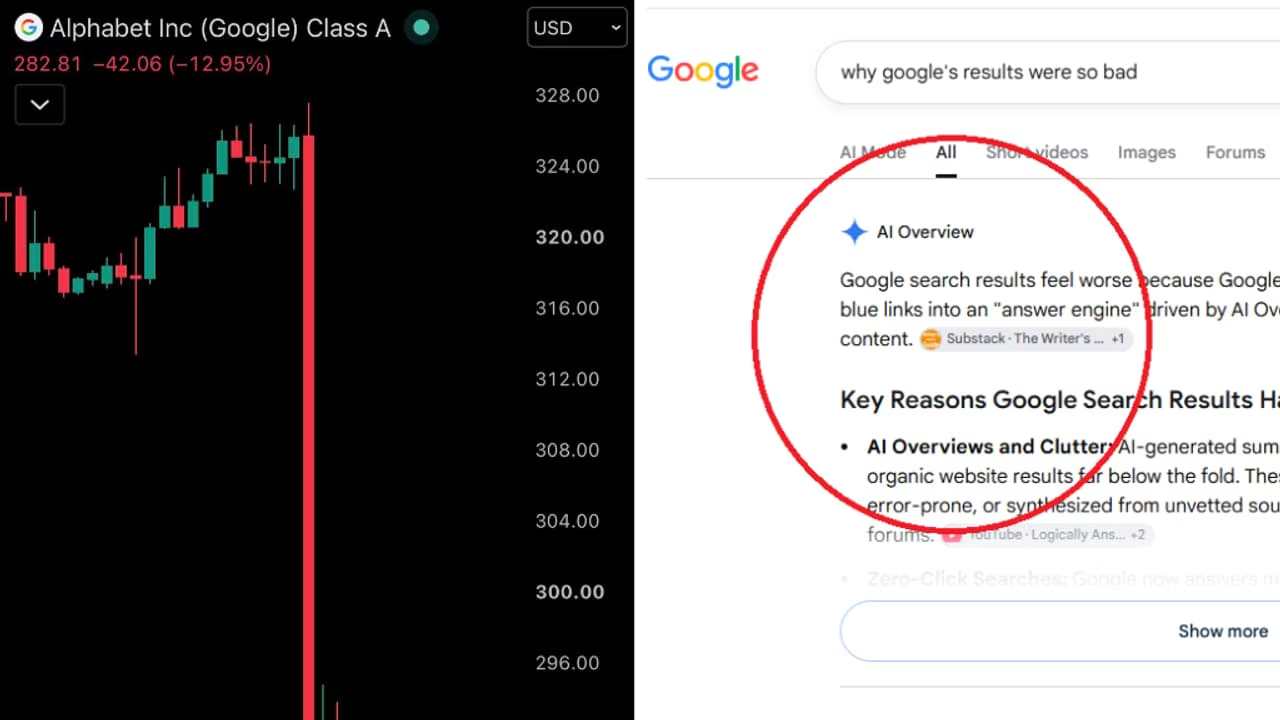
Google owner Alphabet has lost more than half a trillion dollars of market value, marking the biggest ever one-day fall in the tech giant’s history as investors become increasingly nervous its core business is in danger from AI.
Alphabet shares plunged 13 per cent, wiping out $US500 billion ($711 billion) after the company reported disappointing search and advertising sales.
Want more finance news? Download our new app for even more coverage
The Google parent reported sales, excluding partner payouts, of $US11.2 billion for the third quarter, falling short of analysts’ projections.
The company’s Google Services unit missed quarterly revenue expectations by just over $US2 billion, generating $US96.3 billion as growth in search revenue slowed.

Alphabet’s cash flow fell deeper into negative for the quarter, reaching minus $US9.1 billion as it lifted its AI spending to more than $US50 billion in the quarter.
The figure surpassed analysts’ forecasts and marked the second quarter of negative cash flow since Google went public in 2004.
CommSec equity market strategist James Gruber said Alphabet’s search business had been its main operating business since it floated more than 20 years ago, generating an “enormous amount of money for them”.
“The worry from Wall Street and other investors is that that search business is in danger because of AI,” he said.
Think about when people use OpenAI and Claude rather than Google search, or when you go to search for something and get AI summaries.
“That’s eating into their search business, and ultimately that’s advertising dollars. And that’s the main worry for Google, is that as they ramp up this AI spending, they’re losing parts of that search business to other AI operators as well,” Mr Gruber said.
VanEck deputy head of investments and capital markets Jamie Hannah said Alphabet’s result captured the central dilemma facing the big tech platforms.
“Google Cloud is clearly benefiting from the AI boom, with revenue more than doubling as companies spend heavily on the computing power needed to build and run AI products,” he said.
“But the same shift is creating questions for Google’s much larger advertising business as consumers increasingly use AI tools to search that would previously been done with Google search.
“Advertising revenue was softer than expected, while the enormous cost of building AI infrastructure is weighing on margins and cash flow.”
Google chief business officer Philipp Schindler said the growing popularity of AI Mode, a new tab in Google Search, had taken a toll on the company’s results.
AI queries have “lower monetisation”, he told investors on an earnings call, though he said the company was optimistic and had plans to bring more ads to that aspect of Google.
For years, Google executives have argued that AI chatbots won’t cut significantly into its search business.
Today’s massive loss shows investors are worried about AI’s threat to Google’s core business as consumers turn to the likes of ChatGPT, Claude and even Google’s own AI features.
Mr Hannah said the market was right to focus on whether the company could protect and evolve search.
“But it would be premature to view short-term weak performance as evidence that the core business is under threat,” he said.
“Alphabet has the balance sheet, distribution and technical capability to adapt, even if that transition comes with a period of higher investment and more uneven earnings.”
Nasdaq dragged down 1.4 per cent
Alphabet’s share price wipe-out was enough to drive the tech-heavy Nasdaq down 1.4 per cent, compared to 0.3 per cent falls for the S&P 500 and Dow Jones.
Rival Microsoft also reported its quarterly results, but saw its share price barely move overnight, ending the day down 0.2 per cent.
Strong growth in its Azure cloud unit helped revenue and profit beat estimates.
Betashares investment strategist Hugh Lam said the divergence reflected concern that Alphabet’s free cash flow remained negative for a second quarter, while Microsoft is able to fund its AI expansion while retaining positive free cash flow.
“The market is moving from indiscriminately rewarding AI spending to scrutinising how it is financed,” he said.
“The sell-off came despite clear green shoots at Alphabet. Google Cloud revenue rose 103 per cent year-on-year to $30.7 billion, and the division’s operating margin expanded to 36.2 per cent from 23.7 per cent a year earlier. Usage is growing too, with the Gemini app reaching one billion users.
“The key question is whether Alphabet’s 2027 capex, which management expects to increase significantly, converts into Cloud revenue fast enough to bring free cash flow back into positive territory.”
Global X ETF strategy analyst Joseph Marassa said big tech had delivered a split verdict.
“The message from markets is that they will reward AI spending backed by visible cash generation and punish spending that outruns it,” he said.
NAB senior markets strategist Gavin Friend said a “fresh wave of anxiety over AI” had followed Alphabet’s disappointing quarterly earnings.
“Q3 earnings news from Alphabet revealed disappointing search and advertising sales, underscoring worries over AI and whether huge capital investment can generate returns quickly enough to justify valuations,” he said.
“While Microsoft earnings were better received, thanks to a surge in its cloud business, with capital expenditure remaining in check, Caterpillar’s modest earnings beat could not prevent a share slide. Caterpillar has been significant in data centre buildout.”
Amazon’s third-quarter results showed its capital expenditure of $US77.3 billion exceeded analyst expectations of $US58.67 billion, leading to negative free cash flow of $US42.4 billion over the past year.
The company’s shares were down around 6 per cent in after-hours trade, according to Bloomberg.
Intel shares have slumped more than 19 per cent in after-hours trading, after it forecast fourth-quarter revenue of between $US15 billion and $US16 billion, below analysts’ average estimate of $US17 billion.
This content was created in partnership with CommSec.