
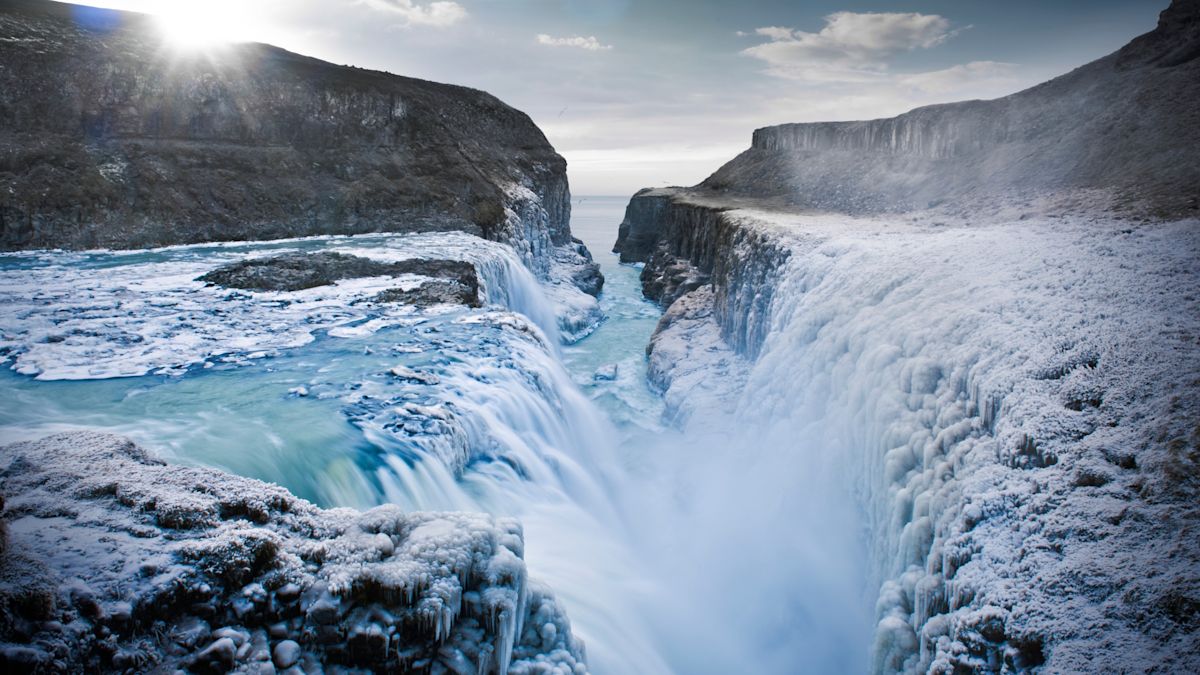
Researchers in the US and Germany found evidence of a glaciation period that began about 2,000 years ago, heralding an oncoming global winter in which temperatures would adjust by a few degrees on average and the planet’s ice caps could expand in all directions.
Instead, we ended up with the climate we have. In a new paper for Science, researchers focus on historical trends at the Barnes Ice Cap on Baffin Island, Canada, which is the last remaining piece of the Laurentide Ice Sheet. This huge, formerly North America-spanning ice sheet spent much of our current geological epoch shrinking, but began growing around two millennia ago.
The researchers show that this trend would likely have continued, if left to progress on its own. Glaciation comes in cycles, and it seemed to be the time for glaciers to begin retaking some of their lost land. For most of the last 2,000 years, the ice rebounded—then the Industrial Revolution began to take hold.
Somewhere about 1960, the ice began to retreat again. These researchers present evidence that this turnaround was due to “anthropogenic greenhouse forcing.” In their view, this means that human greenhouse gas emissions have functionally prevented the next ice age.
Lead researcher Nicolás Young, a geochemist at Columbia’s Lamont-Doherty Earth Observatory, says that this new ice age was “just getting started, everything was normal, the next glaciation was about to happen—and yet it stopped… It’s a very powerful example of how we have jolted the system.”

barnes ice cap glacier aerial shot
Aerial view of Barnes Ice Cap siwing the prominent 1960 trimline that wraps around ice cap.Credit: Nicolás Young
Young’s team could collect this data because of the nature of the Barnes Ice Cap. Usually, glaciation is hard to study, with data moving within the structure of the glacier ice. In the case of the Barnes Ice Cap, though, the ice is uniquely frozen directly to its underlying bedrock, meaning that unlike most glaciers, the Barnes does not slide.
This has allowed it to preserve vegetation from different eras, “entombing” it in ice for future study. As the glacier has retreated since 1960, it has revealed vegetation for sampling. By carbon dating these plants, researchers were able to determine how long ago the ice overtook them.
Another interesting aspect of this study is that these findings somewhat redeem researchers from the 1970s who argued the world was headed for a new ice age. Their data wasn’t inherently wrong, but they sampled unfortunately right at the inflection point.
“It actually was happening,” says Young. “They couldn’t quite prove it, but now we sort of have the evidence.”
At the old rate, it would have taken about 30,000 years for North America to become an all-arctic continent again. For this reason, global warming hasn’t necessarily “saved” us from an ice age. If anything, the planet’s natural cooling trend may be slowing the impact of human emissions and keeping the globe slightly cooler than we would otherwise have made it by now.