
The impact of independent MP Helen Haines’s absence from federal parliament was immense this week. Her colleagues returned to Canberra mulling over what it means for our democracy and their role in it as elected representatives.
The House of Representatives suspended the normal business of the day on Monday to debate a motion of the prime minister’s expressing solidarity with their injured colleague and her family and gratitude for the swift action of bystanders, first responders and health professionals.
Members on the cross bench were inconsolable as newer MPs revealed in their speeches that Haines was a leader and a mentor to most of them.
No one, least of all the member for Mackellar, Sophie Scamps, who has worked as a hospital emergency department doctor, found it easy to comprehend the life-changing challenges their colleague faces.
Scamps gave voice to what many were struggling to accept. She said, “While the relief is immense that your heart and mind are intact – the most beautiful part of you – please also know that we do mourn the loss of your legs.”
This cruel event in Wangaratta could not be seen in isolation from the fact that the victim was a serving member of the federal parliament, no matter what the police investigation into the alleged attack unearths. The Australian Federal Police are not ruling out mental health issues for the driver of the car that struck Haines.
Home Affairs Minister Tony Burke told the House that in his role he assesses the different risk factors for all members of parliament. “Helen was so far down the list,” he said.
The prime minister told his party room on Tuesday that “last week was a turning point, and people have been putting up with this growing threat environment for too long”.
Australian Federal Police Commissioner Krissy Barrett revealed in a Senate estimates hearing just how exponential this growth has been. She said the AFP had received nearly 800 security complaints relating to politicians in the first six months of the year.
Barrett said 50 per cent of the threats were directed at men and 47 per cent at women, and that the latter often had a sexual violence component. Three per cent were more generic against politicians.
Albanese admitted more can and should be done. He understood all members of parliament wanted to feel safe in their communities and have better security at their offices and homes. The prime minister said a review of security arrangements would be fast-tracked, and he was sympathetic to a number of options that had been raised with him, including duress alarms.
The independent member for Bradfield, Nicolette Boele, with the support of the Labor benches but not the Coalition, led a matter of public importance debate on “the urgent need to prevent political violence and foster constructive and respectful public discourse”.
Boele also picked up on the “turning point for our country”. She said the story of Helen Haines should ensure “we chart a new course towards civility in politics, towards respectful disagreement and towards collaborative and constructive governance where people come first, not corporate profits”.
Boele quoted Haines’s husband, Phil. As he put it, “There is a rage boiling in the hearts of too many Australians, but you can choose to tame it or inflame it and it’s for all of us to choose which one.”
On the ABC’s Insiders the AFP commissioner gave weight to this challenge. Barrett said there is a direct link between politicians’ rhetoric and threats and abuse.
“We do see where there is particular political conflict or discourse occurring … it does have a direct correlation to what we see in terms of threats and abuse, and sometimes it’s very immediate.”
The commissioner was asked about a report that surfaced on Sunday showing Pauline Hanson’s Please Explain cartoon series depicting politicians, including the prime minister, being run down by cars and buses.
Barrett said there was “a reaction amongst the community” to material such as these cartoons.
In two cartoons, the popular ABC children’s character Bluey is depicted as a car-target victim as well as a vengeful driver.
Midweek, the ABC reported a One Nation colouring book was given to children at the Mount Gambier show depicting Bluey being robbed at knifepoint.
ABC managing director Hugh Marks told Senate estimates this use of Bluey was “shocking and disrespectful” and a “blatant use of intellectual property”. One Nation is facing demands the cartoons be taken down and possible legal action.
Commissioner Krissy Barrett said the AFP had received nearly 800 security complaints relating to politicians in the first six months of the year. Barrett said 50 per cent of threats were directed at men and 47 per cent at women, and that the latter often had a sexual violence component.
Pauline Hanson refused to answer questions about the cartoons at a midweek doorstop. She pulled out of a scheduled interview with News24’s political editor Andrew Clennell. The reason given was that Clennell was acting “like a dick” again.
The Hanson doorstop was called on the day the Australian Bureau of Statistics released the latest inflation figures. The underlying number of 3.7 per cent is well outside the Reserve Bank’s target range of 2-3 per cent and market speculation reflects an 85 per cent chance that interest rates will rise again on Tuesday.
Hanson wanted to sell her Super Pay Boost policy, giving Australians access to 3 per cent of their compulsory superannuation payments. She says that it is to help them “pay the rent”.
Focus group research for the Labor Party suggests voters are very sceptical of the policy, with a female voter in Western Australia saying the policy “may offer some relief now but I believe this will be detrimental in the future”.
Other responses indicated support for One Nation is soft, and that it is seen more as a vehicle for protest rather than a viable party of government.
A male voter in New South Wales said he didn’t think Hanson had “well thought through policies” and he was “not sure she has experience in governing formally in government”. He said this could mean her government would be unstable and “Trump like”.
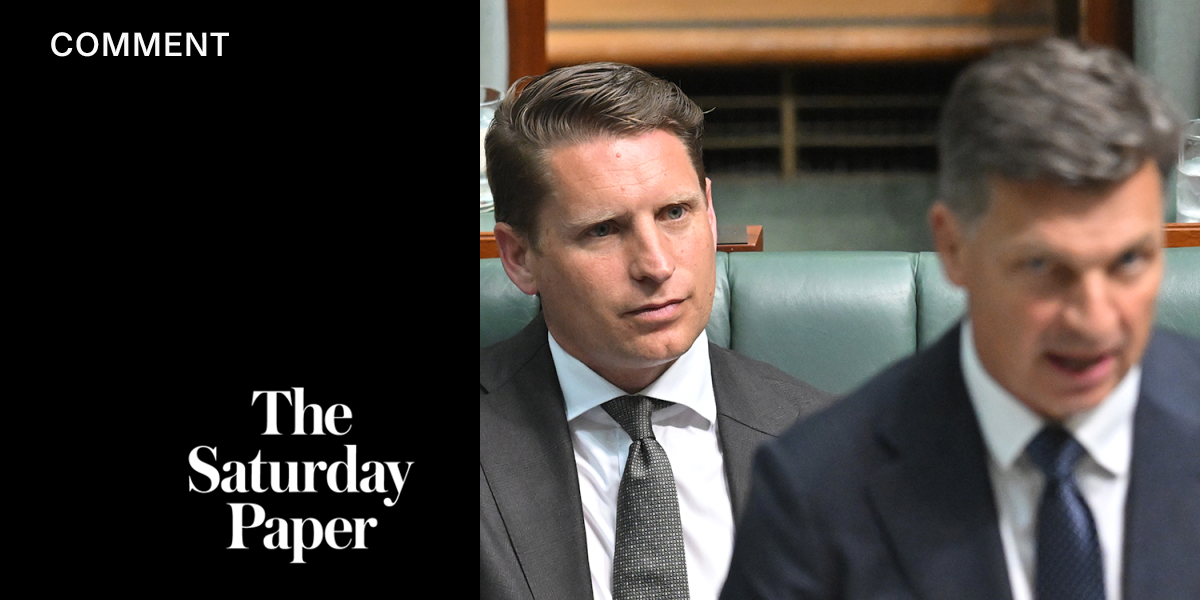
An unexpected fallout of Monday’s parliamentary statements was the contrast in responses from Opposition Leader Angus Taylor and his assumed rival for the Liberal leadership, Andrew Hastie.
Taylor, clearly with the AFP chief’s interview in his sights, said “some” suggest there is a “causal connection between robust parliamentary debate and political violence”. Taylor added, “I disagree with this view.”
Hastie, on the other hand, told the House, “It only takes one person with a twisted mind or perverted sense of reality to strike out … because they judge that an online assassination must be followed up with a real-life assassination.”
The back bench was riveted on Hastie as he concluded. “So what we say here and online shapes the political culture,” he said. “We can all do better and we should strive to do better. So let’s play the ball, not the person, and leave the nasty personal politics of MAGA in the United States.”
Hastie says he won’t be challenging Taylor before the next election and expects the member for Hume to lead the Liberals at the poll. This does not alter the fact that Hastie’s performance, not only on Monday but generally in the media, is impressing his colleagues more than Taylor’s. What may well save Taylor’s bacon is that – as one Liberal frontbencher puts it – “the Abbott–Credlin–Rinehart axis would not cop Hastie as leader”.
Tony Abbott is a very active federal Liberal Party president. His former chief of staff, Peta Credlin, is now an influential News24 commentator, among conservatives and One Nation supporters. Gina Rinehart, meanwhile, has used her considerable wealth to push her causes, including supporting accused war criminal Ben Roberts-Smith, against whom Hastie was forced to testify
in a civil trial.
Warringah independent Zali Steggall says Taylor “didn’t read the room” on Monday. His tin ear was on display elsewhere in Parliament House on the same day, when he called a news conference to announce putative Coalition savings of $31 billion.
The targets are Labor’s renewable energy projects, business incentives, electric vehicle subsidies and social housing.
Taylor, egged on by the coal lobby in the Nationals, misjudges that climate action is electorally toxic. He is intent on ignoring former treasurer Josh Frydenberg’s warning that there is “no goat track” via the regions back to power and certainly not one that ignores seats now held by the urban teal independents.
The same mindset has Taylor rejecting the Australia–European Union Free Trade Agreement, disingenuously claiming it is not giving “meaningful access” to critical industries such as dairy and red meat.
Trade Minister Don Farrell says the dairy industry will see all tariffs effectively eliminated, while market access for beef is going up 700 per cent and for sheep meat by 430 per cent. It’s a much more generous deal than the one the Nationals copped when the Howard government agreed to the Australia–United States Free Trade Agreement all those years ago.
The real sticking point for Taylor is the turning of the trade deal into a “climate agreement to make the nationally determined contributions under the Paris agreement binding”. At the news conference, he melodramatically added, “I mean, seriously?”
Yes, seriously. Not only would a rejection of the deal rob Australian exporters of billions of dollars, but should the Liberals ever return to power and ditch the Paris goals, they would almost certainly open Australia to climate tariffs to access the huge European market.
Greens leader David Shoebridge says it is further proof Taylor and the Liberals are hostage to the One Nation agenda. It’s hard to see it any other way.