
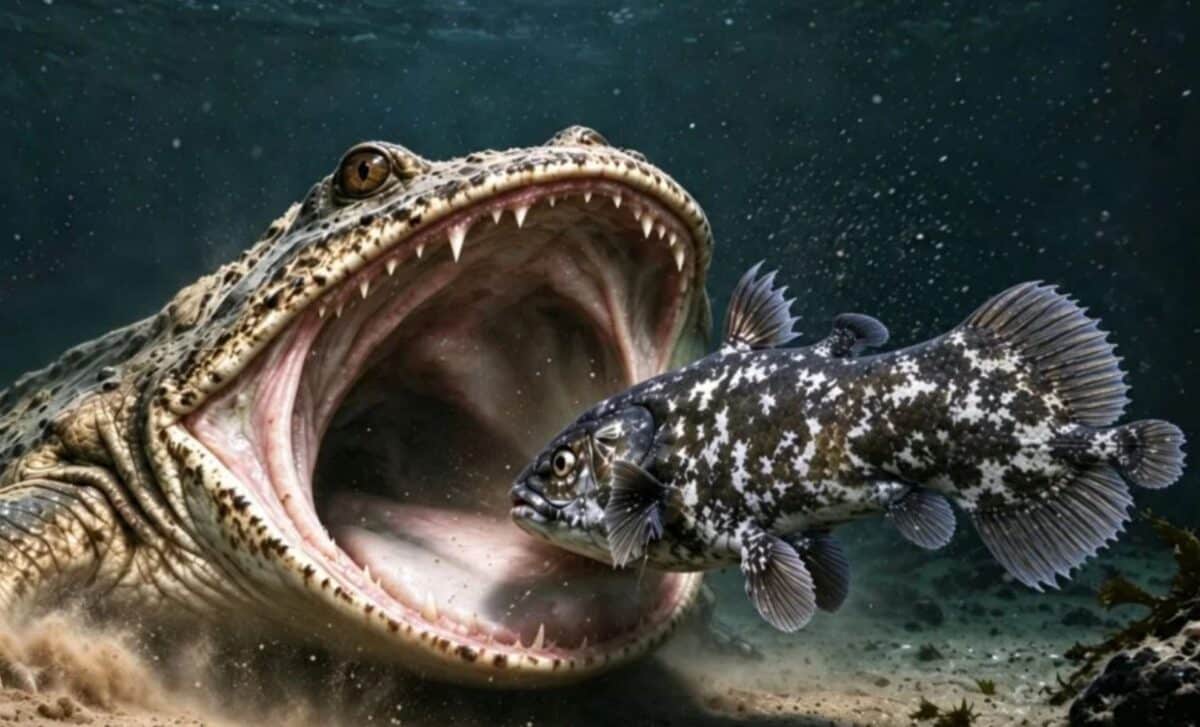
Scientists have discovered an unusual creature that may have lived its entire life in the ocean 237 million years ago. Found in China, two remarkably well-preserved fossils reveal a heavily armored creature called Gerrothorax maritimus, whose bones suggest it was surprisingly well adapted to life in saltwater.
Today, no amphibian lives in the ocean. Their porous skin, which helps them exchange gases and absorb water, generally makes it difficult for them to survive in salty environments. But this ancient creature seems to have been different.
The discovery, described in the journal Nature Ecology & Evolution, stated that the ancient species may have explored environments that their modern relatives cannot inhabit.
An Unexpected Creature In A Prehistoric Ocean
The two fossils were discovered by local farmers in Guanling County, China, in rocks dating back approximately 237 million years. The area is part of the Guizhou Triassic Fossil Sites, a region known for its remarkably preserved prehistoric marine life.
During the Late Triassic, this part of China was completely underwater. Ichthyosaurs, turtles, and crinoids shared these ancient seas, and it now appears that an armored creature lived among them.
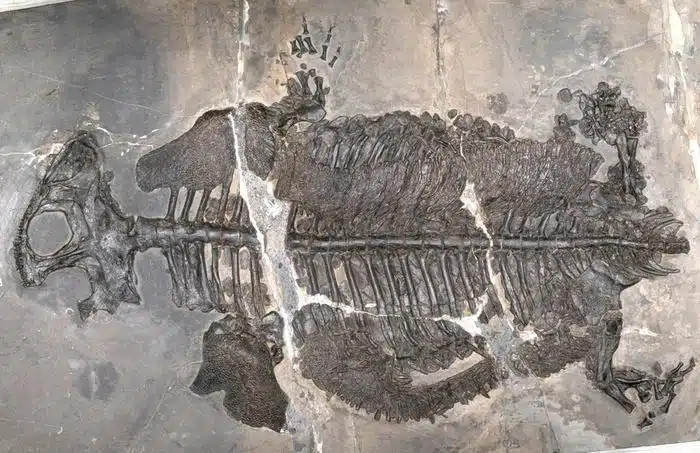 Amphibian with a flattened, armored body that apparently lived entirely in the ocean. Credit: Ryosuke Motani, UC Davis
What makes the discovery of this unique creature particularly interesting is the location. Both fossils were found more than 30 kilometers (18.6 miles) from any possible nearby islands.That raises a simple question: what was an amphibian doing so far out at sea?
“We’ve been mostly studying marine reptiles and the fish from this place, but now we also have this amphibian and it’s a sort of very unusual member of the lineage,” said Ryosuke Motani, a paleontologist at the University of California, who helped conduct the research, in a statement.
Its Fingers Reveal An Unusual Detail
Gerrothorax maritimus looked nothing like the familiar frogs and salamanders of today. It had a broad, flattened body covered in hard armor plates, along with relatively weak limbs. The more complete fossil measures at least 73.7 centimeters (2.4 feet), although several bones from its tail are missing.
Motani compared its estimated body mass to that of a giant salamander, with one noticeable difference: instead of being long and slender, this animal was much stockier. Its heavy armor and body shape would also have made walking on land difficult. But perhaps the most revealing detail is something much smaller: its fingers.
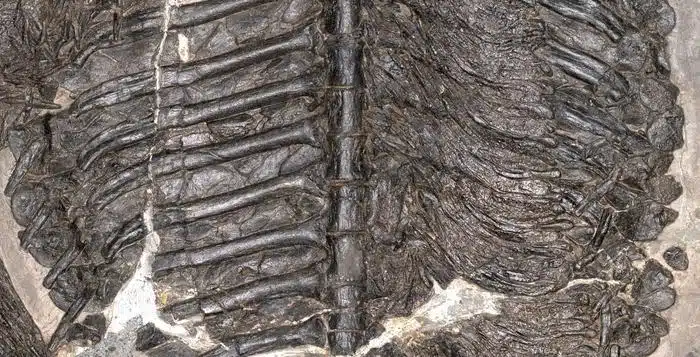 The preserved central body of Gerrothorax maritimus, a prehistoric marine amphibian. Credit: Ryosuke Motani/UC Davis
The researchers initially considered whether the animals might have died near land before drifting into deeper waters. Yet both skeletons were almost completely intact, including their delicate limb bones.
“Carcasses at sea, unless they sink to the bottom right away, tend to dry out and lose limbs prior to sinking to the bottom,” Motani explained. “But these animals had their fingers preserved, so that means they probably died near where they lived.”
What The Bones Reveal Is Just As Strange
The strongest clue was chemical. Animals take up strontium into their bones, and the ratio of its isotopes, 87Sr to 86Sr, reflects their surroundings: on land it follows the local geology, while seawater carries a fairly uniform global signature. Lipin Diao and colleagues found that both fossils matched Triassic seawater rather than the rocks around them, suggesting the animals grew up drinking salt water.
Their armor may explain why. Unlike modern amphibians, which absorb water through the skin, Gerrothorax was covered in bony plates that would have blocked this, so it likely had to drink.
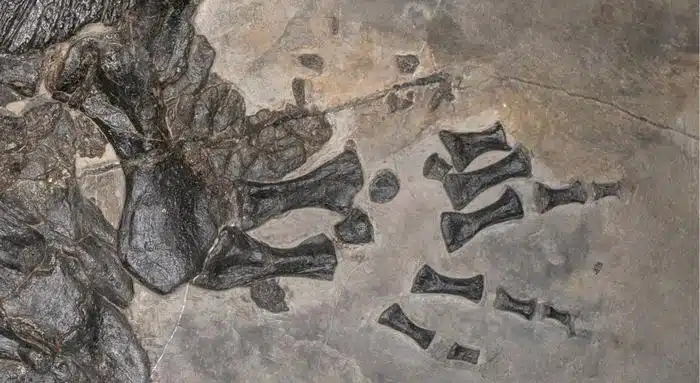 A close-up of the preserved left hand of Gerrothorax maritimus. Credit: Ryosuke Motani/UC Davis
How it coped with saltwater is still unclear, but the marine signatures, near-complete skeletons and heavy armor point to an amphibian that may never have left the sea. That is a surprising idea for a group we usually link to freshwater and land.