
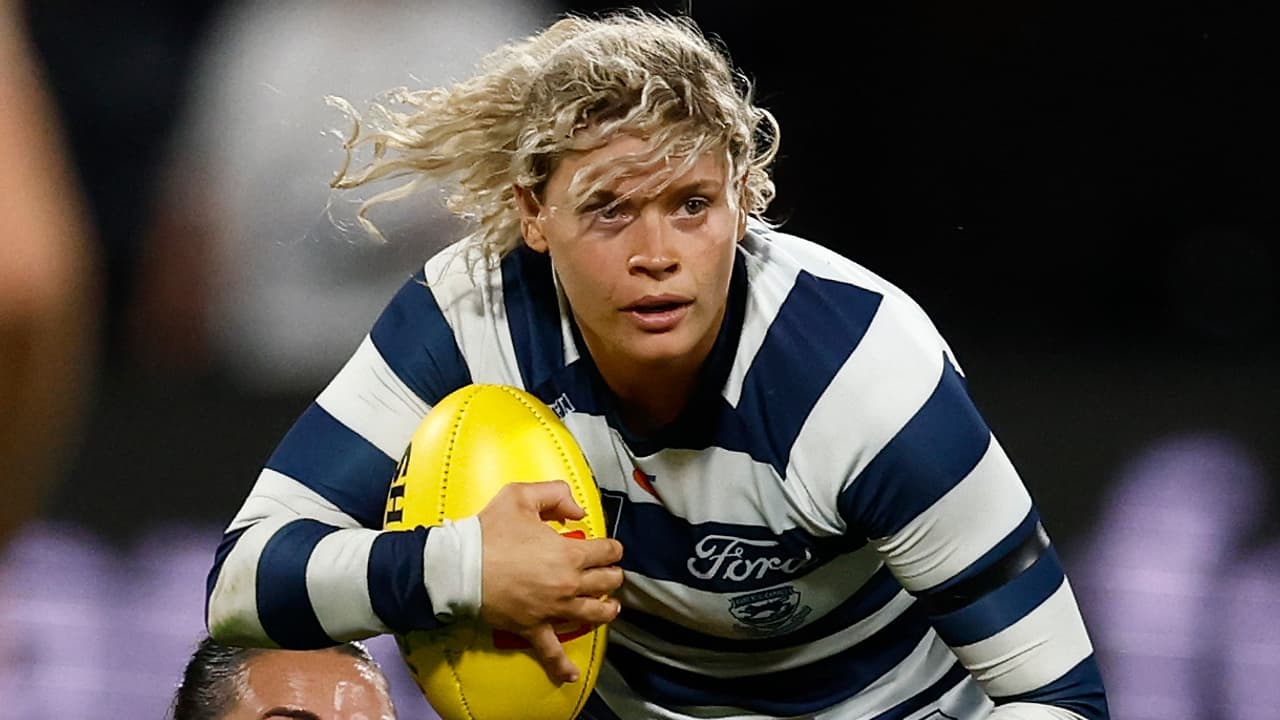
A single behind has landed Carlton an ‘away’ qualifying final at home ground Ikon Park, as Geelong also hosts its qualifying final at the venue to kick off the AFLW finals series.
The Cats will take on the Demons in a qualifying final at 1.05pm Saturday at Ikon Park, having been booted off GMHBA Stadium by an AUSX Supercross event.
Long unable to land a home male final, the Cats will instead play host to a Demons side that knows the trip down Royal Pde far better.
The Dees have played three games at Ikon Park this season and were the home side for two of those matches, while the Cats have only played there once, as the away team against Richmond.
Carlton will also play an ‘away’ final at home, against North Melbourne at Ikon Park.
The Blues held on to the top four by the barest of margins, with Gold Coast needing a single point when attacking in the final 10 seconds of a win over GWS to overtake Carlton on percentage.
But the Suns fell short, ending on 133 per cent, 0.2 behind the Blues.
The Roos-Blues qualifying final will form the second leg of an Ikon Park double-header, starting at 4.05pm.
Fans will be able to watch both qualifying finals through one ticket and won’t be forced out of the venue after the first match.
Sydney will host the Western Bulldogs to start Sunday’s elimination finals at 1.05pm at Henson Park.
Gold Coast will then take on Hawthorn at People First Stadium at 2.05pm AEST.
The winners of the qualifying finals will claim the top two spots in the ranking system to host the grand final.
Geelong could host the decider at GMHBA Stadium, the remaining Victorian sides would host at Ikon Park if they won the rights.
CATS IN POLE POSITION FOR MCCLELLAND TROPHY
Geelong’s qualifying final clash with Melbourne looms as a potential $1m match as the Cats hold pole position in the race for the McClelland Trophy.
The Cats will enter the AFLW finals next week on top of the indicative McClelland Trophy ladder, with the result to be decided by finals results.
By beating the Demons and reaching at least the preliminary final stage, the Cats will guarantee themselves at least 29 points on the McClelland ladder, a total that could only be bettered by Sydney or a miracle finals series from seventh and eighth respectively by the Western Bulldogs or Hawthorn.
The points for the McClelland Trophy are handed out by reverse finish, so the Lions gained 18 points for winning the male competition, with finals finishes taken into account.
Points for losers in the same stage of finals – for example the two elimination finals losers – are split by home-and-away ladder position.
Any ties are separated by percentage across the AFL and AFLW competitions.
Geelong’s indicative total sits at 31 points – 14 from the male competition and 17 from the women’s.
A straight-sets collapse for the in-form Cats would still see them end with at least 27 points and be in the hunt, depending on other results.
Sydney sits on 29 indicative points.
Fremantle will finish on 26, having not made AFLW finals, alongside Melbourne (26), Hawthorn (26), Carlton (26).
Western Bulldogs (24) sits next.
North Melbourne’s poor male season ruled out any chance of the McClelland Trophy and the $1m prize money even accounting for another dominant AFLW regular season.
The $1m prize pool is split with half going to the players on both lists and the remaining $500,000 into the club bank account.
Geelong was the last club to win the McClelland Trophy under its old guise as the award for the AFL’s minor premiership, with the title altered in 2023 to anoint a club champion across the two senior competitions.
It is named after former VFL and Melbourne Cricket Club president, and Melbourne captain, William McClelland.
Essendon’s win over Collingwood on Sunday couldn’t save the Bombers from comfortably being labelled footy’s worst club of 2026, finishing on a paltry four points.