
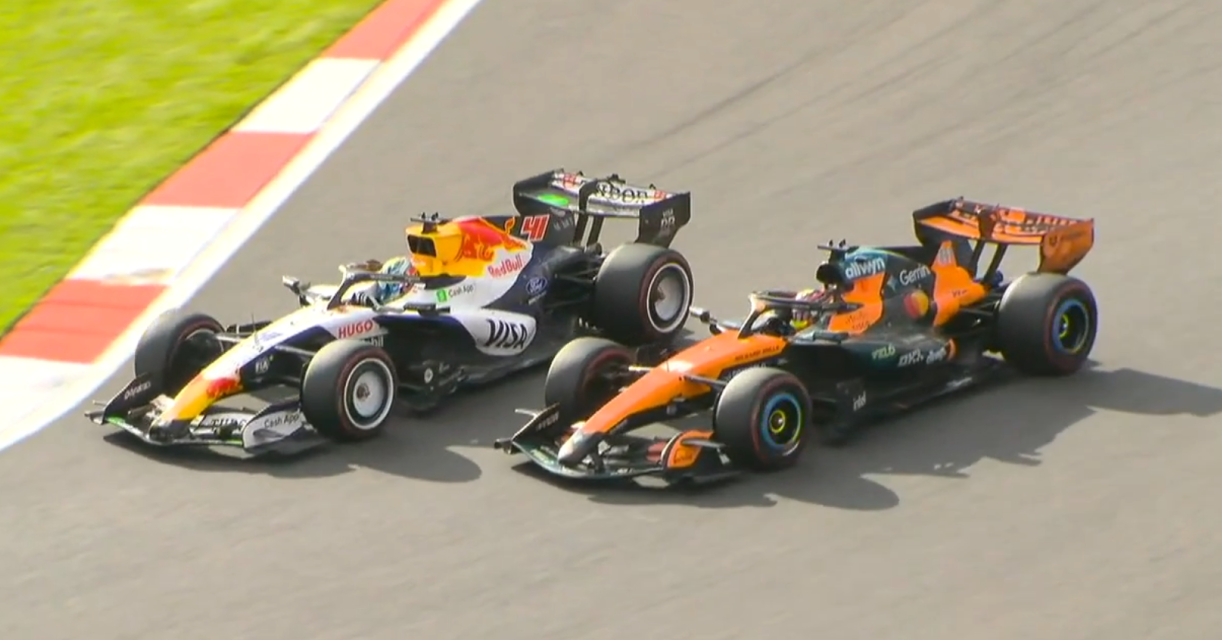
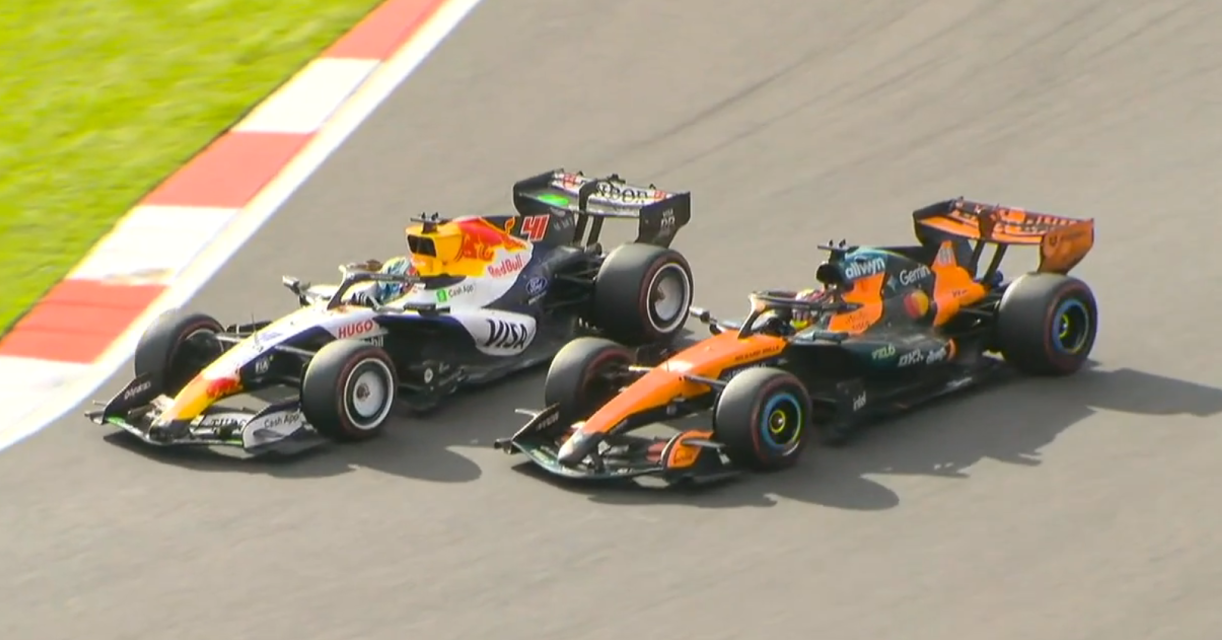
 Oscar Piastri and Arvid Lindblad race before colliding during the Mexico City Grand Prix. Image: Formula
The McLaren driver was handed a 10-second penalty after colliding with Arvid Lindblad late in the race while fighting for seventh at Turn 1.
Piastri attempted to go around the outside of the Racing Bulls car, but officials decided he had not established enough overlap to be entitled to the corner.
They considered Lindblad’s defence legitimate and believed the McLaren still had an escape route to the left, including beyond the edge of the track.
Piastri, however, saw the incident differently.
“I went to go to the inside in Turn 1, and he shut the door extremely late,” Piastri said.
“And at that point I knew I was never going to overtake into Turn 2. But he pushed me so far wide that our wheels were interlocked, and we crashed before we even turned for the corner.”
The 10-second penalty subsequently dropped Piastri out of the points, with further penalties for both Alpine cars over unrelated yellow flag infringements ultimately leaving him classified 13th.
Lindblad said before the verdict that he had spent more than 10 laps defending from Piastri and had no intention of simply conceding the position.
Speaking on Sky Sports F1 after the race, 2016 world champion Nico Rosberg sided with the stewards, saying the McLaren needed to yield because Lindblad was entitled to use the track width.
Piastri loses Mexico City points after post-race penalty
“It’s not 100 percent clear, but I think it’s fair for him to get a penalty because he was never really on the outside there,” Rosberg said.
That disagreement highlights the wider challenge facing the FIA.
The rules are designed to provide a framework for deciding who is entitled to racing room, but applying those principles to incidents unfolding at high speed can still leave room for debate.
Mexico City produced several examples.
Charles Leclerc’s opening-lap duel with Lewis Hamilton produced a five-second sanction for Leclerc after he stayed ahead by cutting Turn 5, with the stewards noting neither Ferrari had slowed enough to negotiate Turn 4.
George Russell was given 10 seconds for contact with Isack Hadjar on the opening lap that sent the Frenchman into a spin and to the rear of the field, while Nico Hulkenberg received the same punishment after colliding with Oliver Bearman following the red-flag restart that put the Haas driver out of the race.
Lindblad and Piastri collide in dramatic fashion! 😮💥
This incident brought out the Safety Car in Mexico ⚠️
#F1 #MexicoGP https://t.co/iVhCoGTgYC
— Formula 1 (@F1) November 1, 2026
Those incidents were more straightforward in terms of responsibility, but others this season have been far less clear.
The Belgian Grand Prix offered another disputed example when Hamilton’s Ferrari slid into Russell at Les Combes on the opening lap, ending the Mercedes driver’s race and earning Hamilton a five-second penalty.
Both drivers nevertheless described the clash as a racing incident.
“Honestly, I think it was a racing incident. He didn’t do it on purpose,” Russell said at the time.
That gap between how drivers view an incident and how the regulations require stewards to judge it remains one of the sport’s recurring points of contention, with the FIA already adjusting its approach in another area this year.
Changes to the 2026 penalty guidelines gave stewards greater discretion over superlicence penalty points, with emphasis placed on the severity and nature of an infringement when deciding whether points should accompany a sporting penalty.
Earlier in the season, several 10-second penalties for collisions and other infringements were issued without any accompanying penalty points.
But that concerns the punishment attached to an infringement once responsibility has been established, rather than the rules used to decide whether an infringement occurred.
The Piastri-Lindblad collision raises a different issue around the rules used to determine when a driver is entitled to space and when responsibility shifts to the attacking or defending car.
So in this week’s poll we’re asking — does F1 need to change its racing rules?