
Uber will have to fork out $81 million after the High Court of Australia determined the rideshare company owed payroll tax in New South Wales.
The company lodged a High Court challenge to an assessment that payroll tax be imposed on the fares given to Uber drivers between the 2015 and 2020 financial years.
Uber had argued that it was merely a “payment collection agent” that gave the fare to the driver after deducting service fees, and that it should not be captured by NSW payroll tax rules.

Uber had argued it provided “mere administrative payment arrangements” and should not pay payroll tax. (ABC News: Morgan Timms)
But the High Court, by majority, dismissed the company’s appeal in full today.
It declared that Uber’s drivers were employed under contracts and that the fares they received were deemed to be wages for the purposes of payroll tax legislation.
Uber will also be required to pay the costs to the NSW Chief Commissioner of State Revenue.
Decision likely to impact broader gig economy
The High Court was being asked whether it should uphold a decision from last year, which declared Uber was captured in six NSW payroll tax assessments.
The rideshare company was first handed the $81 million bill in 2021 but beat the tax office in a NSW Supreme Court decision.
But their success was overturned by the Court of Appeal last year, which challenged Uber for minimising its role as nothing more than connecting drivers and riders.
In its appeal, Uber had argued that payroll tax should not be imposed on it for providing “mere administrative payment arrangements”.
It claimed its drivers were not providing their driving services directly to Uber and that there was no connection between the fares Uber paid its drivers and their work performance.
But High Court Chief Justice Stephen Gageler said that there was a direct relationship between a driver’s performance and the fares Uber paid to drivers for that work, which meant they were deemed to be “wages” captured by payroll tax laws.
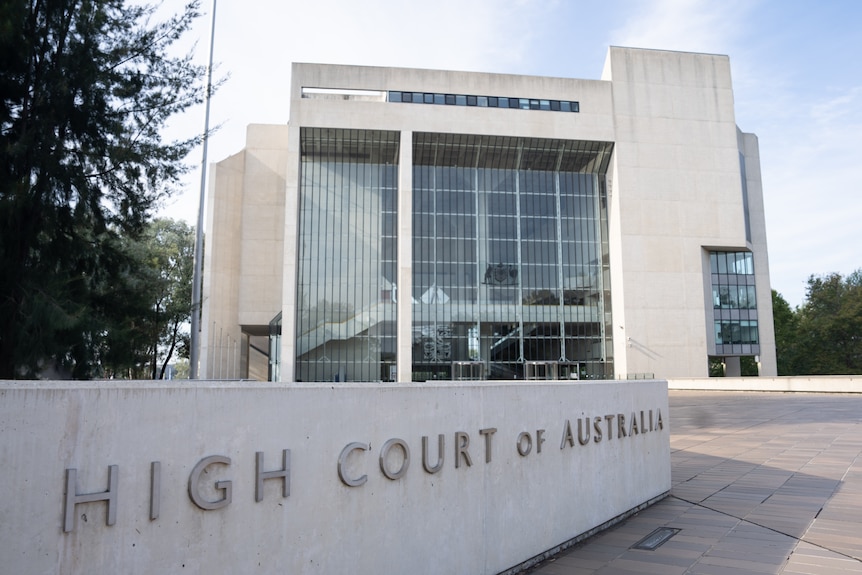
The High Court, by majority, dismissed Uber’s appeal. (ABC News: Matt Roberts)
Justice Gageler said contractor provisions had recently been re-enacted in NSW and Victorian tax legislation which were “speaking in the present” to the emerging gig economy.
In a joint judgment, Justice Michelle Gordon, James Edelman, Jacqueline Gleeson, Jayne Jagot and Robert Beech-Jones agreed with him, adding that contractor provisions were intended by parliament as one measure designed to “catch schemes designed to avoid liability for payroll tax”.
They agreed with the lower court that Uber’s business model depended on collecting money from riders on a per-trip basis and keeping a service fee, and that the driver’s service was what allowed Uber to legally do so.
“Drivers clearly ‘supply’ a service to Uber by doing something that is necessary for Uber to derive service fees and to continue its business,” their judgment said.
“The remitted amounts from Uber to a driver are paid or payable for or in relation to the performance of work (driving services) relating to a relevant contract … and are therefore deemed to be wages.”
Justice Simon Steward dissented.
The decision by the High Court leaves the door open for other states to pursue more aggressive interpretations of tax provisions designed to protect the traditional “employer-employee relationship” from manipulation by use of “so-called contractors to replace wages staff”.
Union slams ‘insidiously created’ model
The Transport Workers’ Union said it welcomed the High Court’s decision, calling it a “critical reality check to companies seeking to skirt our laws”.
“Even companies who engage workers who may not be employees will have to pay their fair share,” TWU National Secretary Michael Kaine said.
“Uber’s entire business model has been insidiously created by trying to distance itself from obligations under our laws, while reaping all the profits.
“But the time is up for gig behemoths and other tech companies who have used loopholes to squeeze from our communities and contribute nothing in return”.