
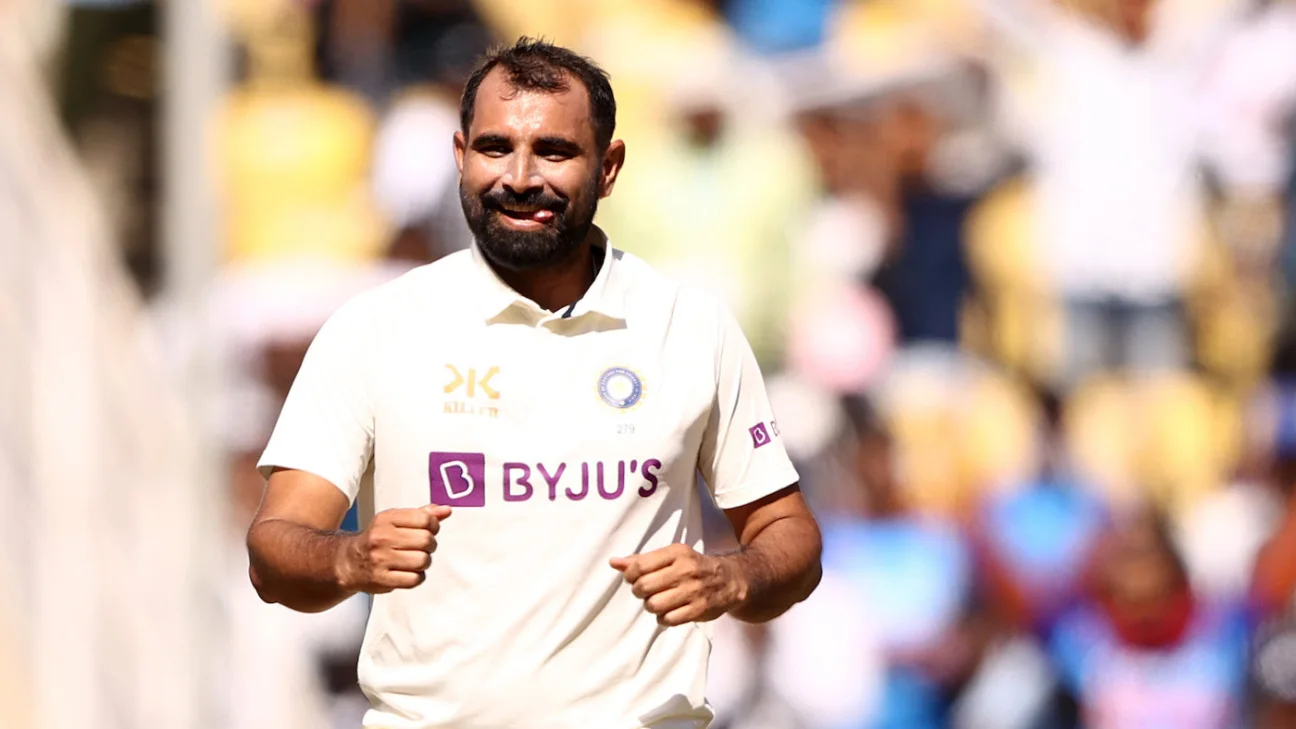
Mohammed Shami, the 20-year-old Ranji Trophy debutant, has a bit of a reputation in Kolkata for being a fast bowler who loves his sleep, biryani and the sound of rattled stumps. He moved there from his village Sahaspur in Uttar Pradesh four years ago. The middle son of tractor spare-parts seller, Shami came to Kolkata with no place to stay, no real acquaintances, and a contract at Dalhousie Athletic Club where cricket is not the No. 1 sport. It was still better than being in UP, a state without a club culture and where careers often depended on bowling two-three balls in mass trials.
The informal cricket network of club owners, former cricketers and state selectors, who still get excited every time they spot young talent, nurture this diamond in the rough.
Shami is no longer the kid who used to ask them whether he will get biryani if he puts in another big effort even when totally spent. He is a professional now, watching his team, Bengal, pile on 562 for the best part of the first two days of his debut. They declare in the dying light on day two, Shami bowls two overs before stumps, and then wakes up with high fever on day three.
He defies logic by taking the field after missing most of the morning session, spends an equal number of minutes on the field to be eligible to bowl again, and then with a fever of 102-103 degrees Fahrenheit, he bowls a long hostile spell to become the only bowler in the match to take three wickets on a dead surface.
WV Raman, the Bengal coach, remembers sending him for tests in Chennai when the fever has not subsided after a week. Turns out Shami has dengue and low platelets.
We’re in the corridor of the old National Cricket Academy building adjoining the Chinnaswamy Stadium in Bengaluru. Shami has come back from knee surgery, spent 40 days on crutches, now walking and in rehab. He has missed IPL 2015, but played through a gruelling tour of Australia and New Zealand: four Tests, an ODI tri-series and then the World Cup.
Shami says the discomfort in the knee began during the first Test, when he landed in the foot holes created by Nathan Lyon. It kept getting worse but he was India‘s best bowler in the World Cup with 17 wickets at 17.29 apiece and an economy rate of 4.81 per over. During the initial stages of the World Cup, he was told that he would eventually require surgery and it was up to him if he wanted to push through the pain and play. It would involve draining fluid from the knee two days before every game, light training on the match eve, and then 10 overs of full intensity.
This is the pre-Jasprit Bumrah universe. The team desperately wants Shami to stay. He doesn’t have second thoughts about playing on even though he hates having missed the IPL. He doesn’t know yet that this will cost him 18 months and one-and-a-half IPL seasons. In a country where bigger legends have timed surgeries to miss Test series but not the IPL.

Mohammed Shami usually let his seam position do the talking•BCCI
Shami’s first home season back brings him to Kolkata, the city that made a cricket career possible, the city where he made his Test debut. On the second day of the Test against New Zealand, his daughter falls sick and has to be in the ICU. On the second and third evenings, he dashes to hospital to be with his child, returns to the hotel late in the night, doesn’t let his team-mates know and finishes the Test with three wickets in each innings.This is necessary context for the disbelief from the likes of Ravi Shastri and R Ashwin at the selectors’ refusal to bring Shami back to international cricket and his subsequent retirement from Tests. To those who have played with Shami, or known Indian cricket of the Shami era from close quarters, there was more to his fitness than just metrics. It is a cliché thrown around all too readily but Shami would indeed run through a brick wall. It’s not just vibes; Shami, laidback but emotional, demonstrated this quality through countless long spells and persistence through injuries.
Age eventually gets the better of the best of us. Twenty years of fast bowling against all odds is bound to have taken a toll. Whether Shami’s body can handle another six months or a year at the top level is a borderline call, which the selectors didn’t want to risk so close to a World Cup.
Ends of cricket careers are rarely not messy. Shami’s is no different. This is him separating – in instalments – from what he has done, what he has loved all his life. And given what he did with the ball, why wouldn’t he love it? He loved it so much that during the Covid-19 pandemic he rolled out pitches at his farmhouse so that he could just keep bowling. Running and bowling were his preferred ways of staying fit; strength and conditioning in the gym were necessities that he embraced.
In an era of wobble-seam bowling – or dirty seam, as it was known when not yet universalised – Shami stood apart as the pure seam bowler with a release as pure as any in the game. His first tours of South Africa, New Zealand, England and Australia in 2013 and 2014 were full of promise but also a lack of control.
Injury and pain were a frequent presence in Mohammed Shami’s 64-Test career•BCCI
Once Shami sorted out the required fitness and endurance to stay accurate until his last spell of the day, he was no less a bowler than any of his era. He swung the new ball, his beautiful upright seam found any assistance the pitch had to offer, and he weaponised old-ball swing as lethally as anyone ever did.
There were few rushes as heady as Shami on a roll. And he was often on a roll, ending up in the top 10 strike rates among bowlers with at least 200 wickets. His method was so direct it almost sounds silly. Run in hard, bowl fast, seam upright, attack the stumps. No sledging, no mind games, no sendoffs. It is almost like the owner of the second club he played for, Town Club, has been shouting at him from the sidelines, “Shami, phaad de yaar [just burst through them].”
Conventionally, fast bowlers don’t attack the stumps so directly because it reduces the margin for error. That’s why Shami had to elevate his fitness to stay accurate and avoid bowling too straight. Attacking the stumps was a necessary reaction to the pitches he grew up bowling on.
And what a reaction it was. What a time it was to be alive when his favourite captain Virat Kohli tuned up the fans in the stands at Indian Test grounds and Shami ran in with a ball ready to go the other way. He used contrast swing with an upright seam as opposed to reverse swing with the seam canted in the direction the ball is meant to go. His release was so good he could bowl contrast swing at hard lengths, thus still attacking the top of off. The ball would start going so late it gave the impression you were watching seam movement with the old ball. Among bowlers who took at least 75 wickets in India – and this doesn’t include Jasprit Bumrah – nobody has a strike rate as good as Shami’s 42.61.We can always look back wistfully at just 64 Tests and 229 wickets. In eight years of his prime, from 2015 to 2023, Shami was also competing with a world-class attack for a finite number of wickets. Neither he nor Bumrah has a 10-wicket haul in a Test. Like Bumrah, he had to fight injuries throughout his career. To put in perspective what a physically demanding job it is to bowl fast in Test cricket, only 12 Indians have more than 200 wickets and six of them are spinners.
So, we can choose to be thankful that Shami had the spirit to keep bowling through injuries and fevers and personal crises, not missing his naps in between. We can choose to be grateful for how he made us feel while he was there, stripping down fast bowling to its basics, turning it into a thing of beauty without letting on the fire that forged it.
Sidharth Monga is a senior writer at Cricinfo