
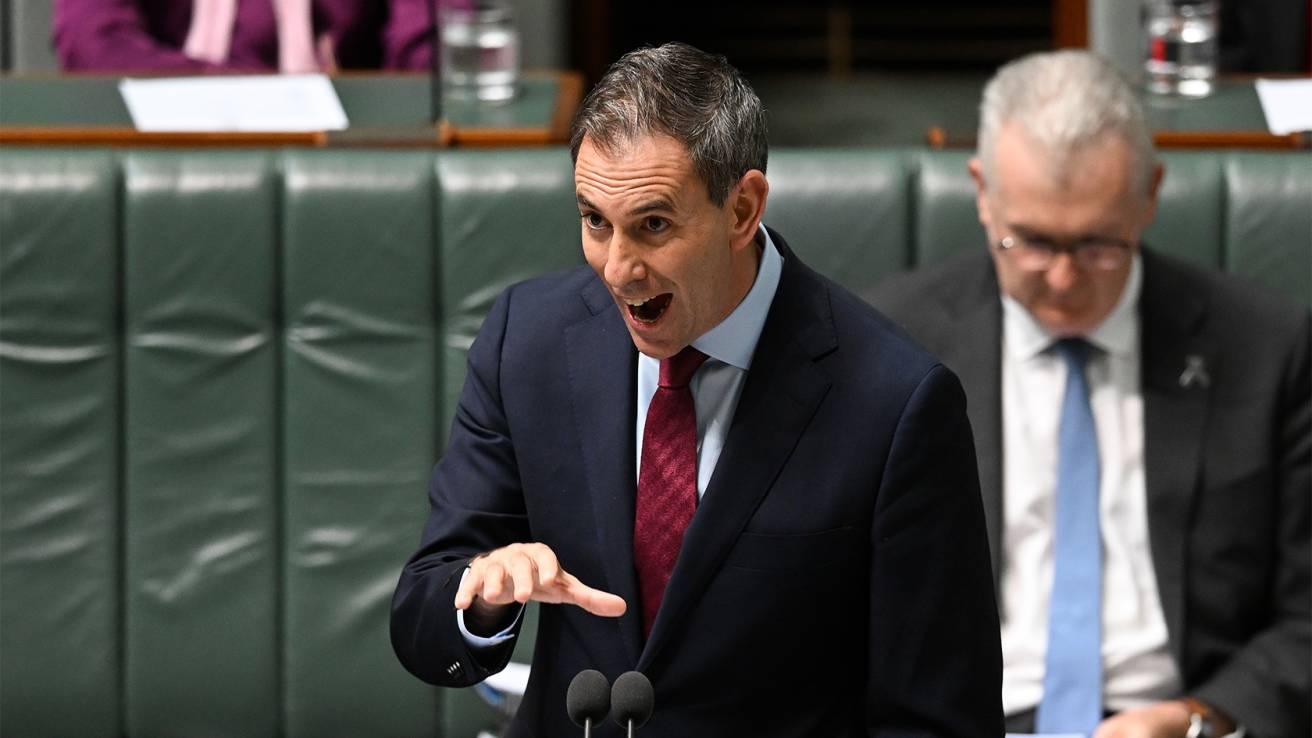
Inflation is high, interest rates have been raised to an 18-year peak, and the treasurer says things will get harder before they get easier. Suffice to say, the economic vibes in Australia are not great right now.
Even the Reserve Bank of Australia has acknowledged that the public has lost faith in the bank’s ability to bring down inflation. Voters are also losing trust in Labor’s economic management, according to a new Australian Financial Review poll.
As confidence in the economy plummets, opinions about why it’s happening are on the rise — and one in particular caught Crikey’s attention.
The Coalition’s assistant treasury spokesperson Kevin Hogan put out a press release in the wake of the RBA’s rate rise last week, asking the question: “Why is inflation higher in Australia?”
Related Article Block Placeholder
Article ID: 1271693

“If you listen to Jim Chalmers, our high inflation is all because of the war in the Middle East, oil prices, and data centres. But Australia isn’t the only country facing those global pressures — so why is our inflation so much worse than comparable economies?” Hogan wrote.
Independent. Irreverent. In your inbox
Get the headlines they don’t want you to read. Sign up to Crikey’s free newsletters for fearless reporting, sharp analysis, and a touch of chaos.
By continuing, you agree to our Terms & Conditions and Privacy Policy.
“The difference is that our economy is resting on the shoulders of Jim Chalmers, who is out of his depth and doesn’t understand the economic reality Australians are facing.”
For the Coalition, blaming the situation on the treasurer is a reflex, and it pays off politically: according to the AFR poll, the opposition is gaining points because of its image of being strong on economic management.
Hogan’s question is undoubtedly relevant. But Hogan used some curious metrics to underscore his point that Australia is doing worse than other countries.
“If we look at core inflation, which removes volatile things like fuel, Australia has the highest of any major advanced economy at 3.6% in September. Higher than Canada (2.2%), Germany (2.4%), the European Union (2.5%), the United States (2.6%), and the United Kingdom (2.8%),” Hogan wrote.
Hogan was “not being very honest” when comparing those core inflation figures, Sydney University senior lecturer in econometrics Luke Hartigan told Crikey. The reason is that each country chooses to exclude different costs to arrive at an inflation figure free from the turbulence of volatile product prices.
“For example, the US looks at the Private Consumption Expenditure deflator (PCE) removing food and energy,” Hartigan said. “This is not the same as the Consumer Price Index (CPI) we look at here. Further, they simply remove food and energy, while we remove extreme price moves which can be different items each quarter.”
The UK, in arriving at the 2.8% inflation figure Hogan cited, does not include price changes in housing, energy, food, alcohol and tobacco. When doing their own calculations, Australian government statisticians remove fruit, vegetables, car fuel and holiday travel, arriving at a 3.6% change over the 12 months to September. (We assume that was the figure Hogan cited, although it could also have been the trimmed mean, which was also at 3.6%. His office did not respond to questions from Crikey).
“The more comparable measure is to refer to ‘headline’ CPI inflation,” Hartigan said. “Here the US is 3.7%, Canada is 3.1%, Germany is 2.8%, the European Union is 4.0%, and the UK is 3.6%, while we are 4.3%.”
In other words, Australia is still doing worse, but the difference is not as stark with this comparison method. So the question remains: why is Australia’s inflation rate so high?
According to Hartigan, the RBA’s slow pace of lifting rates coming out of the COVID-19 pandemic is one part of the answer.
Related Article Block Placeholder
Article ID: 1271537

“It did not lift rates as aggressively as some other economies. The bank’s explanation was that it was trying to hold onto the gains made in the labour market (the low unemployment rate),” he said. “This was called the ‘narrow path’ strategy. The other explanation is that Australia had stronger growth compared to those other countries (besides the US) over that period and we have a productivity problem. The economy’s ‘speed limit’ is around 2% per annum and we have been hitting that limit.”
Jonathan Kearns, the chief economist at Challenger Investment Management, told Guardian Australia that while it was “very clear” Australia had a worse inflation problem than other countries, it was important to keep in mind Australia’s relatively strong labour market.
“Our performance in unemployment has been much better than in New Zealand, Canada and in Europe, and that is a positive thing for Australia,” he said.
When looking at the so-called “misery index” — measuring the experience of households by adding unemployment and inflation figures together — Australia sits right in the middle with a score of 9%, between the Euro zone (10.3%) and Canada (9.6%), and the UK (8.3%), the US (7.9%) and Japan (4.5%), according to The Guardian.