
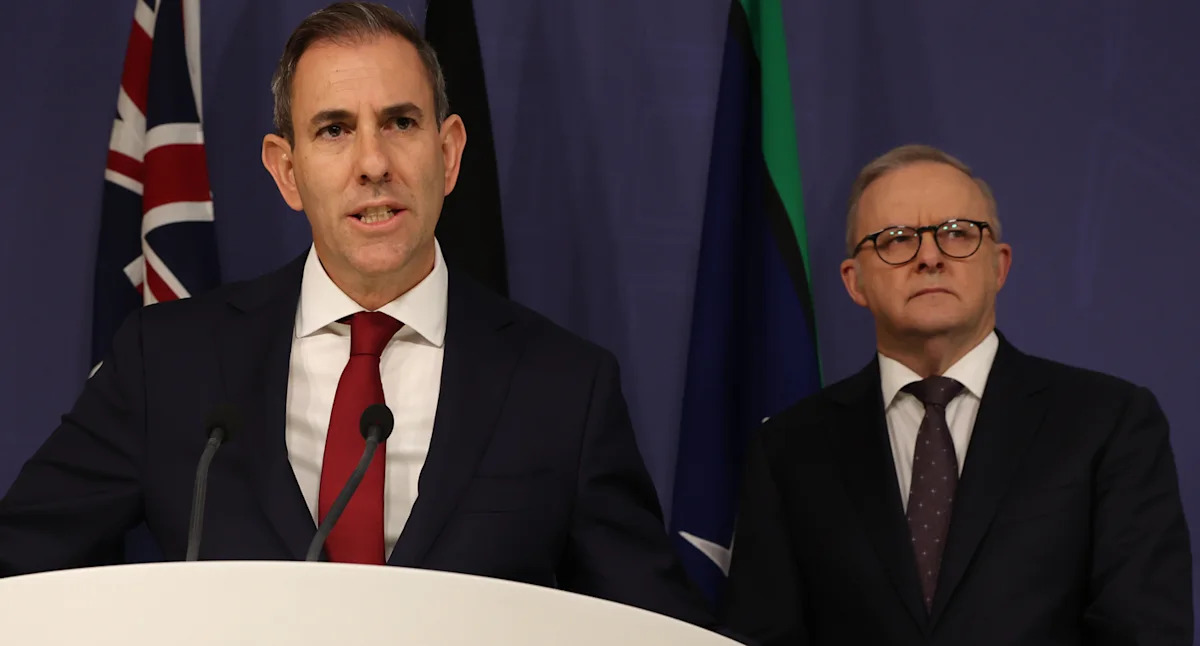
Treasurer Jim Chalmers is under growing pressure to back down on the government’s capital gains tax reform for businesses. From July next year, the 50 per cent discount will be replaced by a system that taxes all real gains – a change that is more punitive for innovative, fast growing businesses.
Immense backlash from the start-up and business community has seen the government revise its carve outs for the sector. But an alternate idea put forth by independent MP Allegra Spender to keep the CGT discount but reduce it to 40 per cent (down from 50 per cent) and apply it to all “active assets” has got the backing of the Australian Industry Group.
The CEO of the peak business body, Innes Willox, wrote to the Treasurer Jim Chalmers on Tuesday urging him to adopt the idea to avoid “unintended consequences” of the planned changes and remove “perverse incentives against risk taking” embedded in the current reform.
“The introduction of CGT indexation in this year’s Federal Budget will unfortunately impose many negative impacts on Australian businesses,” he wrote in the letter seen by Yahoo Finance, pointing to administrative complexity, asymmetric treatment of gains and losses and making Australia one of the highest capital gains-taxing jurisdictions in the OECD.
“We believe these negative impacts on business are unintentional consequences outside the primary objectives of the CGT reforms and could be rectified with appropriately designed amendments. The proposed Active Asset Exemption will rectify all three.”
RELATED
The government has proposed broadening the Innovative Business CGT Concession (IBCC) to keep the current discount rule to shield eligible start-ups, but the proposed plan has been criticised for being narrow and complicated.
Instead, Spender put forth an “Active Asset CGT Exemption Proposal”, which she says is a simpler and fairer alternative. It would mean that an active asset test would be used in place of the five “innovation principles” that the IBCC requires, including high growth potential and a competitive advantage.
It would see all businesses that take a genuine risk receive a flat discount, which Spender said would protect businesses who “might not meet the conditions of ‘innovative’ yet be high-risk and high-growth, and reward risk”.
In his letter, Willox urged the Treasurer to limit the inflation indexation method to passive assets such as property.
Story continues
MORE: Aussies face ‘double taxation’ under proposed CGT changes
“In practical terms, the proposal would retain the CGT discount method at a reduced 40% rate for ‘active assets’ only,” he wrote.
“In broad definitional terms, active assets are those associated or inherently connected with the running of a business. The CGT indexation method would be limited to inactive assets such as property and other types of passive investments.”
Alternate CGT plan provides ‘three fixes’
The AIG has been critical of the tax changes for reducing investment competitiveness, particularly in high-growth technology industries, and for adding to the complexity of the tax system.
“We believe these negative impacts on business are unintentional consequences outside the primary objectives of the CGT reforms and could be rectified with appropriately designed amendments,” Willox wrote.
“The proposed Active Asset Exemption will rectify all three. First, it will ensure businesses can continue to access the simpler CGT discount system for their active assets, avoiding the administrative complexity and compliance costs associated with CGT indexation.
MORE: Chalmers rules out franking credits change amid tax backlash
 Innes Willox, Chief Executive of Australian Industry Group, has questioned the public inquiry into the CGT legislation. · SAJJAD HUSSAIN
“Second, it will remove the perverse incentives against risk taking and asset diversification introduced by the indexation system. These have clearly been an unintentional outcome of the reform and can be entirely avoided by allowing active business assets to utilise the CGT discount system.
“Third, it will also return Australia’s effective tax rate on capital gains to a competitive level. While reducing the CGT discount from 50% to 40% raises the maximum CGT rate above its pre-Budget level (approximately from 23% to 28%), this would nonetheless position Australia near the middle rather than the top of the OECD range.”
Under the proposed policy put forth by Spender, all active assets, including shares and share options, would be excluded from indexation in favour of the fixed discount.
A Parliamentary Budget Office analysis found the lower discount would raise about the same revenue, Spender said.
Get the latest Yahoo Finance news – follow us on Facebook, LinkedIn and Instagram.