
Australia’s most in-demand and highest-paying jobs have been revealed, as workers grapple with a grim end to the year punctuated by mass redundancies and growing AI fears.
New data from the world’s largest talent company reveals people-facing roles had the most vacancies in the face of signs that technology was reshaping the labour market.
But data from Randstad also shows little correlation between the most sought-after workers and the highest paid, with corporate Australia facing a jobs reckoning.

MORE:Unexpected high-paying roles that don’t need a degree
“We’re definitely seeing that the demand is in areas where there are people skills needed, organisational skills, and those things that AI can’t do,” Randstad general manager Madeline Hill said.
“That customer service and customer experience type roles are definitely where things are increasing.”
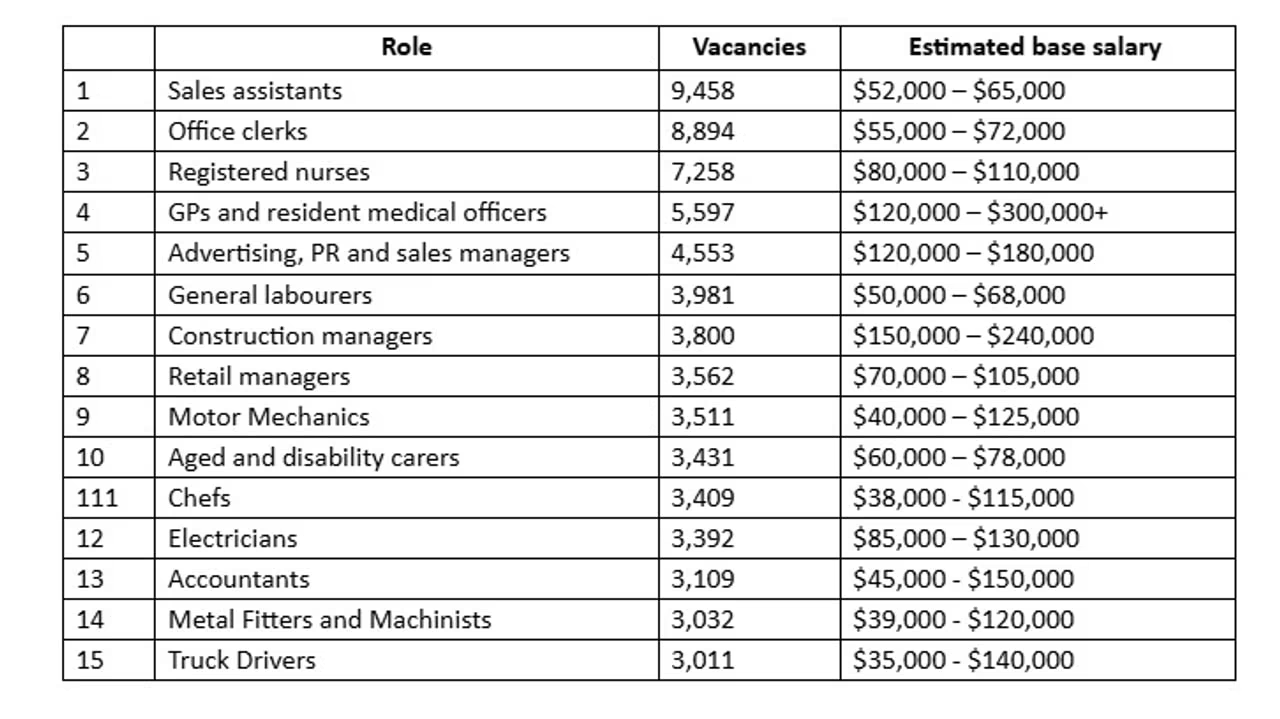
The data released to news.com.au showed sales assistants, office clerks, registered nurses, GPs and medical officers and those in advertising, PR and sales made up the top five most in-demand jobs.
Other hands-on roles like labourers, construction managers, retail, mechanics, and aged and disability carers rounded out the top 10.
MORE:6-figure job you’ve probably never heard of
Tamara Black, a Canberran who works in disability care, said her job offered flexibility and human connection. But she said staff turnover in the industry could be high, with many working it as a second or even third job.
“Whether it’s aged care or disability, there’s always going to be a need for someone to be supported,” Ms Black said. “So a bit of a hot commodity.”
Only one career, construction management, was found in the list of the 10 most high-paid jobs – coming in at eighth and an average salary of $220,000.
Ms Hill said the demand in this area and other trade roles were being driven by the uptick in AI infrastructure investment – like building data centres.
“You’ve also got lots of engineers, plumbers, thermal dynamic engineers and specialists, all needing to be engaged and a workforce stood up to ensure that happens,” she said.
“So we’re seeing job losses in some areas, but … where industry is growing there are job vacancies.”
‘Signs of weaker hiring’
It comes as Reserve Bank of Australia (RBA) chief economist Sarah Hunter spoke this week about the early signs of AI’s disruption of the local jobs market.
“Like other major technological shifts, AI is likely to change the job market significantly,” Ms Hunter said on Monday.
She said the RBA was mindful labour indicators “may mask disruptive displacement effects” for jobseekers, and noted “emerging signs of weaker hiring” in advanced economies.
“There are tentative signs of adjustment, through weaker job ad posting and employment outcomes in more AI-exposed occupations, and stronger growth in areas where the technology has had less of an impact, particularly for younger workers,” she said.
The central bank shared a graph showing how ads for jobs exposed to AI have tracked since ChatGPT was released in November 2022.
It revealed a notable drop into early 2023 before recovering to a level similar to before the AI tool became available in 2025; however, there was another downward trend in 2026.
Employment data also showed that younger workers aged 15 to 24 had faced lower employment than older workers, depending on how exposed their jobs were to AI.
Ms Hunter said AI was “likely to transform all aspects of work” and warned that the benefits were “unlikely to be distributed evenly”.
“Some workers may face a difficult period of adjustment as demand for particular roles or tasks decline, which will weigh on income and spending by some households,” she said.
“The strength of the consumption response will depend not only on the overall increase in income, but also on how broadly the gains are shared across the economy and the pathway for integrating the technology into our daily lives.”
The highest paid jobs
When it comes to the best-paid jobs in the country, there was little surprise in Randstad’s list.
Surgeon ($500,000), anaesthetist ($450,000), psychiatrist ($350,000), financial investment manager ($300,000) and airline pilots ($250,000) made up the top five.
Corporate lawyers, IT systems architects, construction managers, mining engineers and data scientists earned on average, between $200,000 and $250,000 per year before bonuses.
Data science was one white-collar profession Ms Hill saw the potential for significant growth in, due to booming demand for tech specialists across multiple industries.
Ms Hill was not ringing alarm bells for those seeking careers in the corporate world just yet.
“You will still have the corporate roles there. I mean there is so much in corporate Australia that requires complex conversations and driving complex decisions,” she said.
“If you look at banking, media, you still have that complexity there where it impacts humans. “And so any of those roles, they’re not going anywhere any time soon.”
There has been a noted rise in “job hugging”, where employees were prioritising security over career development.
Australian Bureau of Statistics (ABS) data showed that in the first half of 2026, 25 per cent of workers said they were planning to change jobs.
But ABS job mobility statistics revealed only 7.2 per cent actually changed jobs – down from 17 per cent in the second half of 2025.
Despite the doom and gloom in the media, Ms Hill said the desire for human centric jobs was a positive story for workers.
“And as we see this AI boom continue there, there are jobs that are growing in relation to that as well,” she said. “And it will unlock new opportunities for people.”
Australia’s ‘redundancy season’
News.com.au last week reported recruitment firms had seen a spike in jobseeker registrations in recent months, while major firms have been shedding workers.
Sarah Donegan, managing director of recruitment firm Samuels Donegan, said Australia was in the midst of a “redundancy season” – and she expects more hits to come before Christmas.
Her agency noted a 250 per cent spike in jobseeker registrations in October, with nearly half of its registrations since March coming in the past two months.
“I’m old enough to know that in years gone by, they would never make people redundant prior to Christmas. But now they just do it,” Ms Donegan said.
“I hate to say it, but it feels like we are definitely a little bit more cutthroat.”
The official unemployment rate rose to 4.7 per cent in September, with more than 39,000 jobs going since the previous figures in August. Economists expect it to rise past 5 per cent.
Business commentator and recruiter Tammie Ballis said the job market was a “dumpster fire” in 2026 thanks to the economic downturn and rise of artificial intelligence (AI).
“We thought it was bad a couple of years ago in 2024, but now it’s getting worse,” she said.
“I’m finding a lot of people who have been made redundant can’t get rehired. I’m finding a lot of uni grads that have got corporate-style degrees – in finance, HR, marketing, cybersecurity … they’re not getting a look in.”