
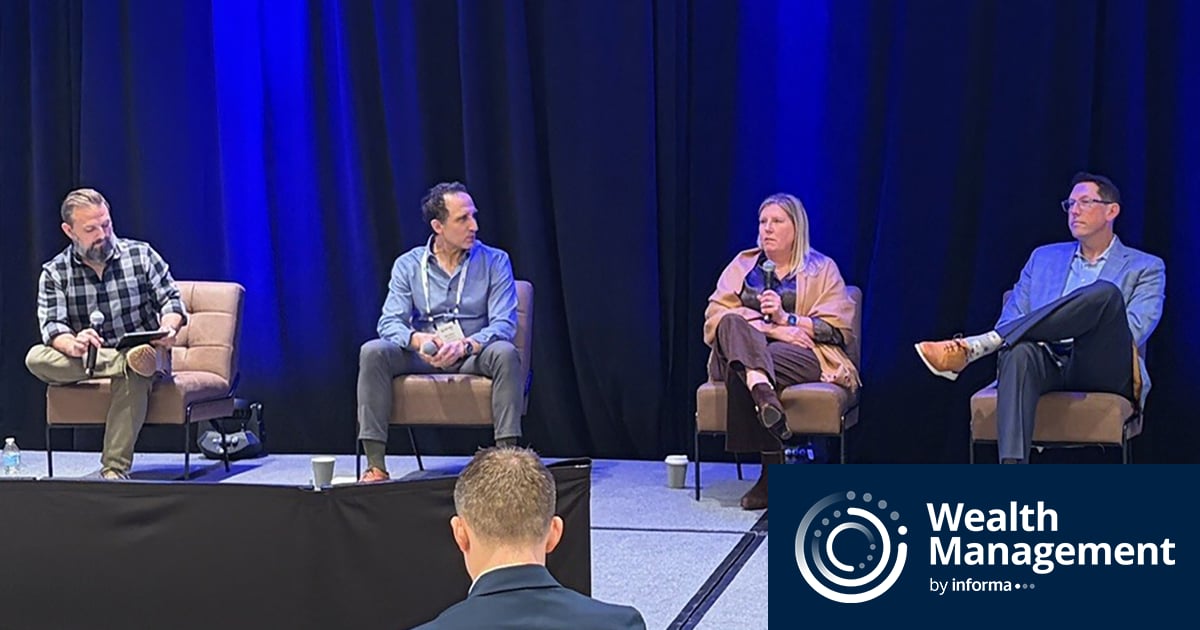
As registered investment advisors begin to consider bringing artificial intelligence agents into their workflows, firms should treat these tech co-workers like new hires, including writing job descriptions, giving them probation and conducting regular status reviews, according to a panel of wealthtech executives speaking at RIA Edge Austin on Tuesday.
The executives made comments during the Tech for Growth Summit portion of the conference, which focused on how wealth management is moving on from AI notetaking to fully embedded, agentic agents working alongside employees.
The panel focused on hiring “agentic staff” and sought to encourage advisors to implement AI co-workers, but at a slow, measured pace with proper guardrails to ensure success.
“My general belief is that while you might want to start with the job description … I advocate starting small,” said Alison Dooher, managing director and head of AI for Schwab Advisor Services. “As you build an agent around one activity, you can really define it with a level of clarity that then allows you to build an agent with the right governance and guardrails and monitoring.”
The conversation about agentic AI is happening as RIAs hear from various vendors promising AI tools that, for a fee, can sync data across platforms and eventually run tasks such as client onboarding.
Trevor Hicks, the former CTO of Advisor360 and recent founder of the consultancy Stack Strategy, said to think of AI agents as trainees who would naturally need guidance before taking on assignments that affect the business.
“Think of the intern that you’re going to bring in,” he said. “You’re not going to give the intern the keys to the castle.”
Karl Simon, co-founder and CTO of Subatomic AI, which builds AI co-workers for wealth managers, said he likes the idea of AI agents growing and evolving in their roles as well, just like human employees.
“As they are proving they can handle it, they can take on more and more responsibilities, similar to a human being,” he said. “There is always a human in the loop, but the AI agent is growing; they’re laddering up in the organization.”
Simon added, however, that even as agents evolve, so will the need for security controls and the proper prompts to guide them.
“This isn’t just writing a long, extensive prompt,” he said. “You really need to actually define the specific checks and boundaries in which they can operate.”
Moderator James Cantwell, founder and product architect at RIA Ascent, asked the group about the need for “clean data” before a firm can start using AI agents.
In general, they agreed that while RAIs need to be aware of the viability of their data sets, it does not need to be “pristine” if they work correctly with the AI agents on its use.
“I do think clean data is the foundation to successful AI, but it can be done in parallel as you build use cases that demand the requisite data,” Simon said.
He added, however, that AI itself can help with cleaning and assessing data for a firm.
Cantwell agreed, noting that advisors can guide its AI on which data to use and which to avoid or be cautious about.
“As you’re building out your agents, you can give them instructions on the data you trust and the data you don’t, and what to do, and what to check, what to verify, and what to surface to you for a decision,” he said. “Your data doesn’t have to be perfect to get started. You just have to understand what’s good enough and give your agent enough context to understand what to do when it’s uncertain about that data.”
Schwab’s Dooher noted a growing conundrum in the marketplace, where clients sometimes tell advisors they don’t want AI managing their personal data. That may be a challenge, she said, once RIAs have embedded AI agents across their systems. One solution, for now, is to be clear and transparent about how advisors use AI, she said, noting regulators may start calling for such disclosures.
Hicks, however, pushed back against the idea that AI would need extensive reporting or transparency in the long run, comparing it to firms’ move to using the cloud for computing.
“Hopefully, we get to a point where AI is part of the normal day-to-day, and it’s not something that’s seen as being very risky,” he said. “I wonder how many of our clients are using AI in their personal lives already.”