
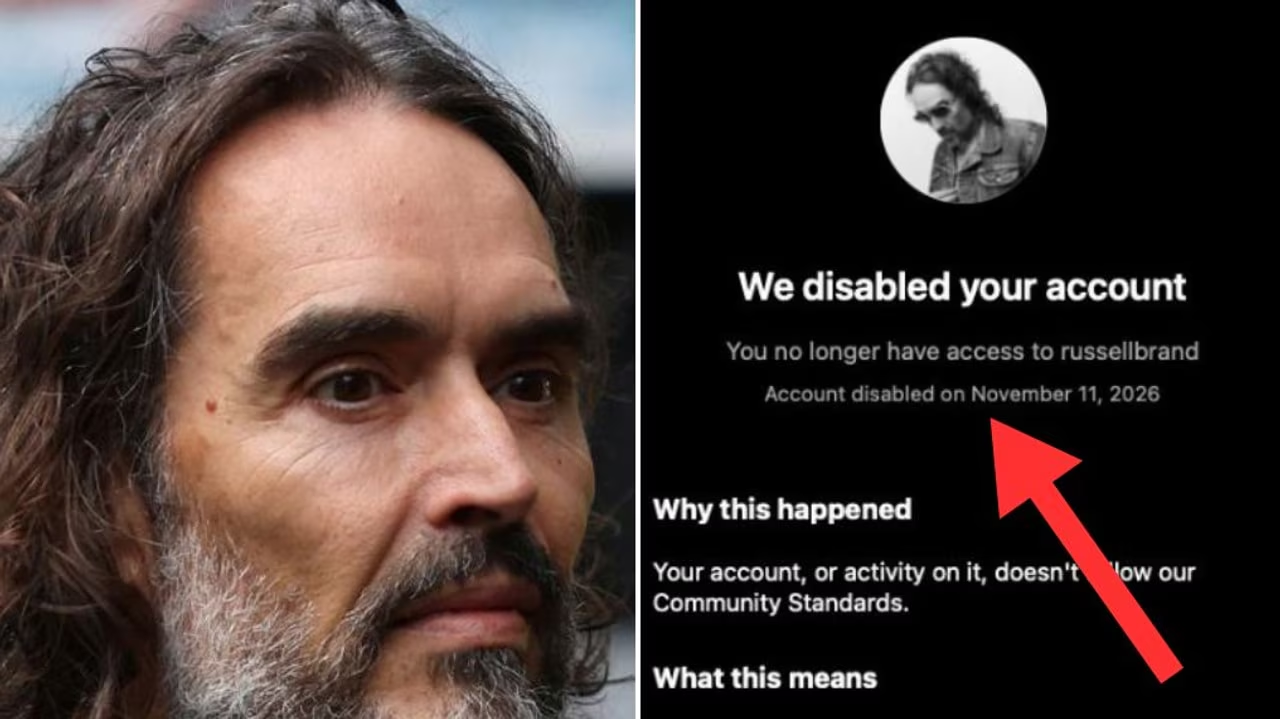
Disgraced actor and comedian Russell Brand’s official Instagram and Facebook accounts have been deactivated overnight in the wake of his high-profile rape and sexual assault convictions, sparking a defiant message shared to his X account.
“There never was a Russell Brand, according to @Meta,” the post on Brand’s X profile read.
Obsessed with the Russell Brand case? Download our new app and never miss a headline

It remains unclear whether the post was written by Brand himself or published by members of his inner circle, given the 51-year-old was handed a 10-and-a-half-year prison sentence in a London court earlier this week.
The shoutout to Elon Musk comes after the tech billionaire publicly waded into the criminal proceedings.
Weighing in on the prospective prison term Brand was facing, the X owner needed only a single word to make his stance known, labelling the potential punishment “unjust”.
Musk offered no further context or explanation for his reaction, failing to clarify why he considered the sentence unfair or identify any specific findings by the jury or the court that he took issue with.
Brand’s social media before his account went down
Before the deactivation of his account, Brand had gained nearly two million new followers across his social media channels in the wake of the disgraced celebrity’s rape conviction.
Instead of falling silent as the accusations mounted, the 51-year-old British actor and comedian doubled down on his media footprint.
By framing grave allegations of sexual violence as an establishment conspiracy aimed at taking him down, Brand tapped into a booming audience of anti-woke sceptics, wellness advocates, and deep-state conspiracy theorists who rallied around him in record numbers.
Cashing in on persecution
The surge in followers became the cornerstone of a heavily monetised online enterprise.
In 2024, Brand relocated his family to Florida, using the move as a springboard for a high-profile metamorphosis into a born-again Christian influencer.
Sharing footage of his baptism and quoting scripture, he presented his mounting legal challenges as modern spiritual persecution.
His US-based wellness business, Reborn, wasted little time capitalising on the loyal following.
The company began selling $US34.99 (around $50.87 AUD) “Free Russell” T-shirts sporting the slogan “silenced for speaking out,” turning the impending court battle into branded lifestyle merchandise.
Online comment sections mirrored the marketing, with supporters declaring that “the elite woke got him” and insisting the case was nothing more than a co-ordinated political take-down.
The claims that took him to jail
The controversy originated in September 2023 following a joint investigation by The Sunday Times, The Times, and Channel 4’s Dispatches.
Four women came forward detailing incidents of rape, sexual assault, and emotional abuse between 2004 and 2009 — a period during which Brand was at the summit of his mainstream television and Hollywood fame.
Brand immediately went on the attack, uploading a pre-emptive video to his accounts where he denied all criminal misconduct, insisted every encounter was “absolutely always consensual”, and accused the legacy press of orchestrating an organised smear.
A 10.5-year sentence
While online algorithms delivered views, subscriptions, and revenue, detectives from the Metropolitan Police and lawyers from the Crown Prosecution Service assembled a comprehensive criminal case.
The trial at London’s Southwark Crown Court heard detailed accounts of predatory conduct, with prosecutors arguing Brand weaponised his celebrity and influence to exploit and assault women.
A jury ultimately rejected his defence, returning a guilty verdict for one count of rape — stemming from a 2009 assault at his London home — along with three counts of sexual assault.
During sentencing, Justice Joel Bennathan demolished Brand’s defence and delivered a scathing indictment of his conduct:
“Whatever women wear, wherever they go, indeed whatever they drink, they retain the right to say no and to demand justice from the criminal courts when sexual predators like you, Russell Brand, act without their consent,” the judge said.
Algorithms vs. the courtroom
The spectacle outside the court on sentencing day laid bare the gulf between online echo chambers and the reality of criminal justice.
Supporters assembled with a handpainted banner referencing his conversion, reading: “CHRIST WAS CRUCIFIED FOR TELLING THE TRUTH. RUSSELL IS THE TRUTH.”
Inside the dock, Brand held a crucifix as the 10.5-year term was confirmed.
In England and Wales, where only around 3 per cent of reported rape cases result in formal charges, securing a prison sentence of this magnitude against a high-profile figure remains exceptionally rare.
While the courtroom delivered legal accountability, the nearly two million followers Brand accumulated after the allegations were aired underscores how modern digital platforms can package criminal accusations as a badge of honour and turn controversy into an insular, profitable brand.