
DULUTH, M.N. (Northern News Now) – A research vessel in Duluth is preparing to help scientists turn Lake Superior into a laboratory for studying some of the universe’s most elusive particles.
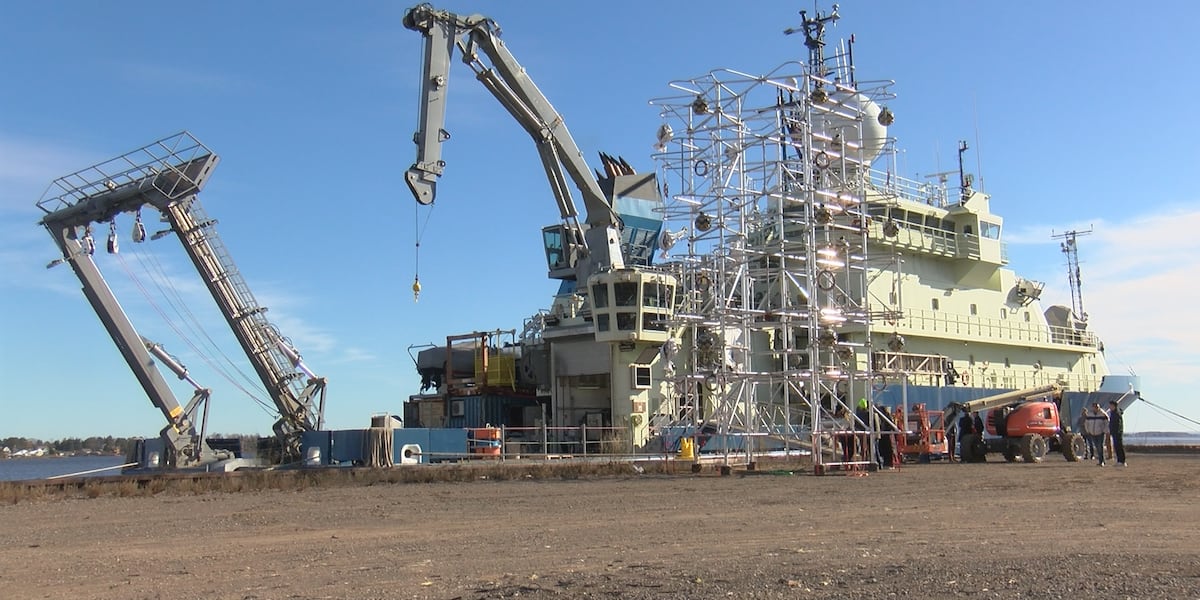
Researchers from the University of Minnesota-Duluth and other institutions plan to place 33-foot-tall sensor arrays on the lakebed near Two Harbors to detect neutrinos, tiny particles that can pass through nearly everything.
Professor of Physics at UMD Alec Habig said, “neutrinos are one of the fundamental particles of the universe, but they’re the one we know the least about.”
The project aims to test whether a natural body of water can be used to detect a beam of neutrinos. The sensors will look for flashes of light associated with neutrino interactions, with data sent back to shore through a fiber-optic cable.
Since 2005, Fermilab in Illinois has aimed a neutrino beam toward the Soudan underground laboratory in northern Minnesota. That beam passes through Lake Superior and is expected to shut off in February as Fermilab prepares a new beam directed toward South Dakota.
“So that’s why we’re here, is to look for beam neutrinos in the lake using the natural body of water to do so as a proof of concept,” said Habig.
The Experimental Neutrino Detector project involves university and government researchers, with testing planned in Lake Superior and Lake Vermilion. The goal is to develop a system that can distinguish neutrinos from the Fermilab beam from background neutrinos and other noise in shallow water.
A vessel built for exploration
The Woods Hole Oceanographic Institution’s R/V Neil Armstrong will help deploy the equipment. During a media event Tuesday at Duluth’s Clure Terminal Expansion Pier, researchers showed off the sensor arrays and offered a look at the vessel’s working deck and laboratory spaces.
The 238-foot ship is making its first visit to the Great Lakes. Its name honors astronaut Neil Armstrong and reflects a connection between ocean and space exploration, according to a representative of the Woods Hole Oceanographic Institution.
Woods Hole Oceanographic Institution vice president Rob Munier said, “just as he rode that rocket to outer space, his namesake goes to the ends of the Earth to help scientists answer fundamental questions.”
For now, researchers say the focus is on testing the technology and exploring what it could make possible in the future.
“We don’t have a preconceived, this is the thing we want to discover with this one,” said Habig, “we’re trying to see what we can do and how we can do it with an eye towards the future.”
Testing is expected to continue through the winter and wrap up around April, although the Fermilab beam used for part of the work is expected to shut off in February.
The first sensor is expected to be placed into Lake Superior on Thursday morning near Two Harbors.
Copyright 2026 KVLY. All rights reserved.