
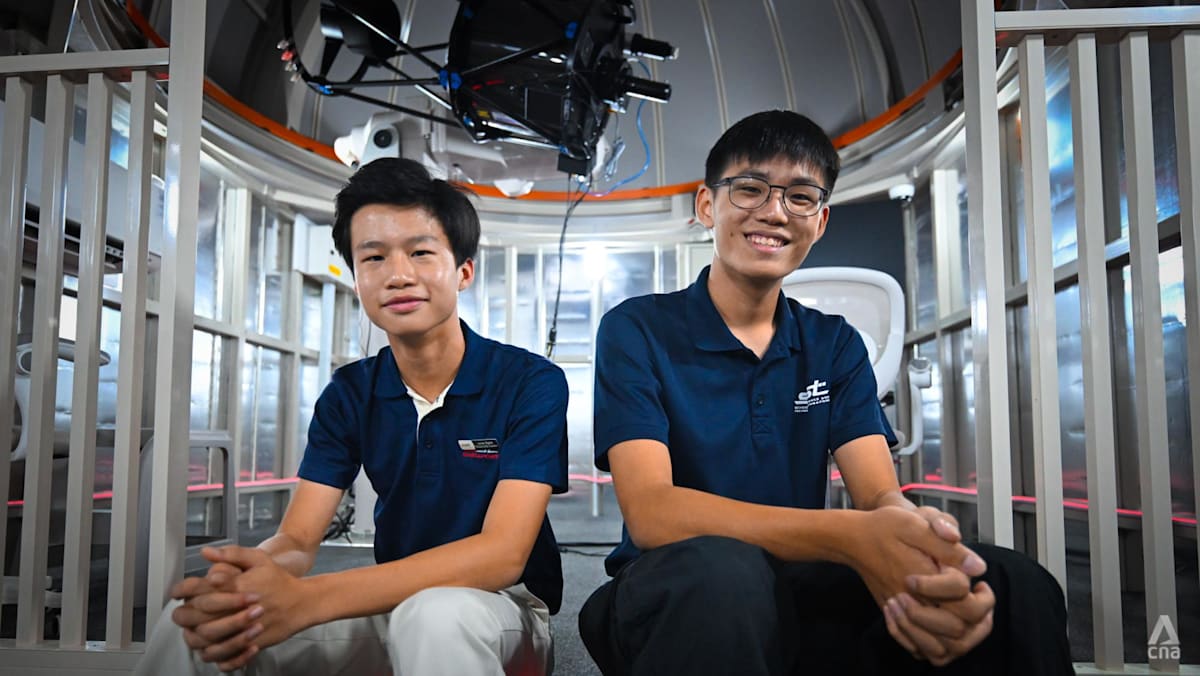
Edmund is among a growing group of young Singaporeans setting their sights on the space industry, with some hoping to turn their passion into a career.
And schools are helping them take their first steps, offering hands-on experience through projects ranging from studying solar flares to building satellites destined for orbit.
The push comes as Singapore looks to grow its nascent space industry, which currently employs about 2,000 professionals, according to figures shared by Minister for Energy, Trade and Industry (Energy and Industry) Tan See Leng in parliament last month.
Beyond astronauts and rocket launches, the sector needs engineers, researchers and data specialists to develop satellites, maintain communications systems and analyse information gathered from space.
The National Space Agency of Singapore (NSAS) noted that the industry also needs professionals who can apply space technologies in sectors such as maritime and finance.
SPARKING AN INTEREST IN SPACE
Educators told CNA that early exposure will be crucial to building a pipeline of local talent.
At SST, students now have access to facilities that allow them to pursue space-related projects beyond the classroom.
Its space technology centre, which opened in April, houses an observatory and radio room, where students can track satellites and communicate with radio users around the world.
SST is one of two secondary schools with an observatory – the other being the NUS High School of Mathematics and Science – and the only one with a dedicated amateur radio station.
For alumnus Gavriel Chia, 17, who was the former president of SST’s astronomy club, the facilities have made pursuing his interests easier.
Previously, he and his peers had to set up antennas in an open field, where strong winds could knock them over and other curious students could disrupt data collection. They also borrowed part of the school’s music room for their work.
Now studying at National Junior College, Gavriel regularly returns to SST to use its facilities. His projects include studying solar radiation and solar flares – powerful bursts of energy from the sun that can disrupt radio communications and satellite operations.
“I’ve also been using the observatory to take deep sky photographs of galaxies and nebulae,” said Gavriel, who hopes to work as an astronomy researcher.
“This sort of equipment is not easily accessible to amateur astronomers like us because of the price and the space constraints we have.”
His passion sometimes draws puzzled reactions from his peers. “Some of my friends ask what I’m doing, and if I’m speaking to aliens,” he said with a laugh.