
The Kangaroos have enjoyed a long dominance over the Kiwis, understandable given the weight of player numbers, the resources and money on that side of the Tasman, and the number of professional clubs. But when lightning does strike for the Black and White V against Australia, it often happens in the Queensland capital.
They have beaten the Kangaroos six times out of 13 matches there in the past four decades. That compares with one win in Sydney – in 2005 – from 11 attempts in the same period and a single victory in Melbourne from five visits, while occasional games in Newcastle, Townsville, Gold Coast, Perth and Canberra have yielded only defeats.
Graeme West touches down for the Kiwis against Australia in Brisbane in 1983. Photo / Courier Mail
And it’s not just the results but the magnitude of the occasion. The start of the Kiwis’ modern era is generally traced back to the famous night at Lang Park in 1983, when Graham Lowe’s team faced one of the best Australian teams in history. Known as “The Invincibles”, a year earlier the Australians had become the first side to go unbeaten through a tour of Britain and France, at a time when such trips were months rather than weeks. But the Kiwis, captained by Graeme West, prevailed 19-12 in an epic contest that delivered their first win over their transtasman rivals for 12 years.
There was an even bigger shock in 1987. Coach Tony “Tank” Gordon’s unheralded team, with several new faces, including amateurs from the local club scene, weren’t given much chance against the Australian superstars, led by Wally Lewis and Peter Sterling. But the Kiwis, with Kevin Iro on debut and captained by Hugh McGahan, tackled themselves to a standstill and scored two fine tries in a 13-6 boilover.
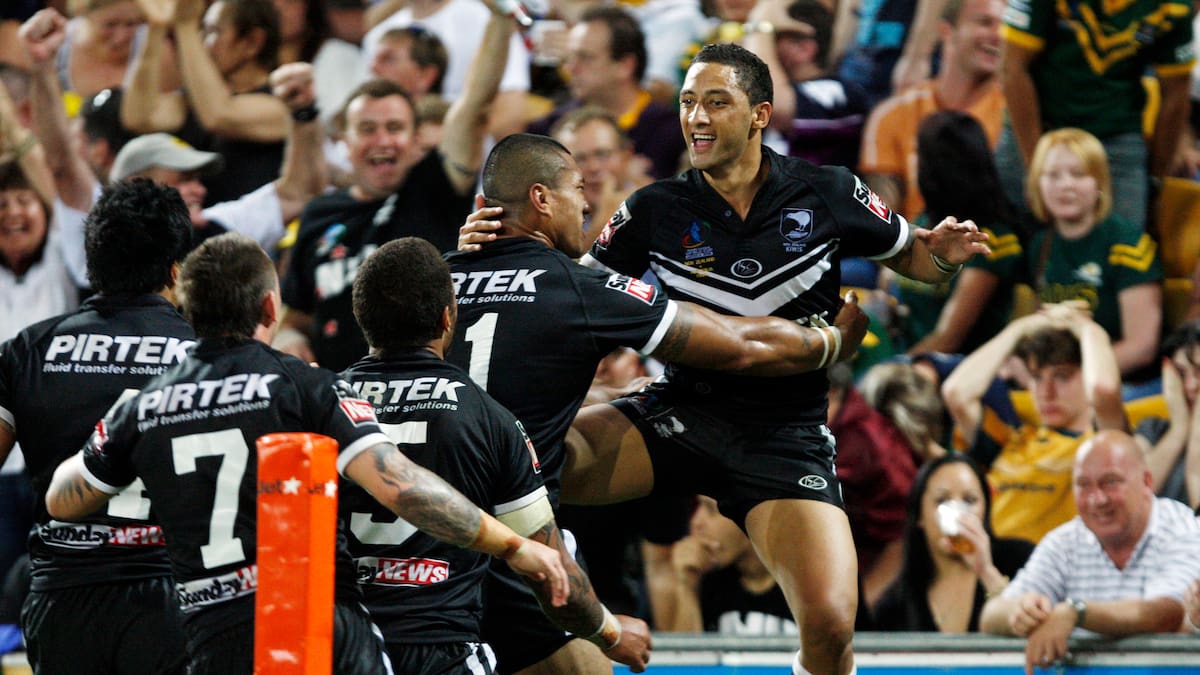
Probably the most unexpected win came in the 2008 World Cup final. The Kiwis were rank outsiders, coming off a heavy defeat in the group stages, against the likes of Cameron Smith, Billy Slater, Greg Inglis and Darren Lockyer. But the New Zealanders crashed the green and gold party, with a stupendous performance inspired by Jeremy Smith, Lance Hohaia, Adam Blair and Benji Marshall leading to a 34-20 victory.
The Kiwis celebrate winning the Rugby League World Cup in 2008. Photo / Andrew Cornaga, Photosport
Two years later the Kiwis managed another Brisbane coup, this time in the 2010 Four Nations final. They trailed until the final minutes, when Marshall and Jason Nightingale engineered a long-range break, which was finished by Nathan Fien for a 16-12 win.
That was followed by more years of pain before the 2014 triumph. The following season the New Zealand side were in Queensland again for the Anzac test, desperate to break a 17-year losing streak in the mid-year fixture. They were superb. After Australia opened the scoring, the Kiwis scored four unanswered tries in a brutal display of power and physicality for a 24-6 halftime lead. The Kangaroos tried to respond after the break but were continuously repelled, for another milestone victory.
Sunday’s World Cup final (9.35pm NZT) is the Kiwis’ first match in Brisbane since that afternoon. It’s been a long time because of the reduction in transtasman matches and Covid, which shut down the international game for two seasons.
But history still matters. For various reasons, Kiwis teams feel comfortable in Brisbane. It’s more relaxed than Sydney, far from the bright lights and easy to get around. The people are different too, as is the climate, while any test here attracts a lot of expatriate support.
Perhaps most of all, the team can take inspiration from history, from Joe Ropati’s bullocking try in 1983 to Roger Tuivasa-Sheck’s inspirational defence in 2015, knowing that the ghosts of the past are on their side.
Michael Burgess has been a Sports Journalist for the New Zealand Herald since 2005, covering the Olympics, Fifa World Cups, and America’s Cup campaigns. He is a co-host of the Big League podcast.