

Nearly 30 years have passed since the rainy night when Yuki was supposed to accompany her son to an Israeli military induction center. Instead, she and other family members drove him to a hospital for involuntary psychiatric treatment. Her son, now 46, has lived with schizophrenia and its consequences ever since.
“We’ve been on a long and difficult journey ever since. His world and ours were turned upside down forever,” Yuki told ynet.

‘Help me, I can’t take it anymore’: The struggle of people living with schizophrenia
(Photo: Shutterstock)
“Looking back, you realize there were warning signs,” she recalled. “He was a very troubled teenager. There were outbursts of anger, aggressive behavior toward family members and suicide attempts. He was receiving treatment, and we weren’t ignoring the difficulties, but nobody imagined the diagnosis would be so severe.”
Shortly before his 18th birthday, his condition deteriorated sharply.
“There was a very serious outburst. He accused one of his brothers of trying to poison the dog and ran away from home. I remember his brother, who was 10 years younger, lying under a duvet, trembling with fear,” she said.
“Eventually, he came home, sat on the floor, held his ears as though he was hearing voices and said, ‘Help me, I can’t take it anymore.'”
At the hospital, he was diagnosed with schizophrenia and admitted involuntarily.
Yuki’s experience reflects the struggles of thousands of Israeli families living with schizophrenia, a severe, chronic psychiatric disorder. Beyond the symptoms of the illness itself, many patients face debilitating side effects from antipsychotic medications, undermining their quality of life and sometimes making it difficult to continue treatment.
Now, a newly developed medication offers the possibility of a different approach. But for many Israeli patients, the greatest obstacle may be its price.
In September 2024, the U.S. Food and Drug Administration approved Cobenfy, developed by Bristol Myers Squibb, for the treatment of schizophrenia in adults. It marked the introduction of a fundamentally different mechanism of action after more than 70 years in which antipsychotic treatment has largely relied on targeting dopamine receptors.
Unlike traditional antipsychotic medications, Cobenfy does not directly block dopamine receptors. Its alternative mechanism has raised hopes of controlling symptoms while avoiding some of the troubling side effects associated with existing treatments.
The drug has now been submitted for inclusion in Israel’s publicly funded national health benefits package for the second consecutive year. The Israel Psychiatric Association has ranked it as its highest priority.
But private treatment costs approximately 8,000 shekels per package, around $2,500, putting it beyond the financial reach of many patients and their families.
Cobenfy is available through Clalit’s supplementary health insurance and several targeted arrangements, including full funding for eligible patients receiving rehabilitation services from Israel’s Defense Ministry and a compassionate access program operated by the manufacturer. None of these arrangements, however, provides universal access.
Yuki’s son is among those waiting for the medication to be included in the national health benefits package.
“People with mental illness are the weakest and poorest population,” said Yuki, who has become active in Otzma, an Israeli organization advocating for people with mental illness and their families.
“Many cannot earn a living and survive entirely on disability benefits amounting to just a few thousand shekels. These families will never be able to purchase the medication unless it is included in the health benefits package.”
Her son, she explained, is intelligent and talented but struggles with obstacles that prevent him from working.
“People on the outside find it difficult to understand why it’s so hard for him to get up in the morning and go to work, or just how difficult interacting with other people can be.”
Psychological treatment is also essential, she said, but long waiting lists in the public system frequently force families to seek expensive private care.
Over the years, Yuki’s son tried numerous medications without achieving sufficient improvement. Eventually, he began taking an older antipsychotic reserved for patients who have not responded adequately to other treatments.
The medication helped stabilize his condition, but the physical consequences were severe.
“Beyond the physical risks, the medication requires monthly blood tests to prevent a sharp drop in white blood cells,” Yuki explained. “There are also side effects such as excessive drooling, trembling hands and weight gain. A few years ago, my son also suffered a severe epileptic seizure as a result of the treatment.”
The side effects, she said, extend far beyond physical discomfort.
“They’re also a major social barrier. If you’re drooling and your hands are shaking, it’s difficult to find employment, work with people or handle food.”
Today, her son’s condition is relatively stable, and he has not required hospitalization for many years. Yet stability does not mean the struggle has ended.
“For someone living with mental illness, the suffering is endless. Schizophrenia is a roller coaster,” she said.
“He can talk to you and say everything is fine, and half an hour later everything is black. He asks why everyone is against him and says he wants to die. It’s an endless upheaval, and the family is part of it. This isn’t a ‘difficult period’ where you take a pill and become balanced. It’s a lifetime, decades of worry.”
Even an ordinary telephone call can become a crisis.
“I always say his phone calls are a little like calls from the lottery, except you don’t always win. You never know whether it’s going to be a pleasant conversation where everything is fine or a terrible crisis that’s very difficult to calm down.”
Over time, she has learned how to respond without being overwhelmed by every episode. But the stigma surrounding mental illness remains another burden for the family.
“My son often describes it as an invisible disability, but it’s not really invisible. It’s murky. The moment there’s even a slight deviation in someone’s behavior, people notice, pull away and can even become insulting.”
Yuki believes effective treatment is not simply about improving everyday functioning. It can also be a matter of survival.
“People living with severe mental illness face constant risks to their lives,” she said. “When my son is stable, he’s pleasant and incredibly loving. But when the illness worsens and he’s unwell, patients can endanger themselves and sometimes the people around them.”
“My son has spoken many times about wanting to die. People with mental illness experience tremendous despair. Imagine looking around and seeing where people your age are, how your siblings have started families, advanced in their careers and built their lives, while you’re still fighting the illness. It’s enormous pain.”
She also pointed to the shorter life expectancy associated with severe mental illness, which she attributed in part to inadequate attention to patients’ physical health.
“For these patients, effective medication can save lives.”
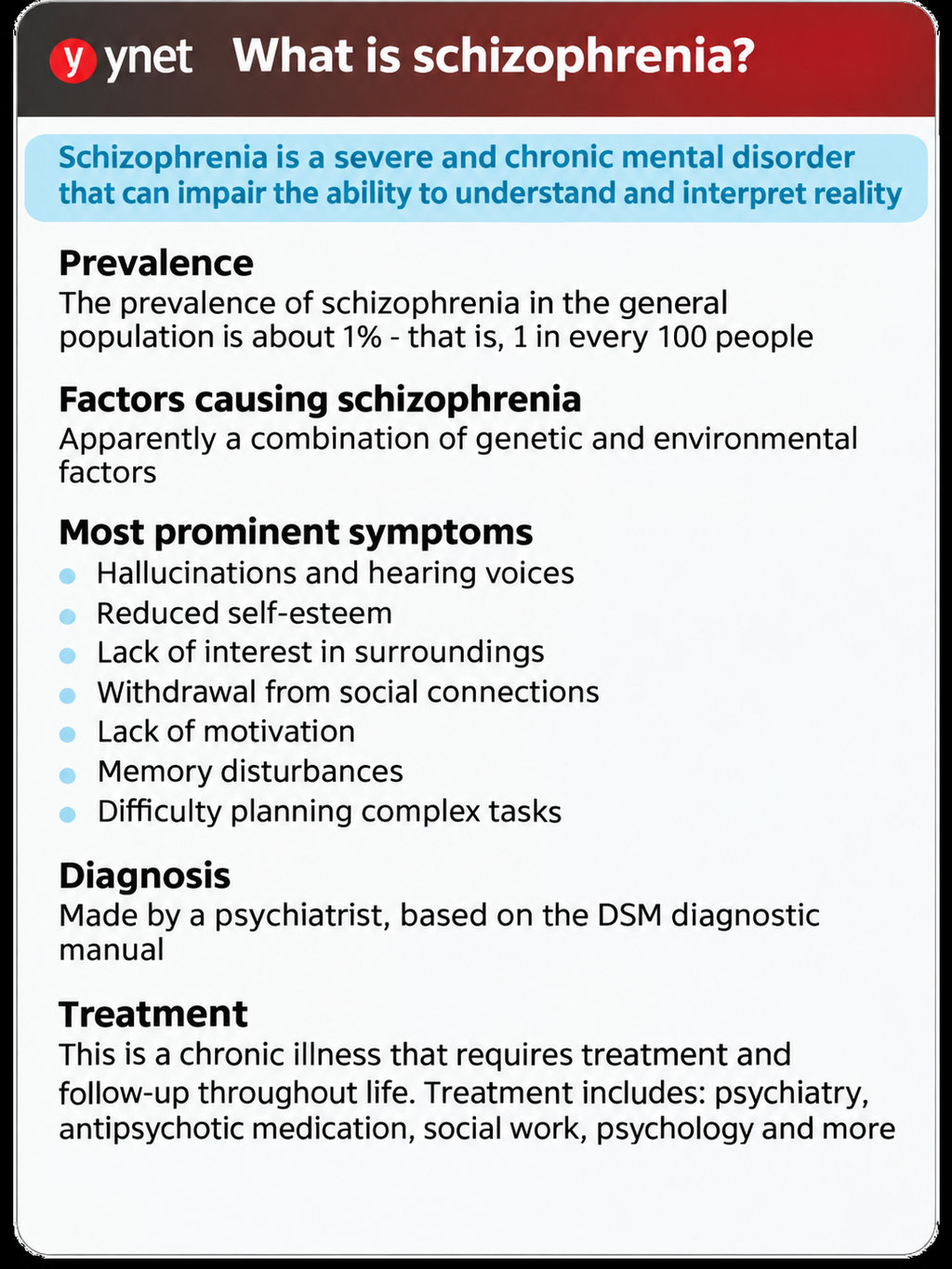
Schizophrenia is a complex psychiatric disorder that can affect how a person perceives and interprets reality. Its symptoms are generally divided into two categories.
Positive symptoms include hallucinations, such as hearing voices or seeing things that are not present, delusions involving persecution or grandiosity, and disorganized thinking, speech or behavior.
Negative symptoms include reduced emotional expression, diminished motivation, limited speech, difficulty experiencing pleasure and social withdrawal. Many patients also experience cognitive difficulties involving memory and concentration.
According to the World Health Organization, approximately 23 million people worldwide, roughly one in 345, live with schizophrenia. In Israel, an estimated 70,000 people have the disorder.
Symptoms typically emerge between late adolescence and the early 30s. Among men, onset tends to occur earlier, often in the late teens or early 20s, and the illness can be more severe.
For decades, antipsychotic medications have primarily targeted dopamine, a neurotransmitter involved in movement, motivation, reward and other brain functions.
“For 70 years, medicine has essentially had one answer for treating the disease: dopamine,” said Dr. Yoav Domany, director of the men’s psychiatric ward at Maayanei Hayeshua Mental Health Center.
“Schizophrenia medications block receptors for this chemical messenger, whose excessive activity is linked to hearing voices and experiencing delusions.”
Those medications, he emphasized, have transformed psychiatric care.
“They work. They’ve brought millions of people out of hospitals and back into their homes, families and workplaces, and they continue to do so every day. But they’re not perfect.”
Blocking dopamine receptors can also interfere with brain functions that depend on the neurotransmitter.
“The blockade also affects areas where dopamine is needed for movement, motivation and pleasure, so some patients experience side effects such as stiffness, weight gain or fatigue. Researchers have been looking for another approach for years. Now they’ve found one.”
Cobenfy works through muscarinic receptors, which respond to the neurotransmitter acetylcholine. Rather than directly blocking dopamine receptors, it influences neural pathways involved in regulating dopamine activity.
“Instead of stopping dopamine at the endpoint, it balances its release further upstream, particularly in the circuits associated with the disease,” Domany explained. “That makes it possible to quiet the symptoms without interfering to the same extent with the other functions dopamine is responsible for.”
The medication combines two active ingredients, xanomeline and trospium.
“One acts in the brain. The other does not enter the brain at all, and its role is to counteract the first ingredient’s effects elsewhere in the body, particularly in the digestive system,” Domany said.
Clinical studies found that the medication reduced schizophrenia symptoms without significant weight gain or movement disorders of the kind associated with some older treatments.
However, Cobenfy has side effects of its own, particularly nausea and constipation, and clinical experience with the drug remains limited.
“This isn’t a miracle drug suitable for everyone,” Domany cautioned. “It’s another important option, the first of its kind in decades.”
Three clinical trials involving 690 patients from the United States and Ukraine assessed Cobenfy among people hospitalized with acute psychotic episodes and moderate to severe schizophrenia.
Some participants received gradually increasing doses of Cobenfy, while others were given a placebo.
In a pooled analysis, after five weeks, patients receiving Cobenfy experienced an average reduction of approximately 19 points on the Positive and Negative Syndrome Scale, or PANSS, a standard measure of schizophrenia severity.
The placebo group experienced an average reduction of approximately 10 points.
Improvements were observed in both positive and negative symptoms, including apathy and lack of motivation. Additional analyses suggested that some patients might also experience improvements in cognitive functions such as concentration, information processing and memory.
The studies found no increase in prolactin levels, a hormonal change associated with sexual dysfunction in some existing antipsychotic treatments.
The most common side effects involved the gastrointestinal system. Most were mild and resolved relatively quickly.
Researchers and clinicians nevertheless emphasize that longer-term experience is needed to establish how the medication performs across different patient populations.
Despite the potential significance of Cobenfy, psychiatric treatments receive relatively little attention in Israel’s annual process for adding new medicines and technologies to publicly funded health coverage.
Only nine psychiatric drugs and technologies were submitted for consideration this year, compared with dozens in oncology and other medical fields.
“There aren’t many new developments in psychiatry,” said Dr. Marina Kupchik, chair of the Israel Psychiatric Association.
Cobenfy, she said, is among the few treatments introduced in recent years that represent a meaningful advance.
“Over the past year, many psychiatrists have gained experience using the medication, and that experience shows it’s genuinely good across the different parameters. That’s why I believe it deserves to be included in the health benefits package this year.”
Kupchik said the limited number of new psychiatric treatments partly reflects the scientific complexity of mental illness and the difficulty of identifying its underlying biological mechanisms.
“Unlike other areas of medicine, psychiatry doesn’t have biomarkers that allow us to diagnose conditions like schizophrenia through a simple test,” she explained.
“There are hardly any differences between the brain of someone living with a psychiatric disorder and that of a healthy person. That makes research and the development of new treatments extremely difficult.”
But scientific challenges are only part of the problem. Kupchik believes stigma also affects how healthcare resources are allocated.
“People living with mental illness are a vulnerable population, and sometimes they’re almost invisible,” she said.
“Even in discussions about the health benefits package, it’s easier to prioritize cancer medications or treatments defined as lifesaving. But from our perspective, a treatment that allows someone with schizophrenia or severe bipolar disorder to achieve stability, undergo rehabilitation and return to their family and community can also save lives.”
Severe psychiatric conditions, she stressed, are associated with shorter life expectancy, social isolation and increased suicide risk. Those consequences are not always given sufficient weight when funding decisions are made.
“Mental illnesses don’t have a strong enough lobby, unlike other areas of medicine,” Kupchik said. “We would very much like to see a change in attitudes toward people living with mental illness.”
The debate over Cobenfy reflects broader disparities in the funding of Israel’s mental healthcare system.
“Israel has a very good healthcare system by international standards, but when it comes to mental health, we’re in a completely different place, almost at a Third World level,” said Gadi Rosenthal, chair of Mishpachot Briut Hanefesh, an organization representing families affected by mental illness.
Rosenthal, a health economist specializing in mental healthcare, is also the father of a son living with a psychiatric disorder.
He said mental health accounts for approximately 6% of Israel’s public healthcare spending, even after an additional 1.4 billion shekels was allocated to the system in recent years.
“In high-GDP countries, among which Israel ranks in the upper half, that proportion is almost double, at around 10%. In Western European countries, it can reach 12% to 16%,” he said.
According to Rosenthal, the funding gap affects virtually every part of the system, from psychiatric hospitalization and residential alternatives to treatment services in the community.
Despite recent budget increases, growing demand following the COVID-19 pandemic and the war has meant that waiting lists have not shortened and, in some cases, have grown longer.
The imbalance is also apparent in decisions about which new medications receive public funding.
“While it’s true that mental health has fewer new medications available compared with other medical fields, the gap is still substantial,” Rosenthal said.
“In recent years, mental health received only about 2% of the additional funding allocated to the national health benefits package.”
In research conducted with Professor Renana Eitan, Rosenthal found that OECD countries allocate approximately 6.5% of medical innovation funding to mental health, while countries such as Sweden and the Netherlands devote as much as 12%.
As both a father and the head of an organization representing approximately 14,000 families, Rosenthal is familiar with the difficulties patients face in continuing medication that produces severe side effects.
In a position paper submitted to Israel’s health benefits committee about a month ago, Rosenthal and retired judge Rivi Tzuk, a member of the organization’s executive committee and its advocacy coordinator, argued that limitations of existing antipsychotic treatments sometimes make it difficult for patients to remain on medication while maintaining meaningful lives.
A survey conducted by the organization among 48 family members serving as primary caregivers, most of whom cared for people with schizophrenia, highlighted the problem.
Of the 40 respondents who answered a question about why medication had been changed, 28, or 70%, cited side effects.
The organization warned that when patients require medication to remain stable, stopping treatment or receiving medication that is insufficiently effective can trigger renewed psychosis, potentially leading to hospitalization and, in some cases, involuntary admission.
Rosenthal and his colleagues are urging the committee to establish a framework that would make Cobenfy accessible to patients who need it.
They argue that excluding advanced psychiatric medications from publicly funded coverage does not necessarily save money. Instead, it can shift the financial burden onto public psychiatric hospitals and families already struggling to cope.
For Yuki, whose son has lived with schizophrenia for nearly three decades, the question is not simply whether a new drug will be funded. It is whether people whose illnesses already limit their ability to work, maintain relationships and live independently will be given access to another treatment option.
As Israel weighs the cost of expanding coverage, families like hers continue paying a price that extends far beyond the pharmacy bill.
This article is for informational purposes only and is not a substitute for individualized medical advice, diagnosis or treatment.
If someone you know is experiencing a mental health crisis or may be suicidal, encourage them to seek professional help. In Israel, emotional support is available through ERAN at 1201 or via WhatsApp at 052-8451201. Additional resources include SAHAR and headspace.org.il.