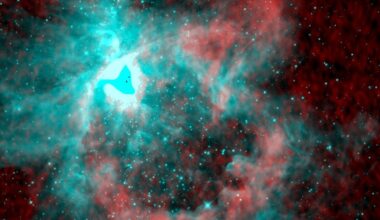
SScience Read More Radio observations reveal once hidden structures around the Orion NebulaJuly 11, 2026 Orion is about as familiar as a patch of sky gets. Visible without a telescope, studied by nearly…
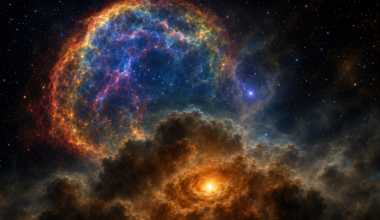
SScience Read More Organic molecules can survive violent supernova explosions – fueling star and planet formationJuly 10, 2026 A supernova remnant is supposed to be a rough neighborhood for a newborn star. Shock waves rip through…
SScience Read More A cosmic gateway near Earth may connect us to other distant worldsJuly 10, 2026 The solar system sits inside a vast pocket of hot, thin gas. However, that nearby structure has never…
PPhysics Read More New study reveals how dark matter formed shortly after the Big BangJuly 9, 2026 Dark matter may not have needed a calm, cold start to help build the universe. For decades, that…
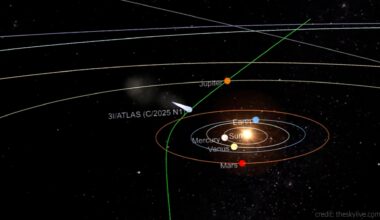
SScience Read More Interstellar comet 3I/ATLAS may come from a solar system much older than our ownJuly 8, 2026 Comet 3I/ATLAS arrived from beyond the Solar System carrying a chemical story unlike anything astronomers had measured before.…
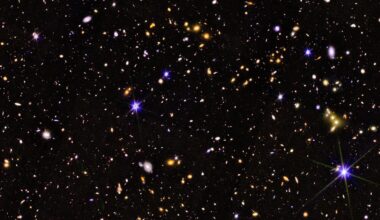
SScience Read More JWST reveals why some distant galaxies suddenly stop forming starsJuly 5, 2026 Distant galaxies that abruptly stopped making stars have puzzled astronomers for years. About 9 billion years ago, during…
SScience Read More XMM-Newton gamma-ray detection shows the Milky Way is bigger than previously thoughtJuly 4, 2026 The Milky Way’s farthest spiral arms have long been sketched more from motion than measurement. Now three violent…
PPhysics Read More The universe isn’t as uniform as we thoughtJuly 3, 2026 Modern cosmology rests on a simple assumption: if we look on large enough scales, matter should be distributed…
SScience Read More New gravitational-wave measurement brings astronomers closer to resolving the Hubble tensionJuly 2, 2026 For more than a decade, astronomers have been divided over a deceptively simple question: how fast is the…
SScience Read More 12 billion years old interstellar comet 3I/ATLAS may be older than the solar systemJune 30, 2026 3I/ATLAS arrived fast, bright, and strange. When astronomers spotted it on July 1, 2025, they knew almost immediately…
SScience Read More Black hole collision lets scientists probe the event horizon for the first timeJune 26, 2026 Black holes do their most important work in hiding. The boundary that defines them, the event horizon, seals…
SScience Read More NASA discovers the ‘puffiest’ two planets in our universeJune 26, 2026 A pair of giant planets circling a star more than 1,100 light-years from Earth looks almost too bloated…