Australia News Beep
  • News Beep
  • Australia
  • Headlines
  • Business
  • Entertainment
  • Health
  • Science
  • Sports
  • Technology
Australia News Beep
Australia News Beep
  • News Beep
  • Australia
  • Headlines
  • Business
  • Entertainment
  • Health
  • Science
  • Sports
  • Technology

Browsing Tag

Genes

141 posts
HHealth
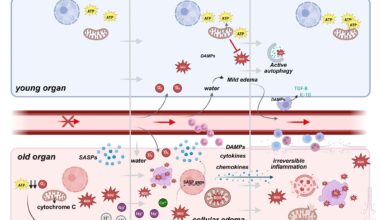
Cellular responses to ischemic reperfusion injury in young vs older donor organs. During ischemia, the deprivation of oxygen and nutrients leads to mitochondrial dysfunction and energy loss. In young cells, mitochondrial resilience helps sustain ATP production, ameliorating damage. Old cells, in contrast, experience significant ATP depletion, relying heavily on anaerobic metabolism, which leads to lactate buildup, pH reduction, and cellular stress. Upon reperfusion, the restoration of blood flow triggers oxidative stress as mitochondria generate excessive reactive oxygen species (ROS). Young cells compensate for those events through robust antioxidant systems, maintaining cellular integrity. Conversely, in old cells, impaired antioxidant defenses result in unregulated ROS production, furthermore damaging membranes, organelles, and DNA. Additionally, old cells release pro-inflammatory genes, amplifying local inflammation. Consequences are particularly severe in aged vascular endothelial cells, with ion pump dysfunction (e.g., Na⁺/K⁺ ATPase) causing ionic imbalances and cellular edema. This disruption exacerbates ischemic injury, progressing to irreversible damage. In contrast, young cells effectively resolve edema and inflammation through mechanisms that include macrophage945 mediated clearance of Damage-Associated Molecular Patterns (DAMPs) and anti-inflammatory cytokine release (e.g., IL-10 and TGF-β), allowing recovery and tissue repair. In old cells, persistent ROS generation, unresolved inflammation, and DAMP accumulation lead to irreversible inflammation, organelle collapse, and eventual cell death. Created in BioRender. Kayumov, M. (2025) https://BioRender.com/m23u7ro .
Read More

Scientists outline how organ rejuvenation strategies could solve the donor shortage

  • December 12, 2025
New insights into cellular aging, perfusion technologies, and senescence-targeting treatments show how aging organs could be revived, turning…

HHealth
New approach doubles chemotherapy effectiveness by targeting cancer cell memory
Read More

AI uncovers how DNA architecture failures trigger blood cancer

  • December 11, 2025
Cancer isn’t just about broken genes-it’s about broken architecture. Imagine a city where roads suddenly vanish, cutting off…
TTechnology
Researchers unveil drug complex that makes cancer cells self-report to immune system
Read More

A slow-growing, bone-covered, noncancerous mass named as ossifying spindled and epithelioid tumor

  • December 9, 2025
It’s not often that a pathologist gets to make a diagnosis that works for the patient by preventing…
HHealth
Study: Industrial and agricultural chemicals exhibit antimicrobial activity against human gut bacteria in vitro. Image Credit: Julien Tromeur / Shutterstock
Read More

Industrial and farm chemicals quietly alter the balance of gut microbes

  • December 9, 2025
A large-scale laboratory screen reveals that widely used chemicals do more than contaminate food and water. They can…
HHealth
UCSF research maps over 600 conditions linked to endometriosis
Read More

Modern pollutants and ancient genetic variants could explain why some women develop endometriosis

  • December 5, 2025
A new study suggests that certain genetic differences, passed down from ancient human ancestors, and exposure to common…
HHealth
3D illustration. DNA helix with damaged segment highlighted in red
Read More

AI model popEVE: Prioritizing genetic variants effectively

  • December 3, 2025
By combining deep evolutionary signals with human population data, the popEVE model provides a novel approach to identifying…
HHealth
New therapeutic approach targets undruggable protein driving aggressive breast cancer
Read More

Obesity-driven estrone emerges as a key driver of deadly postmenopausal breast cancer

  • December 2, 2025
A new analysis of research into the most common type of breast cancer has zeroed in on an…
SScience
Researchers discovered how the brain decides what to remember
Read More

Researchers discovered how the brain decides what to remember

  • December 2, 2025
A song from childhood can hit you out of nowhere. A smell can carry you back decades. Then…
HHealth
Wild birds found to be key drivers of H5N1 outbreak in North America
Read More

Fever-resistant bird flu viruses pose a significant threat to humans

  • November 29, 2025
Bird flu viruses are a particular threat to humans because they can replicate at temperatures higher than a…
HHealth
Epigenetic editing enables safer and more effective T cell therapies
Read More

Epigenetic drift explains why the aging intestine becomes more vulnerable to cancer

  • November 29, 2025
Researchers from the Leibniz Institute on Aging – Fritz Lipmann Institute (FLI) in Jena, Germany, the Molecular Biotechnology…
HHealth
Doctor tripped up by $64K bill for ankle surgery and hospital stay
Read More

Lung to gut movement of hospital-acquired bacterium raises the risk of sepsis

  • November 25, 2025
A hospital-acquired bacterium that causes serious infections can move from the lungs to the gut inside the same…
SScience
CRISPR-mediated DNA methylation editing regulates inflammation and tumor growth
Read More

Discovery of sequence-driven DNA methylation offers new path for epigenetic engineering

  • November 22, 2025
All the cells in an organism have the exact same genetic sequence. What differs across cell types is…
Australia News Beep
www.newsbeep.com