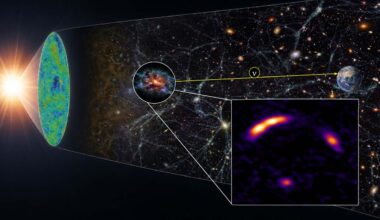
SScience Read More Black hole collision lets scientists probe the event horizon for the first timeJune 26, 2026 Black holes do their most important work in hiding. The boundary that defines them, the event horizon, seals…
SScience Read More NASA discovers the ‘puffiest’ two planets in our universeJune 26, 2026 A pair of giant planets circling a star more than 1,100 light-years from Earth looks almost too bloated…
PPhysics Read More Astronomers discover faint dwarf galaxy that seems to exist without dark matterJune 25, 2026 A faint dwarf galaxy drifting 45 million light-years from Earth may have joined one of astronomy’s strangest clubs.…
SScience Read More NASA’s Lucy spacecraft finds asteroid Donaldjohanson is tumbling through spaceJune 23, 2026 Asteroid Donaldjohanson does not move through space with the tidy, steady spin scientists often expect. It tumbles in…
SScience Read More Earth may not be swallowed by our dying sun after all, study findsJune 22, 2026 For a long time, Earth’s ending seemed settled. In about five billion years, the sun will swell into…
SScience Read More New analysis finds signs of life on Mars actually came from EarthJune 21, 2026 A pair of stubborn molecules, prized because they can survive deep time, just passed an important Mars test…
PPhysics Read More Scientists use Einstein’s equations to reveal what came before the Big BangJune 21, 2026 Some of the hardest questions in cosmology begin where the usual math gives up. Push Einstein’s theory far…
SScience Read More Shadow Blaster points to starburst galaxies as hidden sources of cosmic neutrinosJune 20, 2026 A ghostlike particle from deep space sent astronomers chasing one of the Universe’s hardest mysteries. The trail led…
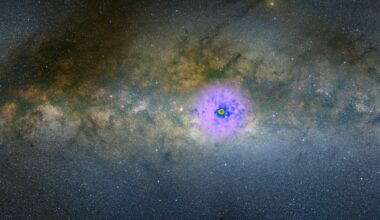
SScience Read More A strange glow in the heart of the Milky Way may be dark matterJune 19, 2026 A faint glow of gamma rays hangs over the center of the Milky Way, stretching across thousands of…
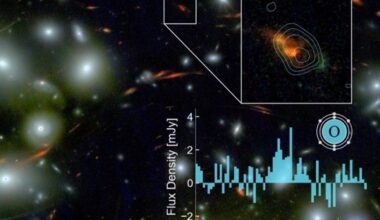
SScience Read More Astronomers detect first direct evidence of star-forming gas in early galaxiesJune 17, 2026 The first galaxies were already busy by the time the universe was 700 to 800 million years old.…
PPhysics Read More Darkness can travel faster than the speed of light — without breaking Einstein’s relativityJune 17, 2026 A dark point inside a beam of light should not be much of a traveler. Yet in a…
SScience Read More Collapsing stars could form gravastars instead of black holesJune 14, 2026 A black hole is supposed to be the last word in stellar collapse: matter falls inward, spacetime caves…