
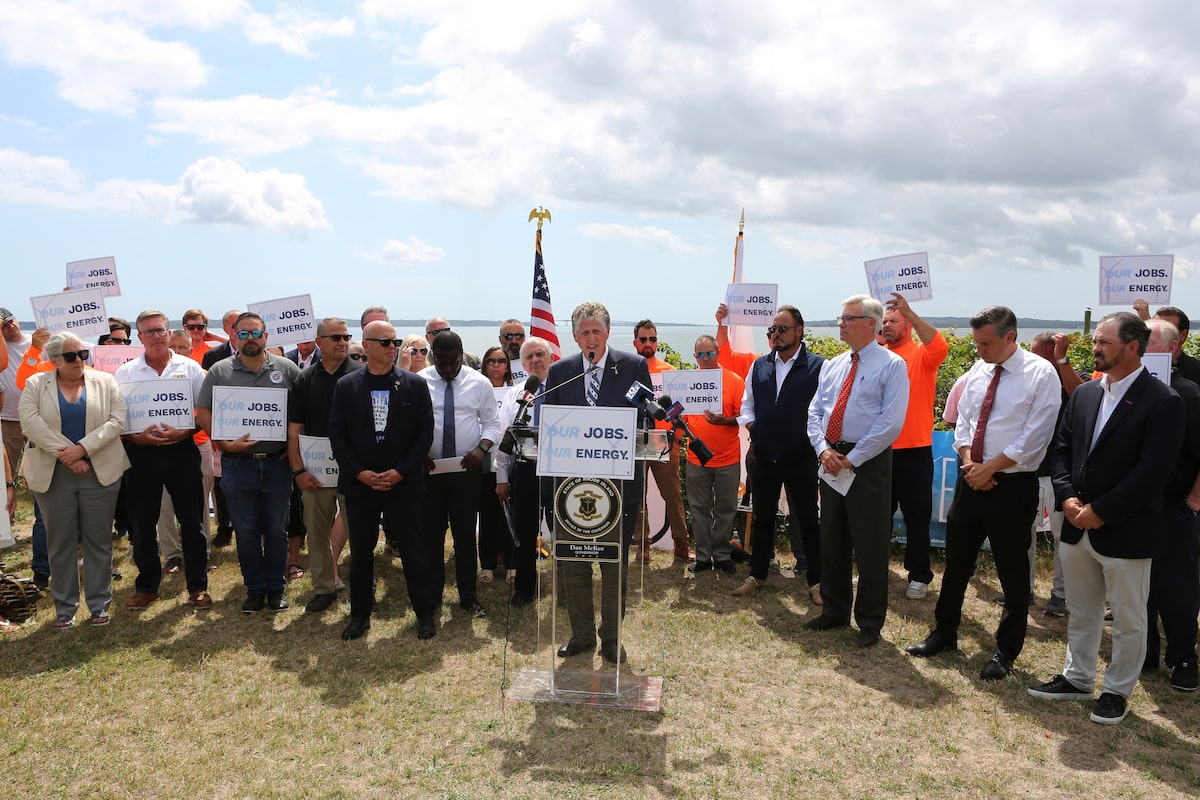
Rhode Island Gov. Dan McKee talks about the importance of the Revolution Wind offshore wind farm to the state’s economy and energy future during a news conference last month.Jennifer McDermott/The Associated Press
Donald Trump is busy rewriting the rules of American-style, hands-off capitalism, and it’s starting to look like a state-managed or, more accurately, Trump-managed system.
The U.S. has bought a 10-per-cent stake in Intel, demanded a “golden share” in U.S. Steel – allowing the government (actually, the White House) to veto major corporate decisions – and is taking a 15-per-cent cut of Nvidia’s and AMD’s revenue from AI chips sold in China.
It doesn’t stop there, and Denmark’s Orsted is a case in point. Orsted, the biggest and most successful offshore wind-power company, has been gutted by Mr. Trump, sending it into deep crisis. The latest blow came in August, when the President ordered it to cease construction of the US$1.5-billion Revolution Wind project off Rhode Island.
Opinion: Donald Trump is on the brink of becoming a dictator. Can he be stopped?
Never mind that Revolution was 80-per-cent complete, had all the required permits, broad political support in New England and would have supplied clean energy from its 65 turbines to some 350,000 homes starting next year. It was still deep-sixed.
The Trump administration cited “security” issues for the stop-work order, though it never said what they were. Was he worried that fighter jets would crash into the enormous swirling blades? Maybe it was retribution. Mr. Trump wants to own Greenland, which is controlled by Denmark, and Denmark is not selling. Punishing Orsted is punishing the state of Denmark, since it owns 50 per cent of the company.
What is known is that Mr. Trump has no interest in clean energy, especially wind power. He once sued the Scottish government to try to stop the construction of a wind farm within eyeshot of one of his golf courses.
“We’re not allowing any windmills to go up,” he said at a cabinet meeting last month. “They’re ugly, they don’t work, they kill your birds. They’re bad for the environment. And if you look at them from a house, your house is worth less than 50 per cent.”
Opinion: Thanks, Mr. Trump. You are changing Canada for the better
Partly right: They are ugly, they do kill birds and they almost certainly crunch the value of nearby houses. But they are an important part of the clean-energy mix pretty much everywhere. The voracious electricity appetites of data, AI and bitcoin-mining centres mean that wind, along with solar and nuclear, has a bright future. Except in Trumpland. He’s the leading proponent of the “drill, baby, drill” philosophy.
Orsted’s Revolution is not the only offshore wind project to walk the plank. The White House is trying to kill five other projects off the U.S. East Coast through stop-work orders and by yanking permits. Orsted is suing the Trump administration and seeking a court order that would allow it to finish the Revolution site.
Before Mr. Trump came along, Orsted was a superstar company, one that had undergone Europe’s most successful black-to-green transition. As late as 2009, when Denmark hosted the COP25 climate summit, Orsted, Denmark’s main power producer, was mostly burning coal to keep the lights on. Wallowing in sooty black guilt, it embarked on a campaign to shutter its coal burners and reinvent itself as an offshore wind player.
Carney unveils billions in aid to help tariff-hit sectors, delays EV mandate
It became a stock market darling; in 2021 it had a market value of more than US$95-billion and embarked on a campaign to become America’s first offshore wind developer. Seemingly endless growth captured investors’ imaginations.
In the U.S., Orsted got off to a good start, then ran into trouble during the pandemic, when inflation took off, interest rates rose and global supply chains broke down. In 2023 it abandoned two projects off the New Jersey coast and took a write-down of about US$4-billion. It also abandoned a few European projects.
But it remained committed to the Revolution project. Despite the setbacks, then-president Joe Biden’s lavish support for renewable energy gave the company the hope that the U.S. market would be rewarding.
Then came Mr. Trump. Within hours of entering the White House for the second time, he announced, “We are not going to do the wind thing,” then signed a flurry of executive orders that unwound Mr. Biden’s infrastructure funding, putting hundreds of billions of dollars of projects at risk – everything from battery plants for electric vehicles to offshore wind developments.
Opinion: Canada’s electricity crisis: Why national interest demands a national grid
Still, Orsted pushed on, believing that its permits, support from New England governors, the appeal of clean energy and the U.S. legal system would keep Revolution alive – after all, a contract was a contract. The company was wrong. Mr. Trump turned into a one-man wrecking machine. Orsted shares are down more than 50 per cent in the past year, and the company is seeking salvation in a US$9.4-billion rights issue, backed by the Danish state and Equinor, formerly Statoil, Norway’s oil and gas giant.
The U.S. offshore wind industry and much of the rest of the country’s clean-energy business face an existential crisis. What bank would lend money to any project that could be brought to its knees by the Trump White House at any time, with no explanation? And if Mr. Trump can wreck one industry that puts him in a bad mood, why not others? Trump-managed capitalism is the opposite of the free and fair market.