
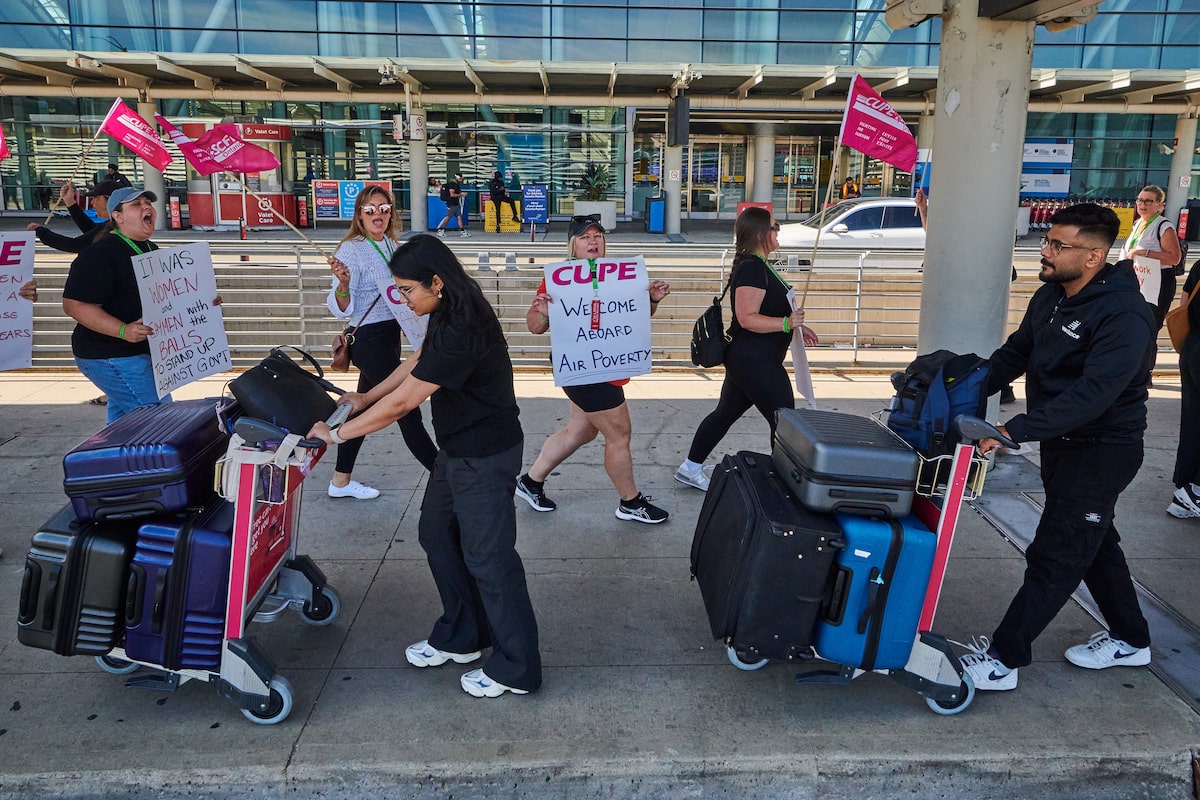
Air Canada and the Canadian Union of Public Employees are going to mediation because flight attendants rejected a tentative deal.Sammy Kogan/The Canadian Press
Unionized Air Canada flight attendants rejected a recent wage agreement that has pushed the ongoing labour dispute into a new phase.
The air carrier and the Canadian Union of Public Employees (CUPE), which represents about 10,000 flight attendants, will now turn to mediation in hopes of reaching a new collective agreement after the previous one expired at the end of March.
Here’s what you need to know about the bargaining process.
What is mediation?
Mediation can be requested any time during the bargaining process. Bargaining parties (the union and the employer) voluntarily choose to take this approach, which involves a neutral and impartial third party who helps the two sides negotiate in an open and respectful manner.
“Mediation allows the parties in a dispute to examine their interests and concerns, explore a variety of creative options, and develop mutually satisfactory solutions to problems,” according to the Government of Canada website.
Why are Air Canada and CUPE going to mediation?
Air Canada and CUPE are going to mediation because flight attendants rejected a tentative deal brokered Aug. 19, with 99.1 per cent of the voters saying no.
In early August, flight attendants gave a near unanimous vote to take strike action and went on a nationwide strike in mid-August over wages and the issue of unpaid work. They defied a back-to-work order issued by the federal government 12 hours after the stoppage began, resulting in a three-day strike and the grounding of domestic and international flights.
This ultimately culminated in CUPE brokering a tentative deal with Air Canada that gave flight attendants, for the first time, compensation for the unpaid work they do before an aircraft departs and after it lands. For one hour prior to takeoff, flight attendants would receive 50 per cent of their hourly rate as ground pay. This rises to 70 per cent by the fourth year of the contract.
Most of the agreement was binding, including the ground pay, meaning that flight attendants were only voting on the issue of hourly pay to ratify the deal.
At the end of the voting process on Sept. 6, they shot down Air Canada’s proposed wage increase of 20.25 per cent over four years for flight attendants with tenure of five years or less, and 16.25 per cent for those with tenure of six years or more.
What happens if Air Canada and CUPE still can’t reach a deal through mediation?
The matter will be referred to an arbitrator at the Canada Industrial Relations Board, who will decide on an appropriate wage increase for flight attendants – a decision that cannot be challenged by either side and will avoid another work stoppage.
Air Canada, flight attendants turn to mediation after union votes to reject wage agreement
What is arbitration?
When both sides cannot reach a new agreement through collective bargaining or mediation, they can choose or be forced by the government to choose binding arbitration.
Similar to a mediator, the arbitrator is a neutral third party. The difference is they don’t help each side negotiate. Instead, the arbitrator, which can be a single person or consist of a board, hears submissions and evidence from both sides about matters on which they cannot agree. The arbitrator then issues their decision, which is legally binding and must be implemented.
In a simplified example, suppose an employer proposes wage increases of 2 per cent while the union bargains for 5 per cent. If the two sides cannot reach an agreement, forcing an arbitrator to intervene, the arbitrator would unilaterally determine a wage increase that both sides must accept.
Could Air Canada go on strike again?
Both sides said they agreed that no labour disruption could be initiated, meaning there will be no strike or lockout, and flights will continue operating during the mediation process.
With reports from Vanmala Subramaniam