
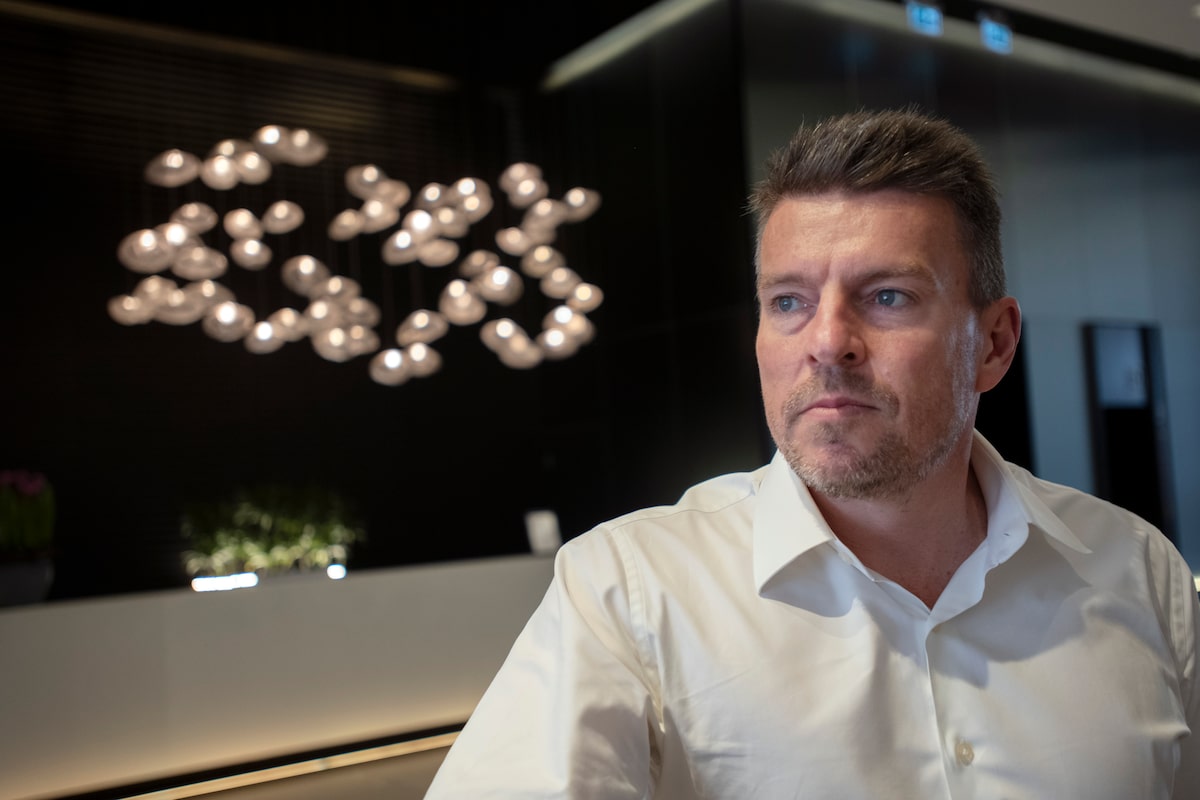
Chris Evans, managing director for Winsome Resources, on Sept. 10. Winsome is looking to repurpose an old diamond mine in Quebec and use it for processing lithium that is mined nearby.Fred Lum/The Globe and Mail
A small Australian mining company is racing to save a key industrial site in a remote corner of northern Quebec from being demolished, a last-ditch effort to recast a now-defunct diamond mine into a lithium processing facility.
Winsome Resources Ltd. is a publicly traded junior miner aiming to develop what it says is a rich lithium deposit in Quebec’s Eeyou Istchee James Bay region.
It had exclusive purchase rights on the assets of bankrupt Stornoway Diamond’s Renard mine, which it had planned to repurpose to handle its own mineral deposit 60 kilometres away.
The Australian company gave up those rights in July after failing to find a strategic investor, concluding that it could not take on the $20-million in annual costs to maintain Renard by itself.
But it still believes its lithium project will come together as the market for the resource firms up. And it’s now scrambling to cement a new deal with Renard’s owners and other stakeholders to keep the mine from being dismantled before it’s too late.
“We need a bit more time because I’m sure there’s a solution,” Winsome managing director Chris Evans said in an interview, adding that the company is lobbying both the federal and Quebec governments to help finance the maintenance costs but has so far had no success.
“If this proceeds the way it’s going, in the worst-case scenario 12 months from now someone’s going to say ‘Is Renard gone? What happened there? Why didn’t we save that?’”
2023: Stornoway Diamonds files for bankruptcy for second time, stops operations at Quebec site
Renard has exposed the pitfalls of investing taxpayer money in infrastructure tied to risky private-sector projects. And it’s left everyone questioning whether Premier François Legault’s government has the appetite for a concerted expansion effort in the north – or whether it will retreat in the face of more pressing economic challenges.
Renard’s diamond operation was once a compelling symbol of Quebec’s mineral wealth. And the $400-million highway built to get there, mostly with public money, was proof the province could take serious strides in opening up the territory north of the 49th parallel for growth.
Things haven’t quite worked out as planned, however.
Stornoway filed for bankruptcy protection a second time in 2023, the victim of a deep diamond-price correction and gem-import freeze in India while it faced competition from a battery of better-capitalized international rivals.
Renard has since ceased operations. Soon that 240-kilometre gravel highway, known as the Route 167 extension heading north from Chibougamau, could be a road to nowhere.
For Winsome though, the site holds significant value because it is useful infrastructure in a remote location. In addition to Route 167, an all-season access road that connects further south to the provincial road network, the mine has an airstrip, gas-fired power station, water-treatment and tailings-containment facilities, largely new sorting and crushing plants and housing for 330 workers in addition to mineral-processing and operating permits.
Winsome, which trades on the Australian Securities Exchange, doesn’t have a commercial operation to speak of yet. But its Adina lithium deposit happens to be a quick helicopter ride away from Renard. And to Winsome executives, that’s an opportunity too good to pass up.
How the critical minerals trade is shifting amid rising geopolitical tensions
Mr. Evans points out that about $1-billion in capital was invested in Renard, money that will go to waste if the mine is just sold off in pieces. He says taking over the mine would reduce Winsome’s own cost and project risk while smoothing its entry into the North American electric-vehicle supply chain. Lithium is a key raw material in electric-vehicle batteries.
“In that eastern part of James Bay, it’s really the only significant piece of infrastructure in the region,” Mr. Evans said of Renard, adding that the site could be a hub for other exploration companies. This is about “much more than just Winsome.”
Stornoway’s main shareholders include Osisko Gold Royalties Ltd. and Investissement Québec (IQ), the Quebec government’s investment arm.
The diamond producer is in creditor protection and there are currently no talks taking place between Stornoway, Winsome and the court-appointed monitor about a new deal that would maintain the infrastructure for future use, said Jean-François Nadon of Deloitte, which is supervising the miner’s operations.
Renard’s fate will probably be decided fairly quickly, Mr. Nadon said, adding that there are several options on the table. He said certain assets have already been sold, notably things that would not have been part of any sales agreement with Winsome, and “we’re in the process now of evaluating what to do with the rest.”
“There is no view to restarting the mine in any short and medium term,” Mr. Nadon said.
Tearing down Renard’s infrastructure and liquidating it would be “stupid,” said Eric Lemieux, an independent mining analyst with EBL Consultants. “Is asking the government to pay for the maintenance and upkeep of the site in order to preserve options too much? I think not.”
Quebec came within a sliver of dismantling the Quebec North Shore and Labrador Railway in the 1990s as iron-ore prices crashed, he said, which “would have been a tragedy” had that happened. Metals are cyclical and new minerals can be discovered that have societal interest to see developed, he said.
Lithium prices have tumbled in recent years as China flooded the market and EV sales have slowed. Winsome executives have said they remain optimistic, however, that critical-mineral companies on this continent will find backers as the United States and its allies ramp up production in a bid to decouple from Chinese supply.
The industry is in flux.
Taiwan Cement Corp. last year shelved plans for a $1-billion lithium-ion battery-cell production plant in Maple Ridge, B.C., saying it will be “very difficult” for the company to build new plants abroad before achieving full efficiency at its Taiwanese facility. Meanwhile, mining giant Rio Tinto PLC in May completed its takeover of lithium producer Arcadium, making a US$6.7-billion wager that the market will rally.
Arcadium owns 50 per cent of Nemaska Lithium and the Galaxy Lithium project – both in Quebec. Nemaska’s other major shareholder is the Quebec government, through IQ.
The province recently injected another $150-million into Nemaska as the company aims to launch Canada’s first processing plant for battery-grade lithium products. The sum takes Quebec’s overall financing commitment in the company to more than $900-million, its biggest single investment in the EV battery space.