
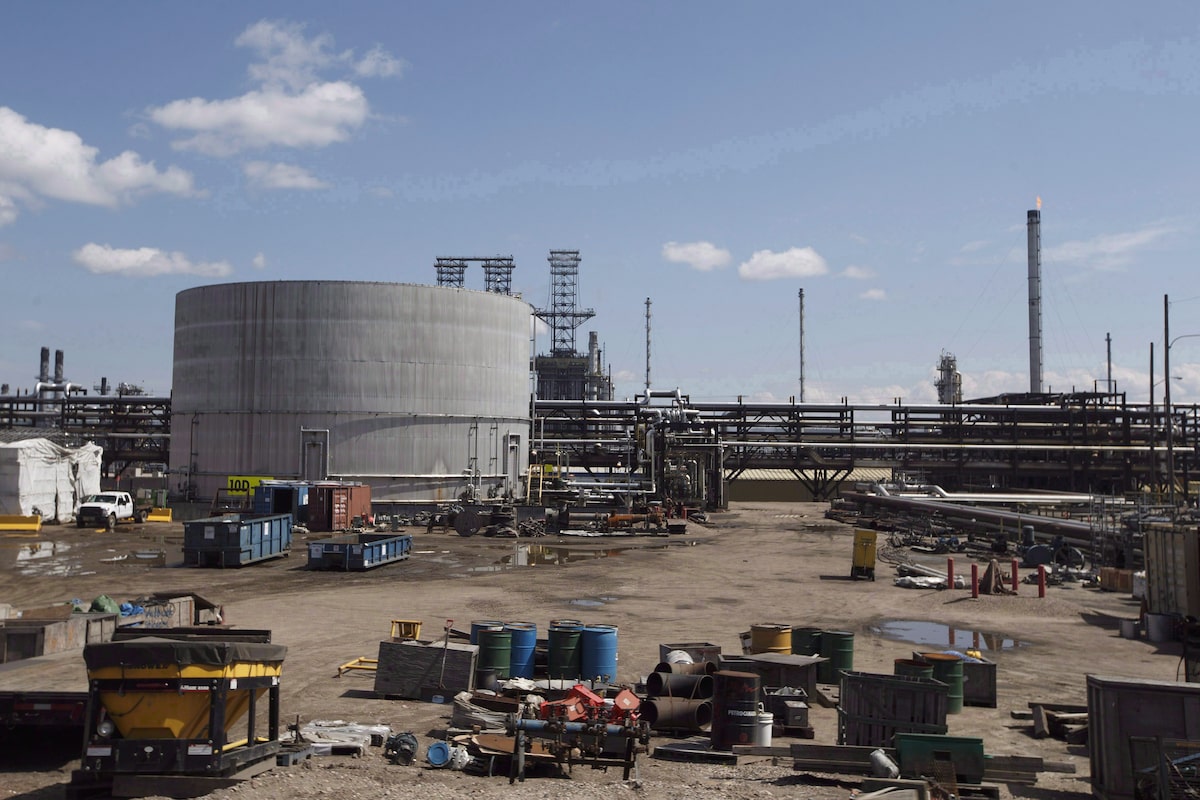
Suncor’s base plant and upgrader in Fort McMurray, Alta., June, 2017. The Pathways project is meant to play a key role in the pledge by the Pathways Alliance to bring emissions to net zero by 2050.JASON FRANSON/The Canadian Press
Reducing emissions from Alberta’s oil sands, including progress on a massive carbon-capture project, will be a “necessary condition” to unlocking new pipelines to Canada’s coasts to access export markets, Prime Minister Mark Carney said Thursday.
The Pathways Alliance carbon-capture initiative is a 400-kilometre-long pipeline that would transport carbon trapped at oil-sands facilities to an underground hub near Cold Lake, Alta., with the aim of reducing emissions by 22 megatonnes a year.
Mr. Carney announced Thursday in Edmonton that the plan will be referred to the federal Major Projects Office, which has the task of determining and advancing projects of national importance.
Pairing progress on Pathways with a new pipeline reflects what Alberta Premier Danielle Smith has called a “grand bargain” in talks with Ottawa.
Dangling the prospect of a new oil pipeline as a carrot to industry is, however, far from a guarantee that one will be built, given that there are no private-sector proponents floating such a project.
Carney announces five major projects to be reviewed for fast-tracking
“What’s happening here today is we are saying that we are going to accelerate work on Pathways,” Mr. Carney said, which is “a potentially viable project.” He added that progress on the project will be “a necessary condition to unlock” any new pipelines.
Ottawa’s move is something of a win for Ms. Smith, who met with Mr. Carney this week.
She told media Thursday that it was “about as encouraging as any meeting I’ve had with the federal government in a long time.” In part, she said, because Mr. Carney seems to understand why Alberta takes issue with various policies it believes are damaging investment in the oil and gas sector.
Those include an emissions cap and a ban on tankers, which Ms. Smith wants to see scrapped. Reuters reported later Thursday, based on three unnamed sources, that the federal government is in discussions with Alberta and energy companies about doing away with the emissions cap if the industry and province reduce their carbon footprint in other ways.
Ms. Smith made no mention of this, but did say she and Ottawa are “making great progress.”
“I understand that the Prime Minister is looking for a next tranche of major projects to be announced by Grey Cup [mid-November], and I’m really hopeful that by then, we’ll be able to have something to share,” she added.
Reality check: The first ‘major projects’ for fast-tracking are already on the fast track
Kendall Dilling, the president of the Pathways Alliance, said in a statement Thursday that he was encouraged that the federal government has recognized the importance of the carbon-capture project, and said he would like to see Ottawa continue to work together with industry and other levels of government to remove barriers to investment.
The Pathways project has been floating around since 2021. It is meant to play a key role in the pledge by the Pathways Alliance – a group of major oil-sands producers – to bring emissions to net zero by 2050.
The current obstacles to Pathways are not primarily regulatory, but financial.
The federal government under former prime minister Justin Trudeau put in place an investment tax credit that would cover up to 50 per cent of the project’s capital costs, and Alberta’s government is offering an additional 12-per-cent capital-cost subsidy. But Pathways members have expressed reluctance to proceed because of revenue uncertainty.
The likeliest way to derive financial value from carbon capture in the oil sands is by generating carbon credits under Canada’s industrial carbon-pricing system, which could either reduce companies’ compliance costs or be sold to other companies to meet their obligations.
Alberta Premier Smith says plan for new West Coast oil pipeline ‘pretty close’
However, the credit market has been soft. And it is further threatened by political uncertainty, including around the Alberta government’s commitment to the provincial industrial-pricing system that it runs under an equivalency agreement with Ottawa. In addition, there are questions around whether future federal governments will remain committed to the policy.
Ottawa has been trying to provide greater certainty through a mechanism generally known as carbon contracts for differences (CCfDs), which involves the government taking on revenue risk by prepurchasing or otherwise guaranteeing the value of carbon credits.
But the federal government − and the Canada Growth Fund, the agency mandated with offering CCfDs − has to this point balked at the amount of revenue risk Pathways has asked it to take on. Based on both the project’s size and the desired level of credit-value certainty, it could be well above $10-billion.
Amanda Bryant, a senior analyst with the oil and gas program at the Pembina Institute, a think tank, said in an interview that the best thing that Ottawa could do to lessen investment risk in carbon capture is strengthen industrial carbon pricing.
Still, she said, Canada can’t meet its climate goals through major projects alone.
“If you increase oil-sands production to pump out an additional million barrels per day, even if you build Pathways, emissions from the oil sands still go up. So we don’t see that kind of ‘grand bargain’ as aligned with a climate-competitiveness strategy,” Ms. Bryant said in an interview.
Lisa Baiton, chief executive of the Canadian Association of Petroleum Producers, said in a statement that the lobby group would have liked to have pipelines on the first list of projects in the national interest, but understands “that more work needs to be done to attract proponents, and that process will take some time.”
Ms. Baiton said she hopes such a project makes the cut for the next list. And she encouraged the federal government to consider referring the Bay du Nord offshore oil project off the coast of Newfoundland and Labrador to the Major Projects Office.